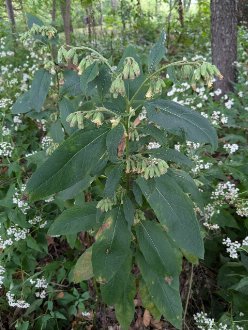

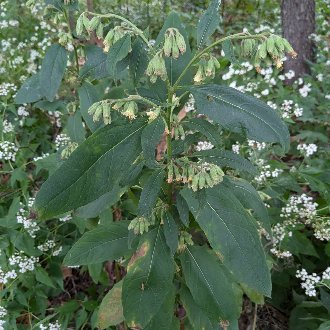
Nodding Rattlesnakeroot (Nabalus crepidineus (Michx.) DC.)
Also classified as Prenanthes crepidinea Michx.
↑Habitat
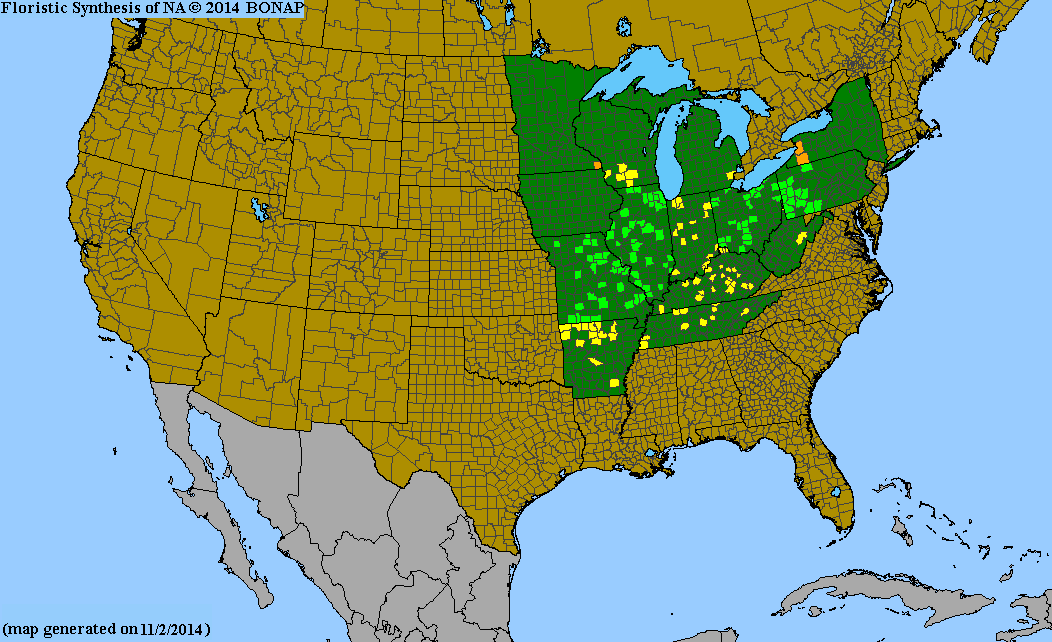
Nabalus crepidineus occurs mostly in floodplain forests and other forested bottomlands, usually on relatively well-drained sites within these habitats, but it can occasionally occur in other habitats. Natural habitats include floodplain forests, rich mesic upland forests, moist depressions in prairies, locally-wet sites in barrens, and less commonly, slightly dry sites in upland forests. This species is more limited to well-drained sites in the southeast of its range, and moves into wetlands more frequently in the west and north of its range.
It favors sites that experience irregular, but sometimes severe canopy-opening disturbance, which can include beaver activity, flood-scouring of streambanks, or ice slabs removing woody vegetation. Plants often persist in dense thickets, but do not reproduce until woody vegetation is removed.
Although it is rare to uncommon over much of its range, and has a scattered distribution, where it does occur it can form vigorous colonies with large numbers of plants.
Although classified in the G4 ("Apparently Secure") category by NatureServe, it is listed as a species of special concern in eleven states. It is uncommon to rare in much of its range, has a scattered distribution, and has been extirpated from the northeasternmost and northwesternmost parts of its historic range. These factors place it at risk of decline.
Humans have degraded the habitat for this species in multiple ways. Humans have contributed to overpopulation of white-tailed deer, which harms this species as deer prefer this species over other plants early in the season. This species is also threatened by competition from invasive plants, especially garlic mustard (Alliaria petiolata), and by logging of bottomland forests.
↑Life Cycle
Nabalus crepidinenus is a monocarpic perennial, living many years, flowering once, then dying. Much is unknown about its lifecycle, but it seems to be opportunistic, an adaptation to the dynamic habitats it tends to inhabit.
For most of its life, this species grows only as a basal rosette, usually emerging in early spring, before deciduous trees have leafed out. It often forms large colonies, with rosettes forming a continuous blanket on the forest floor. As the canopy leafs out and light levels decrease, the smallest rosettes go dormant first, leaving only larger, more established plants. By summer, all rosettes are dormant, but some plants have begun to bolt.
Especially where both deer and this plant are abundant, the rosettes tend to be browsed heavily by deer, often to the point of removing most or all of the leaf surface area early in the season. Herbivory decreases as the season progresses, both due to plants naturally dying down, and other vegetation emerging.
At some point, plants bolt, growing upright to bloom. Bolting is unpredictable and tends to cluster together in a single year. Even in habitats where this species is abundant, multiple years can pass without a single plant bolting. When plants do bolt, only a small portion of plants do. It is not known exactly what triggers bolting, but it seems to increase in years following those when a disturbance opened the canopy.
Plants begin blooming several weeks into summer, and blooming continues gradually throughout the entire growing season, with seed production following. Plants are sensitive to frost, but the forested bottomland habitats where this species usually occurs provide significant shelter from frost, so plants typically continue blooming until a relatively hard frost finally kills them. Plants die after flowering; a significant number of bolting plants, as many as half on some sites and in some seasons, can fail to produce seed, and usually die anyway.
We found speculation that this species may reproduce vegetatively before blooming, but we did not find any source rigorously confirming such reproduction.
The seeds are likely distributed both by wind and water.
↑Faunal Associations
The young rosettes of this species is a preferred food of white-tailed deer, to the degree to which deer often will ignore other plants they usually eat as long as this plant is available.
The flowers attract a wide variety of pollinators.
Stems are eaten by the gall-forming wasp Aulacidea nabali, a specialist on the Nabalus genus, and the galls in turn also support other hemiparasites.
↑Links & External Resources
• Prenanthes crepidinea (nodding rattlesnakeroot) | USDA PLANTS Database (About This Site)
• Nabalus crepidineus | Biota of North America Project (BONAP) (About This Site)
• Prenanthes crepidinea | NatureServe Explorer (About This Site)
• Prenanthes crepidinea | Flora of North America (About This Site)
• Nabalus crepidineus | Missouri Plants (About This Site)
• Nodding Rattlesnake Root | Maryland Biodiversity Project (About This Site)
• Prenanthes crepidinea Michaux (Midwestern Rattlesnake-Root) | Digital Atlas of the Virginia Flora (About This Site)
↑Photo gallery