
White Rattlesnakeroot (Nabalus albus) vs Three-leaved Rattlesnake Root (Nabalus trifoliolatus)
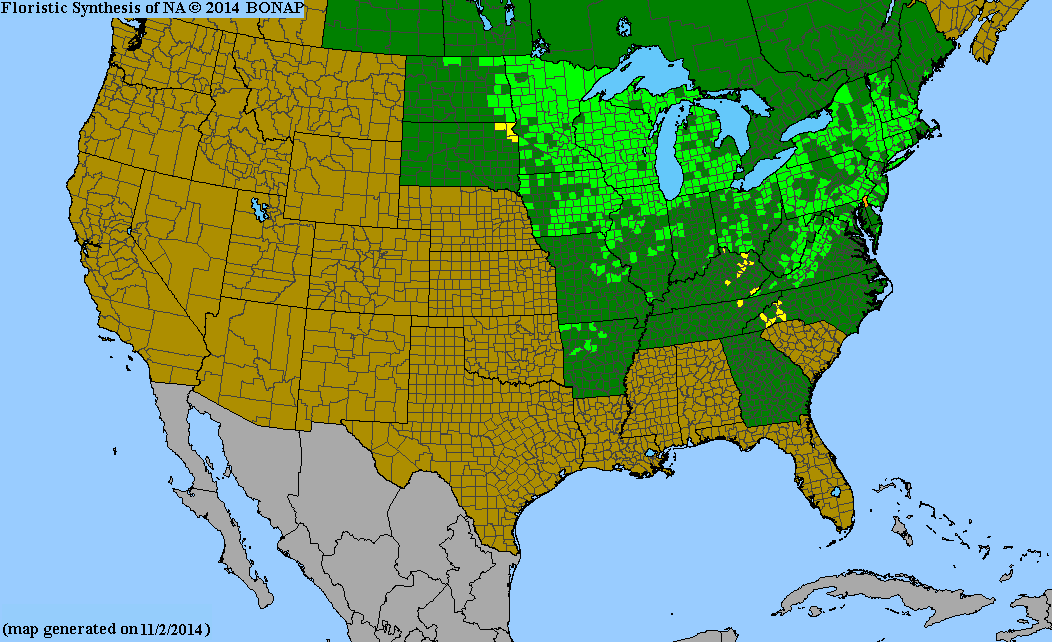
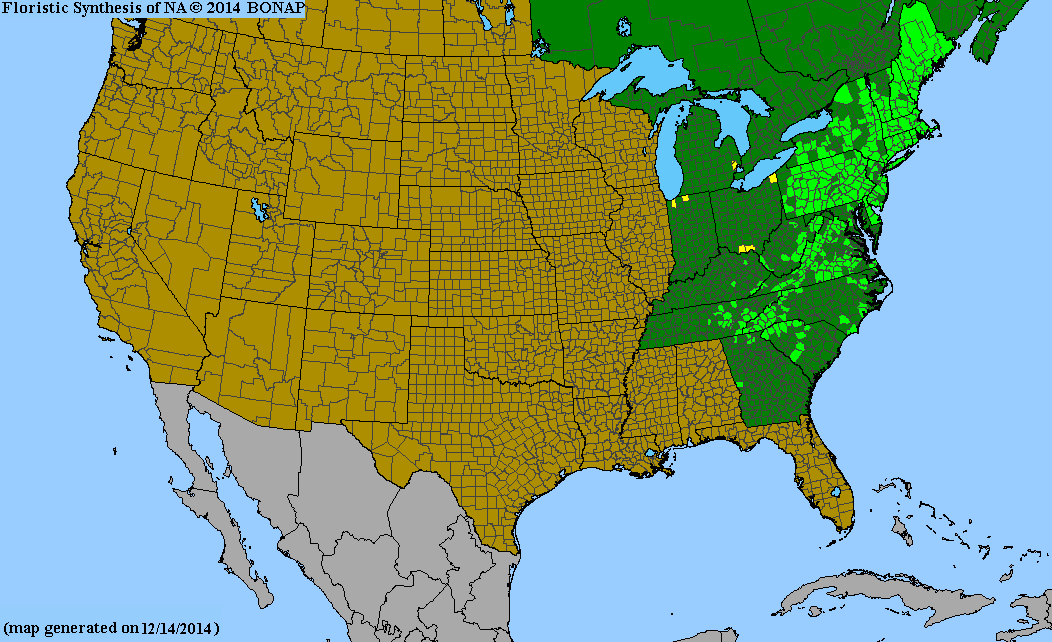
This guide is under construction and has not been published yet. It may have errors. When in doubt, double-check other sources for definitive ID.These two species are visually-similar and easily confused. They are easily distinguished by flower and phyllary color, and they have other average differences. N. albus ranges much farther north and west and is limited to higher elevations in the southeast of its range, tolerates deeper shade, and prefers higher-pH soils. N. trifoliolatus ranges farther south and towards the coast and is more tolerant of soil acidity and salinity.
White Rattlesnakeroot (Nabalus albus) | Three-leaved Rattlesnake Root (Nabalus trifoliolatus) |
Thought to be a monocarpic perennial, native to forests in northeastern North America, usually in high-pH soils. | Thought to be a monocarpic perennial, native to forests and rock outcroppings in eastern North America, usually on acidic soils. |
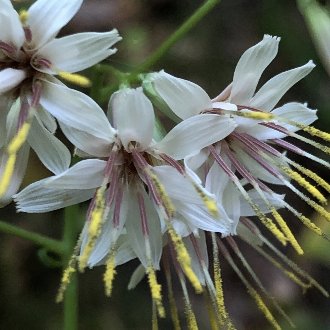 Flower corollas are clean white, often with a pinkish or purplish tinge. Photo © Christopher Zacharias, CC BY 4.0. | 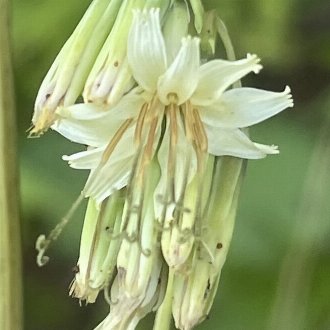 Corollas are usually cream color, pale yellow, or yellowish. Photo © Ingolf Askevold, Public Domain. |
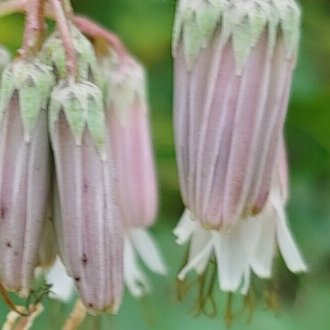 Fresh phyllaries (bracts or leaflike structures enclosing each flowerhead) tend to be pink to reddish-purple or maroon, rarely dark grayish. Involucres (structure including all the phyllaries) average slightly longer ( 13–15mm) and narrower (3–5mm.) Photo © Ryan Sorrells, CC BY 4.0. | 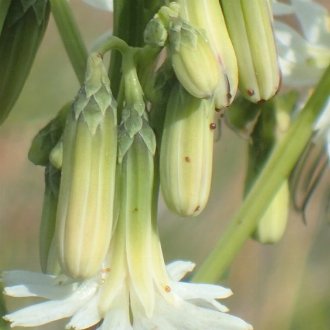 Fresh phyllaries tend to be pale yellow to dark green, and are often blackish at the base, becoming paler towards their tips, or rarely, dark grey-green extending the whole way to the tips. Involucres average slightly shorter (10–13mm) and wider (4–5mm.) Photo © Ian Manning, CC BY 4.0. |
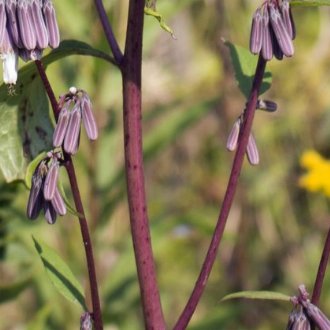 Stems average more purple: stems may be green, but are often mottled purple or even solid purple. Photo © aarongunnar, CC BY 4.0. | 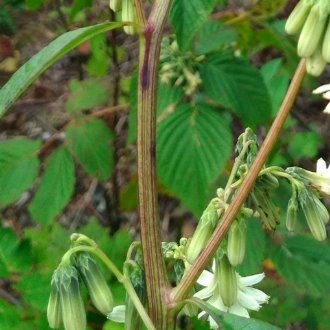 Stems average less purple: stems are often solid green, only sometimes mottled purple, and rarely solid purple. Photo © Ben Armstrong, CC BY 4.0. |
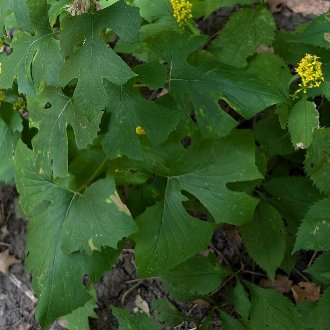 Lower leaf blades can be much larger (to 30cm long × 18cm wide) and although they may be deeply 3-lobed, they are not usually fully subdivided into leaflets. Leaves rarely have more than 3 main lobes. Photo © Marilynn Miller, CC BY 4.0. | 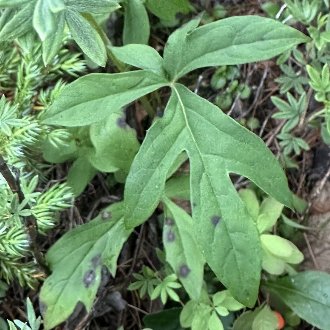 Lower leaf blades do not reach quite as large (to 12cm long × 15cm wide) and are more likely to be divided into 3 leaflets. Leaves are sometimes even divided into 5 deeply-cut lobes or leaflets. Photo © Cassidy Best, CC BY 4.0. |
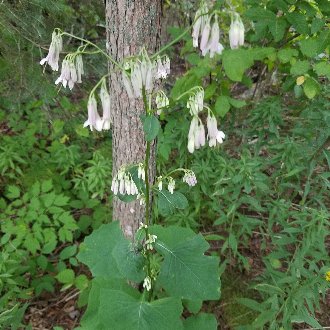 Ranges into shadier habitats. Usually found on higher-pH soils. Absent from coastal areas exposed to salt. Photo © Sarah Johnson, CC BY 4.0. | 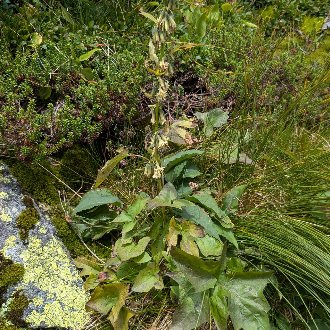 More likely in slightly sunnier habitats; tolerates acidic soil and some salinity from salt spray in coastal areas. Photo © Kristof Zyskowski, CC BY 4.0. |
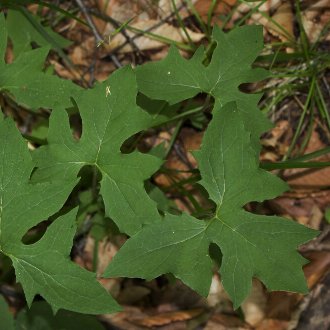 Basal leaves (on non-flowering plants) may be deeply lobed, but are less likely to be as deeply lobed, and are rarely divided into leaflets, and rarely have more than 3 main lobes. Photo © aarongunnar, CC BY 4.0. | 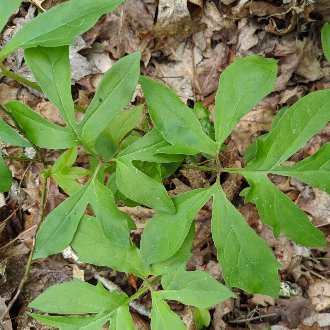 Basal leaves (on non-flowering plants) average more deeply lobed, relatively commonly have up to 5 lobes, and are commonly divided into leaflets. Photo © Fives, CC BY 4.0. |
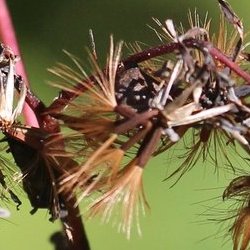 Pappi (wispy parts attached to seeds) average much darker: usually reddish-brown to rusty, rarely yellowish. Photo © Rob Foster, CC BY 4.0. | 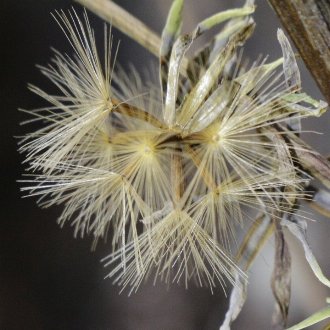 Pappi average much lighter, consistently pale yellow. Photo © Charlie O'Brien, Public Domain. |
Additional Notes
Both of these species have a highly-variable leaf shape, which can complicate ID on non-flowering plants. However, with familiarity with what each species looks like locally, it can be possible to reliably identify individuals that are not flowering. The larger, fuller leaves of N. albus capture more light and correspond to its greater shade tolerance. The more deeply-cut leaves of N. trifoliolatus reduce wind drag, enabling greater drought tolerance, allowing that species to inhabit sunnier habitats as well as habitats where the soil chemistry, including acidity and/or salinity, compound drought stress.Habitat can also be a strong clue for these species; although at a glance, their habitats seem to be similar, there is little overlap in terms of soil chemistry. A combination of understanding the underlying geology, and looking at indicator species of pH changes, and associated plant communities, can make habitat a stronger ID clue. N. albus often associates with sugar maple (Acer saccharum) and American basswood (Tilia americana), trees that cast deeper shade and often prefer higher-pH soils. N. trifoliolatus often associates with pines, which cast lighter shade and tend to occur on acidic soils.
FSUS uses count of florets per flowerhead as a way of distinguishing these species, saying N. trifoliolatus has 8-10 flowers per head whereas N. albus usually has 10-11 flowers per head and rarely as few as 9. These traits may indeed be reliable in the area of coverage of FSUS, but we found this trait less reliable across the species' whole ranges, finding individuals of N. trifoliolatus with 10 florets per head relatively commonly.
Note that, especially for non-flowering plants, both of these species can be easily confused with other Nabalus species. Other Nabalus species also occurring in forests include tall rattlesnakeroot (Nabalus altissimus) and lion's foot rattlesnake root (Nabalus serpentaria).
References & External Resources
These short lists show only links helpful for ID. For a complete list of references and resources also covering other aspects of ecology, visit the links section of the full article on each plant, which is the first entry here.