
White Baneberry (Actaea pachypoda) vs Red Baneberry (Actaea rubra)
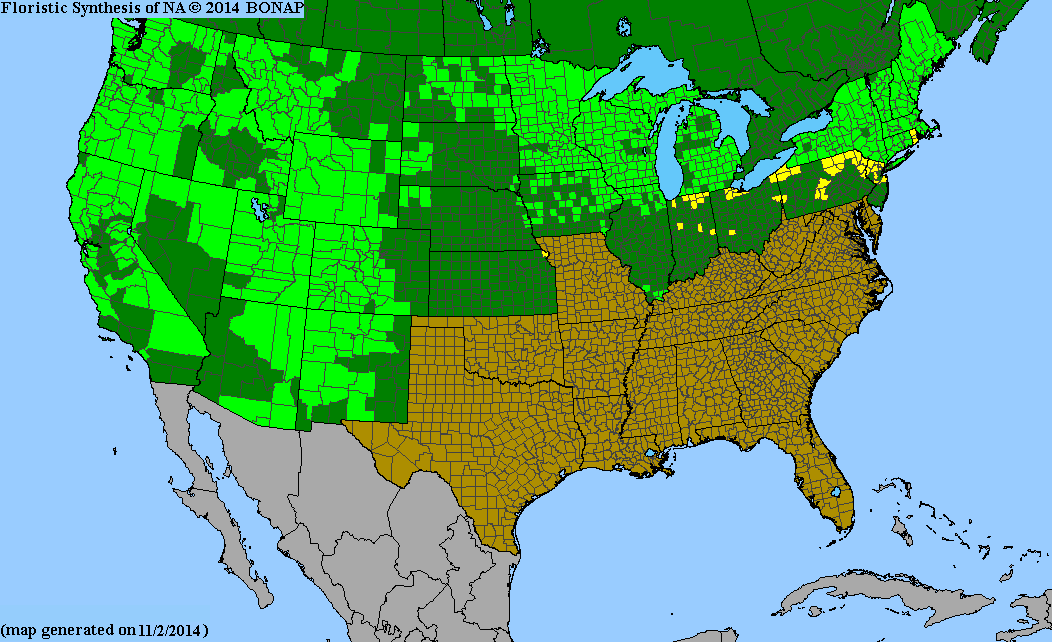
These species are frequently confused, especially in the rare cases when A. rubra has white fruit or A. pachypoda has red fruit, or when fruit is not present. They can be easily distinguished by fruit pedicels, and they also have average differences in pubescence on leaf undersides, pistil dimensions, petal shape, and inflorescence shape. Where their ranges overlap, A. pachypoda ranges much farther south, is more limited to deciduous forests, and prefers near-neutral loamy soil. A. rubra ranges much farther west and into mixed (conifer-deciduous) forest, prefers slightly more acidic soil, and is more tolerant of sand or clay in the soil. These species can hybridize to form Louis's baneberry (Actaea ×ludovicii), so ambiguous individuals may be hybrids.
White Baneberry (Actaea pachypoda) | Red Baneberry (Actaea rubra) |
A perennial native to rich deciduous forests of Eastern North America. | An herbaceous perennial of woodlands, native across northern North America, coast to coast, and farther south in the mountain West. |
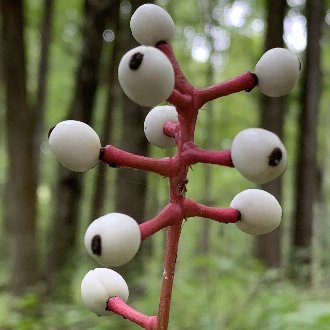 Ripe fruit is usually white. Fruit pedicels are much wider (1-2mm wide) and look robust and large relative to the fruit. Central axis of the inflorescence is similar in width to the pedicels. Black dot on fruits is bolder. Photo © Holly Sanderson, CC BY 4.0. | 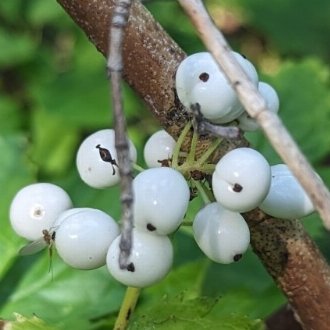 Ripe fruit is rarely white. Fruit pedicels are much narrower (0.4-0.7mm wide) and look delicate and smaller relative to the fruit. Central axis of the inflorescence is visibly thicker than the pedicels. Black dot on fruits is smaller. Photo © Caleb Catto, CC BY 4.0. |
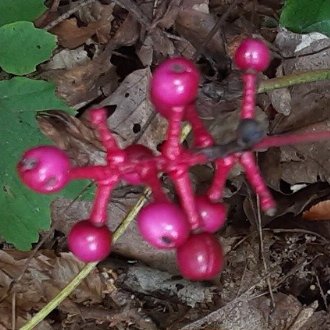 Ripe fruit is rarely red. Red fruit averages a more magenta color, with a more bluish hue. In this case, the pedicels and central axis of the inflorescence are usually similar in color to the fruit. Rarely, pedicels and central axis may be greenish. Photo © Larry Jensen, CC BY 4.0. | 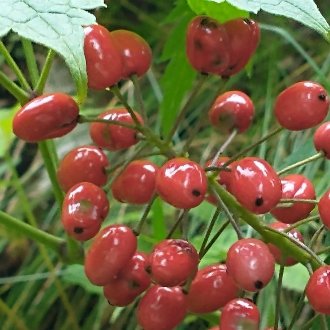 Ripe fruit is usually red. Red fruit averages a deeper red color, not as bluish in hue. In this case, the color usually contrasts sharply with the color of the pedicels and central axis of the inflorescence, which is usually green or brown. Photo © Tom Norton, CC BY 4.0. |
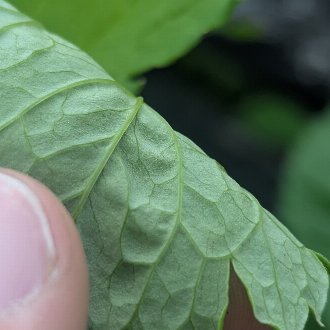 Underside of leaflets are usually hairless. Photo © Ryan Sorrells, CC BY 4.0. | 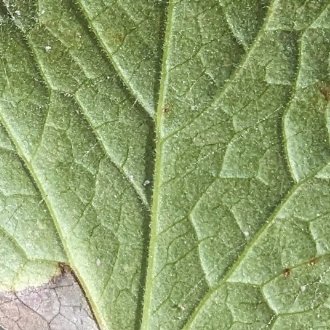 Underside of leaflets are usually hairy, although they may uncommonly be hairless. Photo © joergmlpts, CC BY 4.0. |
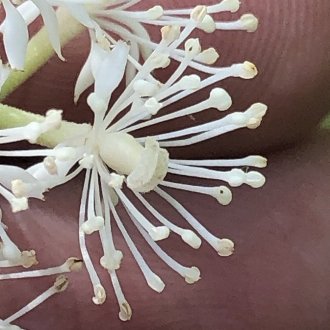 Stigma (pollen receptacle at the tip of the pistil in the center of each flower) is usually 1.5-2.8 mm in diameter, the same size as or wider than the ovary (swollen base of the pistil that becomes the fruit.) Photo © Daniel J. Layton, CC BY 4.0. | 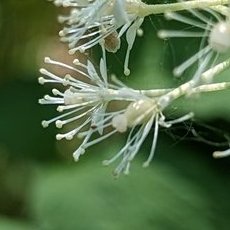 Stigma is usually 0.7-1.2 mm in diameter, much narrower than the ovary. Photo © Ryan Sorrells, CC BY 4.0. |
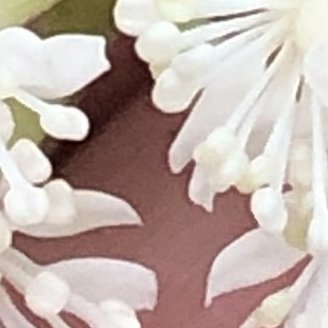 Petals (which are often less visible than the anthers) are usually truncate (straight-across) or cleft at their tips. Photo © Daniel J. Layton, CC BY 4.0. | 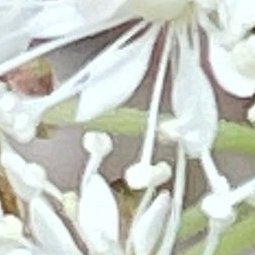 Petals usually come to an angle, acute to obtuse, at their tips. Photo © Tom Scavo, CC BY 4.0. |
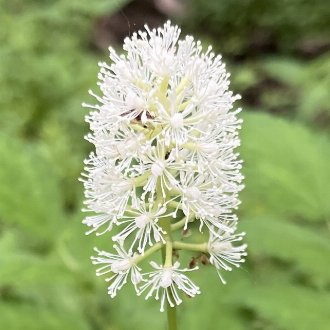 Inflorescence is often (not always) longer than wide, tending more towards a short-cylindric shape, more similar in width throughout its length, especially at the base, and only narrowing slightly at the tip. Photo © Christopher Zacharias, CC BY 4.0. | 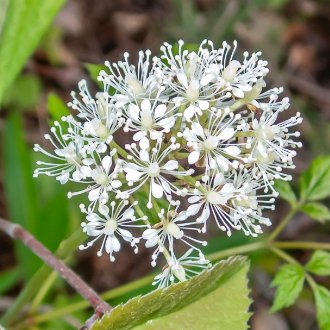 Inflorescence is usually similar in length and width, and often has a weakly pyramidal shape, narrowing slightly at the tip and wider at the base. Photo © Jay Brasher, CC BY 4.0. |
Additional Notes
The soil pH and texture preferences of these species correspond to the distinction between pure deciduous (hardwood) forests and mixed deciduous/coniferous forest. In the transition zone between pure deciduous and mixed forests, hardwoods are usually favored on sites with richer, loamy, near-neutral soil due to increased nutrient availability. Sites with sandy and/or clayey soil of greater acidity tend to have lower nutrient availability and thus favor evergreens which retain their foliage through multiple seasons. The needle litter has a high carbon-nitrogen ratio and breaks down slower, causing acidic conditions to persist. This transition is driven in large part by temperature, and this transition is the main reason for A. rubra having the more northerly range of the two species. Conifer-dominated forests extend much farther south in the mountainous West, which is why this species also ranges farther south in the West.References & External Resources
These short lists show only links helpful for ID. For a complete list of references and resources also covering other aspects of ecology, visit the links section of the full article on each plant, which is the first entry here.