




Catawba Rosebay (Rhododendron catawbiense) vs Great Laurel (Rhododendron maximum)
This guide is under construction and has not been published yet. It may have errors. When in doubt, double-check other sources for definitive ID.These two rhododendrons are easily confused in their range of overlap; both occur in mountains on rocky, sloped terrain, and have large evergreen leaves with lower surfaces that lack the dots and brown scales found on some rhododendrons. They can be easily distinguished by bloom color and leaf shape. R. maximum prefers moister, shadier habitats, and ranges much farther north, whereas R. catawbiense prefers sunnier habitats and ranges slightly farther south.
Catawba Rosebay (Rhododendron catawbiense) | Great Laurel (Rhododendron maximum) |
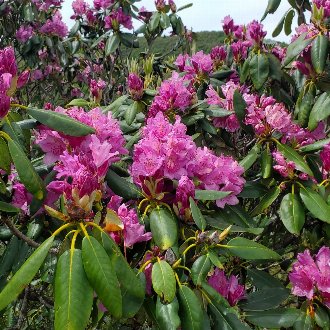 Flowers are usually a deep pink color, occasionally tending towards purple. Photo © Sean Feirstein, CC BY 4.0. | 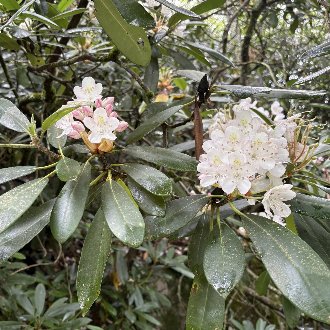 Flowers are usually white, occasionally tending towards pale pink. Photo © Kyle Van Houtan, CC BY 4.0. |
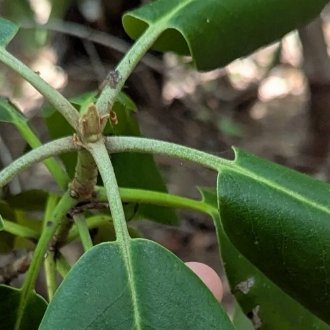 Leaf bases are usually rounded, occasionally even slightly heart-shaped; when leaf bases are tapered, they do so more broadly. Photo © Alina Martin, CC BY 4.0. | 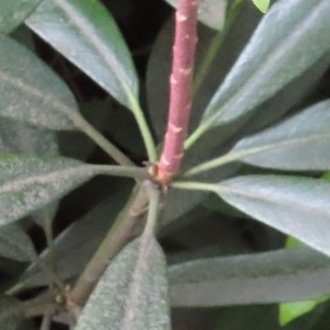 Leaf bases taper to a point, usually much more narrowly. Photo © Ken Clark, CC BY 4.0. |
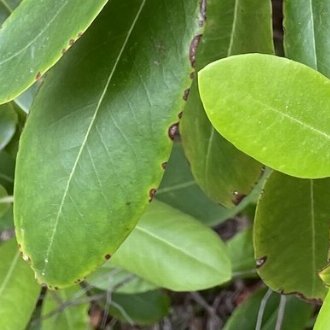 Leaf tips are more rounded, and if pointed, form a much broader, obtuse angle. Photo © Kristály Cravens-Liszak, CC BY 4.0. | 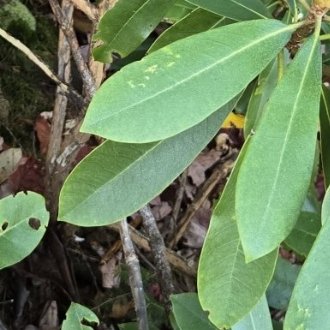 Leaf tips are more sharply pointed, forming a narrower, usually acute angle. Photo © Micki Colbeck, CC BY 4.0. |
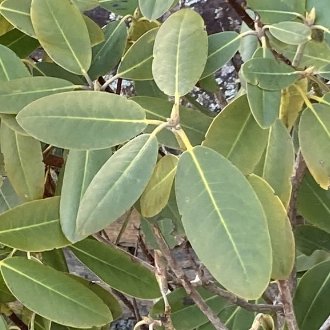 Leaves are more stout, tending to be about 1.5-2.5x as long as they are wide. Photo © Hill Craddock, CC BY 4.0. | 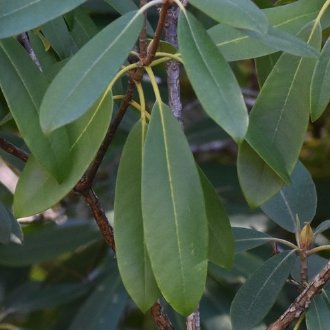 Leaves are narrower, tending to be about 3-5x as long as they are wide. Photo © Ryan Watson, CC BY 4.0. |
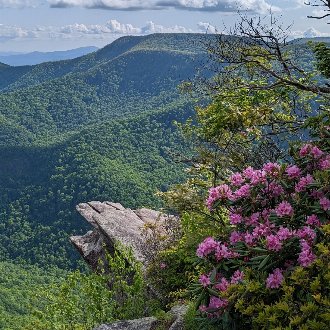 Prefers sunnier, drier habitats. Often found on rock outcroppings and at or near mountain summits. Photo © portulaca, CC BY 4.0. | 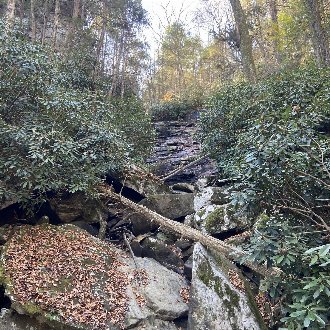 Prefers shadier, moister habitats. Often found in sheltered mesic woods, in ravines, and along streams. Photo © Scott Ward, CC BY 4.0. |
Additional Notes
In the wild, there are few species that could be confused with these two as most other species are easily distinguished by having a different appearance and texture on the underside. However, there are numerous species from East Asia that are widely planted in landscaping. When identifying landscaping plants there may be more species to check against.FNA unambiguously states that these two species can hybridize, but we found no reports or records of hybrids occurring in the wild, so we do not know whether or not hybrids are possible. Most individuals in the wild look unambiguously like one species or the other.
References & External Resources
These short lists show only links helpful for ID. For a complete list of references and resources also covering other aspects of ecology, visit the links section of the full article on each plant, which is the first entry here.


