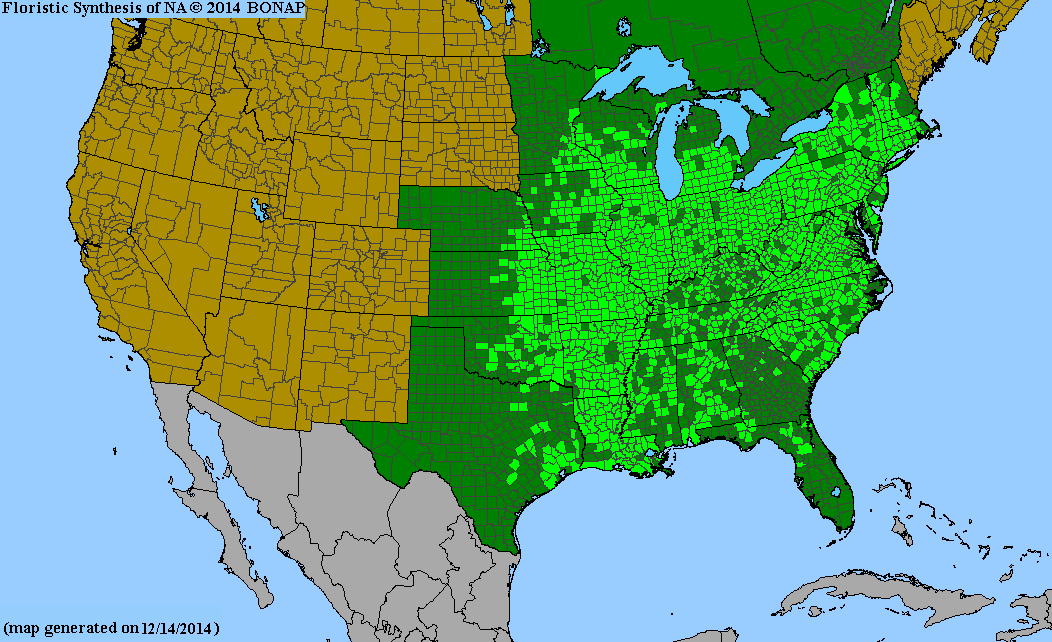

Jumpseed (Persicaria virginiana) vs Asian Jumpseed (Persicaria filiformis)
These species are visually similar and are easily confused. The confusion is worsened by nurseries mislabeling P. filiformis as P. virginiana. They can be distinguished by leaf shape, chevron pattern, and flower color. Some plants are cultivars that are easily identifiable as P. filiformis, but wild-type plants warrant closer examination. P. filiformis is less common throughout, but mostly found in the same range and similar habitats to P. virginiana.
Jumpseed (Persicaria virginiana) | Asian Jumpseed (Persicaria filiformis) |
A rhizomatous perennial native to moist deciduous woodlands in Eastern North America, named for its spring-loaded seeds. | A rhizomatous perennial whose cultivars are frequently planted in gardens and can escape in the wild; at risk of becoming invasive in Eastern North America. |
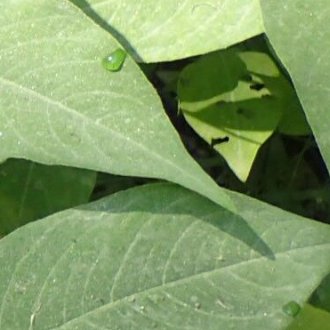 Leaves consistently taper to a point (acuminate), and tip averages longer. Photo © John Baur, CC BY 4.0. | 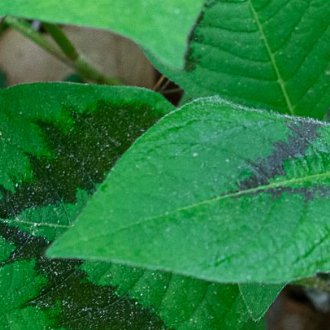 Leaves either taper to a shorter tip (short acuminate), or have a simple acute angle with no taper. Photo © Ana Ka'ahanui, CC BY 4.0. |
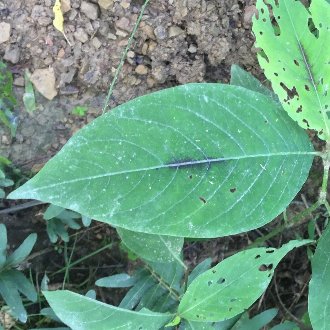 Leaves tend to be ovate, vaguely egg-shaped with the widest point closer to the base. Photo © Mark Eanes, CC BY 4.0. | 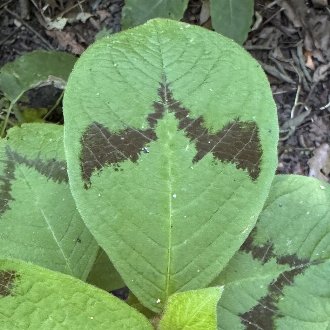 Leaves tend to be obovate, vaguely egg-shaped with the widest point closer to the tip. Photo © chrischalfant, CC BY 4.0. |
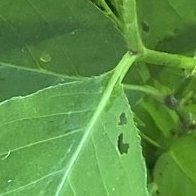 Leaf bases are not attenuate; the leaf blade may form an acute angle at the base but does not taper to a narrow base. Photo © Mason Heberling, CC BY 4.0. | 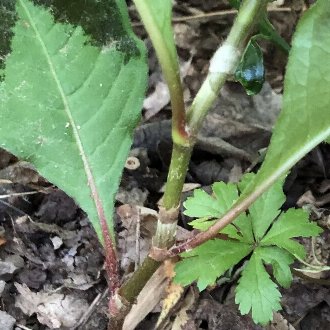 Some leaves have an attenuate base, gradually tapering to a very narrow base. Photo © jonsense, CC BY 4.0. |
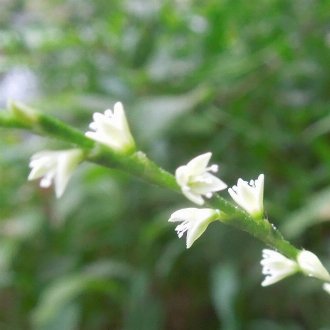 Flowers are usually white, very rarely pink to red. Photo © , CC BY-SA 4.0. | 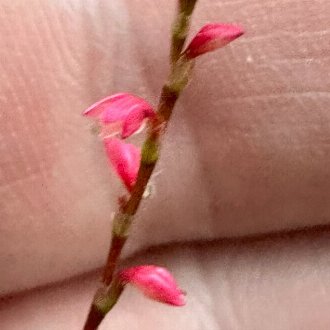 Flowers are usually red to pink, very rarely white, although variegated forms may have variegated flowers with white splotches. Photo © Emily Summerbell, CC BY 4.0. |
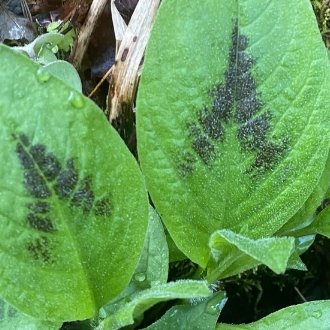 Dark chevron on leaves, when present, tends to be more concentrated near the leaf center and does not usually extend as far to the leaf margin. Pattern is often longer (in the direction of the leaf) relative to its width. Chevron is only present on immature leaves and does not persist as leaves mature. Photo © Emily Franzen, CC BY 4.0. | 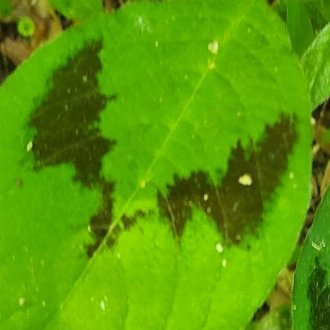 Dark chevron on leaves, when present, tends to extend farther towards the leaf margins and is often bolder near the margins and narrower in the center. The pattern is often shorter relative to its width. Chevron persists longer on recent descendants of cultivars, but plants may revert back to wild form where chevron is less persistent. Photo © Megan Massa, CC BY 4.0. |
Additional Notes
All these traits tend to be variable, sometimes even on a single plant. It is safest to consult multiple characteristics.Some sources, including FSUS, report that the dark chevron on the upper leaf surface of P. filiformis is persistent, i.e. not fading away as leaves mature, whereas the similar pattern on P. virginiana is not persistent and is only present on immature leaves. However, we found this trait to be unreliable, particularly on wild-type plants in the original range of P. filiformis in East Asia, and we have also found individuals in North America where the pattern is not persistent. In its native range, the chevron often fades completely by late in the season, and there are also individuals where the dark pattern does not even make a chevron but consists of two separate splotches concentrated near the leaf margins and separated in the middle. We suspect that the persistence of the dark chevron in North American populations is an artifact of most North American plants being derived from garden escapes. Cultivars have been selected for the persistence of the chevron for aesthetic reasons. This trait will likely fade over generations as plants revert back to a more wild form. We have found the concentration of the blotches closer to the leaf margin in P. filiformis to be more reliable and consistent with wild specimens in the native range of that species, so this trait will likely retain its reliability even as plants revert back to wild forms.
Thus, the presence of a persistent pattern on mature leaves late in the season can be a clue that you are probably looking at P. filiformis, but the absence of such a pattern on mature leaves is not sufficient to exclude P. filiformis.
FSUS also uses the number of pairs of lateral veins as a trait to distinguish these two species, but we have found this unreliable for two reasons. The vein pattern of both species is such that there are often faint lateral veins spaced between more robust lateral veins, and it can be subjective deciding what counts as a lateral vein. But, even being conservative about what counts as a "lateral vein", only counting robust veins that extend most of the way to the leaf margin, we found it is common to find individuals of P. virginiana whose leaves have 10 or more lateral veins, thus making FSUS' proposed cutoff unreliable.
In most cases, the other traits will be more than sufficient to distinguish these species.
Although there are numerous other Persicaria species, both native and introduced, that overlap with these in range in North America, most of them have much narrower leaves and are easily distinguished from these two species. The only other one that has such broad leaves is the introduced kiss me over the garden gate (Persicaria orientalis), which is visually distinctive and found in sunnier habitats.
Habitat is little clue to identification of these species. Due to its origination as garden escapes, P. filiformis is most common in woodlands near suburban gardens, but it can also occur in wild forests. Although FSUS reports it as rare to uncommon in most of its range, it may be underreported because many people do not know to check against it. Furthermore, P. virginiana is common in almost its entire range, and although it is frequent in intact wild areas, it is also common as a garden weed in suburban gardens and degraded, fragmented woodlands in urban and suburban areas. Both plants are also widely planted.
We have found sources speculating about the potential for these two species to hybridize, but it is unlikely that they hybridize commonly because of incompatible chromosome counts: P. virginiana has 2n=44 whereas P. filiformis has 2n=48.
References & External Resources
These short lists show only links helpful for ID. For a complete list of references and resources also covering other aspects of ecology, visit the links section of the full article on each plant, which is the first entry here.
Jumpseed (Persicaria virginiana) | Asian Jumpseed (Persicaria filiformis) |
No corresponding entry | |
• Antenoron virginianum (Jumpseed) | Illinois Wildflowers (About This Site) | No corresponding entry |
• Persicaria virginiana | Flora of North America (About This Site) | No corresponding entry |
• Persicaria virginiana | Biota of North America Project (BONAP) (About This Site) | No corresponding entry |
No corresponding entry | |
• Persicaria virginiana (Jumpseed) | Minnesota Wildflowers (About This Site) | No corresponding entry |