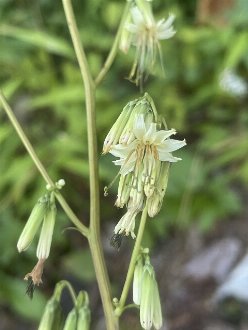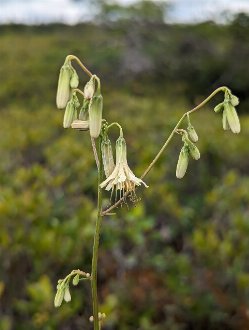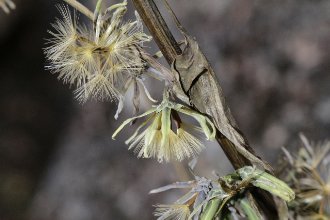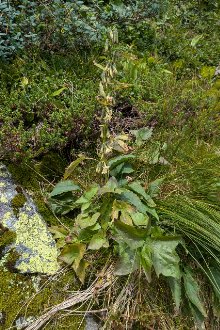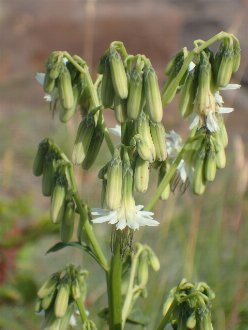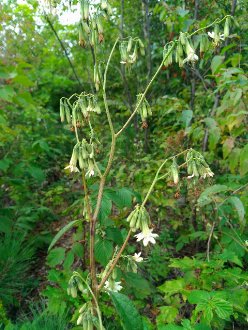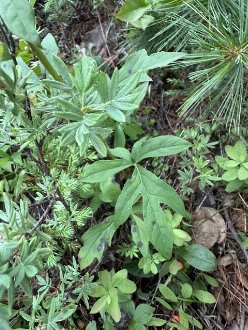

Three-leaved Rattlesnake Root (Nabalus trifoliolatus Cass.)
Also known as gall of the earth, gall-of-the-earth, dwarf rattlesnakeroot; also classified as Nabalus nanus (Bigelow) DC., Prenanthes trifoliolata (Cass.) Fernald, Prenanthes nana (Bigelow) Torr. ex DC.
Some authorities separated this taxon into two populations, the main one under the epithet trifoliatus/trifoliata, and a "dwarf" species in NY, NH, and ME, referred to as nanus/nana. However, most modern authorities have merged the two. A few sources recognized the dwarf taxon as a variety, var. nanus/nana, but most modern authorities do not even recognize those. We merge the taxa without recognizing any sub-taxa, per POWO's treatment. Independently of this consideration, this species was moved from the Prenanthes genus into the Nabalus genus; normally it would keep the same epithet, except that in this case, the name Nabalus trifoliolatus Cass. (1825) is older than the name Nabalus nanus (Bigelow) DC. (1838). This situation is the reverse of the names in the other genus: Prenanthes nana (Bigelow) Torr. ex DC. (1838) is older than Prenanthes trifoliolata (Cass.) Fernald (1900). Hence many sources refer to Prenanthes trifoliolata and then reclassify it into Nabalus trifoliolatus.
↑Summary
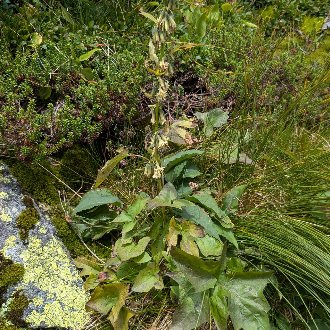
Thought to be a monocarpic perennial, native to forests and rock outcroppings in eastern North America, usually on acidic soils.
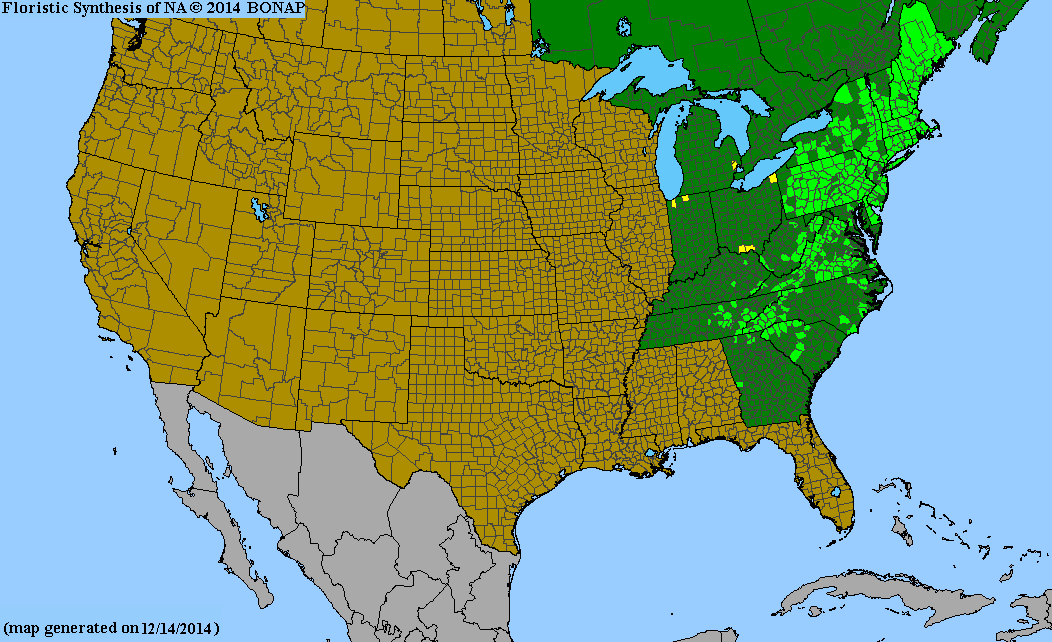
↑Range - Expand
| Legend | Color |
| Native or Not Present | |
| Native |
This tentative map is based on our own research. It may have limited data on Canada and/or Mexico, and there is some subjectivity in our assignment of plants as introduced vs. expanded. Read more in this blog post.
Although this plant occurs somewhere in each of these regions, it may only occur in a small part of some or all of them.
This species is also native to Canada, but we have yet to build this portion of its map.
↑Similar Plants
↑Habitat
Nabalus trifoliolatus occurs in open forests and exposed sites on acidic soils. In the heart and south of its range it occurs in moist to mesic oak-hickory woods and swampy thickets. In the north of its range it ranges farther into sunny habitats and is frequently found on barrens, rock outcroppings, and rocky balds. It can occurs in coastal habitats exposed to salt spray. It can occur in anthropogenic habitats, especially along roads or other anthropogenic edges through the open forests it prefers.
It spans a wide range of elevations, from sea level to 1,400m (~4,600ft) which reaches slightly into the alpine zone above the tree line, where it co-occurs with alpine rattlesnakeroot (Nabalus boottii). However, in the south of its range, it is rare in the coastal plain and relatively more common in mountains.
It is usually found on soils that are rocky and/or sandy, often thin, and acidic. It tolerates salinity better than other Nabalus species and can thus occur both on coastal rock outcroppings in areas with a rocky coastline, and in maritime forests on barrier islands where the coast is more sandy. Although it can grow on exposed coastal rocks, in areas with sandy coastlines it is absent from coastal dunes and limited to slightly sheltered habitats farther back from the dunes. Its salt tolerance also allows it to thrive where roads cut through forests, especially when the road bed is made of a substrate that weathers to acidic soil; the gravel of some road beds raises the soil pH above the preferences of this species.
Most populations of this species are secure although there are large regions around the edge of its range where it is rare and certain local populations may be vulnerable or threatened. It has suffered less human-induced habitat loss than some species because it tends to grow on rocky or sandy soils of low fertility that humans are less likely to develop or use for agriculture. Humans may have increased habitat for it through deforestation and soil loss and degradation following European colonization, and the creation of more of the open habitats it prefers.
↑Life Cycle
Nabalus trifoliolatus is thought to be a monocarpic perennial, as with other members of its genus, although we have not located a rigorous study that established this speculation as fact.
We also could not find specific information on its lifespan. Based on inferences from comparing to other Nabalus species as well as other species in its habitat, it likely is opportunistic and can have wildly different lifespans on different sites. This species is unusual in that it can range from full sun into considerable shade; most shade-growing Nabalus species are triggered to flower in a year following a canopy-opening disturbance. However, open-grown plants of this species may be more limited by annual weather conditions, as it tends to have little shade and competition when growing in rock outcroppings.
↑Faunal Associations
The early-season basal rosettes of mos Nabalus species are a preferred browse of deer, but we were unable to find any information on the degree to which deer browse this species in particular.
The Fletcher's Larch Looper (Eupithecia fletcherata) and the gray-banded leafroller moth (Argyrotaenia mariana) have been recorded eating this species.
↑Notes
We prefer the common name "three-leaved rattlesnake root" because it is descriptive, and follows the pattern of a descriptor (three-leaved) that corresponds to the scientific epithet trifoliolatus, whereas "rattlesnake root" refers to the Nabalus genus. The common name "gall of the earth" is also ambiguous as it can also refer to Nabalus serpentaria.
↑Links & External Resources
• Prenanthes trifoliolata (gall of the earth)† | USDA PLANTS Database (About This Site)
• Prenanthes nana (dwarf rattlesnakeroot)† | USDA PLANTS Database (About This Site)
• Nabalus trifoliolatus | Biota of North America Project (BONAP) (About This Site)
• Nabalus trifoliolatus | Go Botany (About This Site)
• Prenanthes trifoliolata | NatureServe Explorer (About This Site)
• Prenanthes trifoliolata | Flora of North America (About This Site)
• Gall of the Earth | Maryland Biodiversity Project (About This Site)
• Prenanthes trifoliolata (Cass.) Fern. (Gall-of-the-earth) | Digital Atlas of the Virginia Flora (About This Site)
• Nabalus trifoliolatus Cass. | Plants of the World Online (POWO) (About This Site)
Different Taxonomic Treatments
† Each of these links refer only to part of the populations covered by this page.
↑Photo gallery