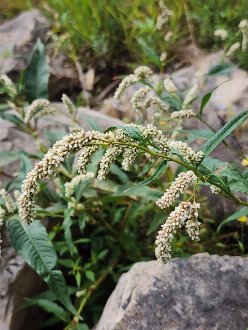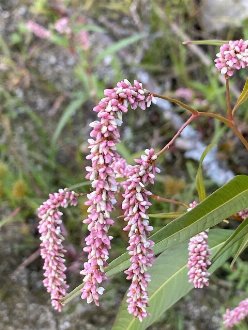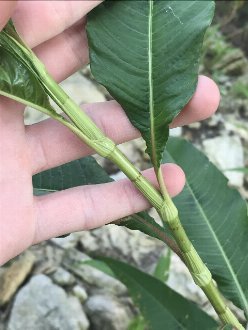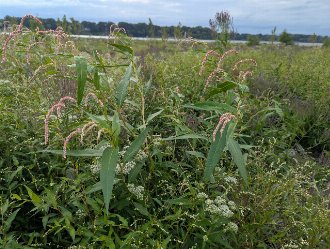

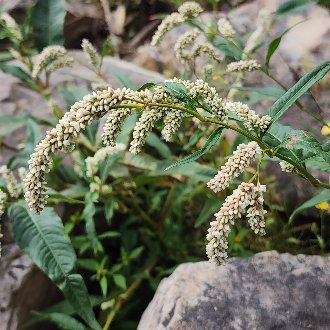
Pale Smartweed (Persicaria lapathifolia (L.) Delarbre)
Also known as curlytop knotweed; also classified as Polygonum lapathifolium L., Persicaria incarnata (Elliott) Small.
This species is sometimes separated into two species, one of European origin, and one native to North America. If separated, the native North American species is called Persicaria incarnata (Elliott) Small. We lump them together following the treatment of mo st current authorities, including POWO and FSUS.
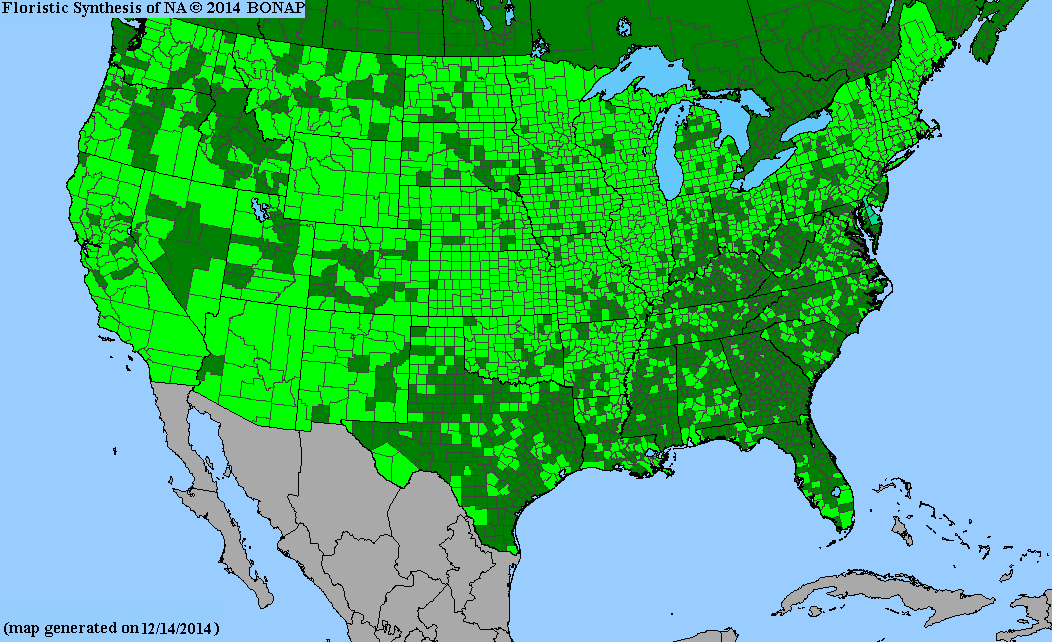
↑Range - Expand
| Legend | Color |
| Native | |
| Native or Not Present | |
| Native or Expanded |
This tentative map is based on our own research. It may have limited data on Canada and/or Mexico, and there is some subjectivity in our assignment of plants as introduced vs. expanded. Read more in this blog post.
Although this plant occurs somewhere in each of these regions, it may only occur in a small part of some or all of them.
BONAP reports this species as native in almost its entire range where it occurs, but adventive in Delaware; FSUS on the other hand marks it as native in Delaware too. Our map reflects this uncertainty but we point out that FSUS is using more up-to-date information and theirs is likely correct. This species is also native to Canada and Mexico, but we have yet to build these portions of its map.
↑Similar Plants

↑Habitat
Pale smartweed is found across North America on wet to moist, rich, disturbed sites in full to partial sun. Natural habitats include freshwater shores of lakes, ponds, and marshes, wet depressions in prairies, and sand, mud, and gravel bars in rivers and streams. Anthropogenic habitats include fields in bottomland areas, moist depressions in fields, ditches along roads and railroads, moist sites on waste ground, drainage basins, margins of holding or drainage ponds, and rocks placed to stabilize freshwater shorelines.
Pale smartweed most commonly occurs on sites that have experienced a major disturbance that has not only exposed some soil, but removed competing vegetation. It prefers full sun but can grow in partial sun. It is tolerant of competition from ground-level vegetation that emerges and matures later in the season, but cannot establish on sites with dense vegetation cover early in the season.
It prefers moist to wet conditions, and tolerates temporary flooding, but cannot grow in persistent standing water. It occasionally ranges onto drier sites following a disturbance, but it is less common and less persistent than on moist sites.
It is mostly limited to mildly-acidic to near-neutral soils, and is absent from strongly acidic soils, which is why it is less common in the southeastern coastal plain, and more restricted to floodplains in that region. In the North and West of its range, it ranges farther onto upland sites, but still prefers rich, moist soils.
It is intolerant of salt and absent from shorelines of estuaries and bodies of salt water.
↑Life Cycle
Pale smartweed is a summer annual; its seeds typically germinate in spring. It matures quickly, typically pushing up through competing vegetation and it is usually one of the taller plants in the habitat where it grows by the time it flowers. Although it can grow upright, it often sprawls or leans on other vegetation or other objects.
Plants flower from late summer to early fall, with a bloom period lasting as long as two months. Seeds mature gradually, and even after flowering is complete, there are several weeks in which some seeds on each spike are mature and dried whereas others are still maturing. This process enables the plant to funnel additional resources into seeds over a longer period of time, while timing the blooms earlier when pollinators are still abundant. Most seeds are distributed in late fall although some seeds often persist into winter.
As this species has a large range, the timing of flowering, seed maturation, and distribution can vary considerably in different regions.
Seeds exhibit a cold dormancy in most temperate regions and do not germinate until the subsequent season.
In suitable conditions, most seeds will germinate in the first season after dispersal, but significant numbers fail to germinate and remain viable, with progressively smaller numbers germinating in subsequent years. A small portion of seeds has been recorded persisting in the seed bank as long as five years. This pattern is typical of the Persicaria genus. Seed production is high enough that the portion of viable seeds in the seed bank even after five years can be sufficient to allow this species to re-establish, allowing it to persist on sites where suitable habitat only occurs once every few years.
↑Links & External Resources
• Polygonum lapathifolium (curlytop knotweed) | USDA PLANTS Database (About This Site)
• Pale Smartweed | iNaturalist (About This Site)
• Persicaria lapathifolia | Biota of North America Project (BONAP) (About This Site)
• Polygonum lapathifolium | NatureServe Explorer (About This Site)
• Persicaria lapathifolia | Flora of North America (About This Site)
• Persicaria lapathifolia | Missouri Plants (About This Site)
• Curlytop Knotweed | Maryland Biodiversity Project (About This Site)
• Persicaria lapathifolia (Nodding Smartweed) | Minnesota Wildflowers (About This Site)
• Persicaria lapathifolia (L.) Gray (Dock-leaf Smartweed, Pale Smartweed) | Digital Atlas of the Virginia Flora (About This Site)
↑Photo gallery