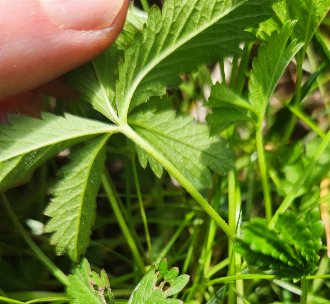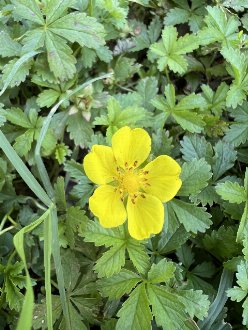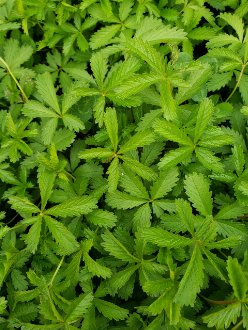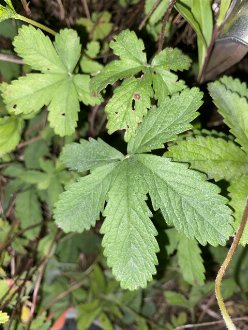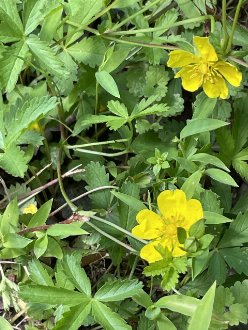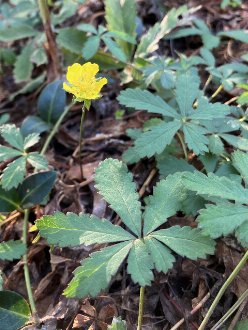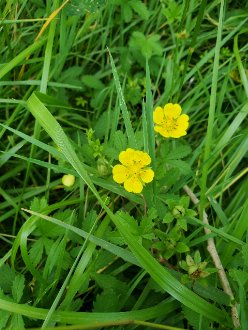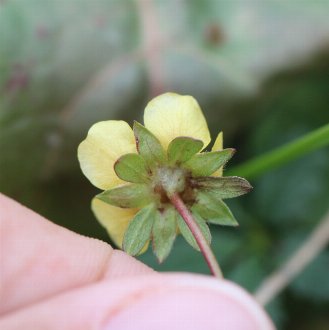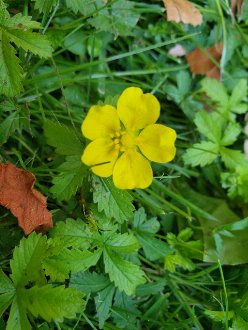

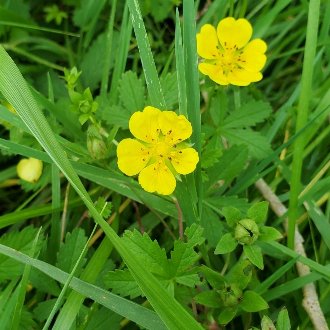
European Cinquefoil (Potentilla reptans L.)
Also known as creeping cinquefoil, creeping tormentil, creeping five-fingers.
↑Summary
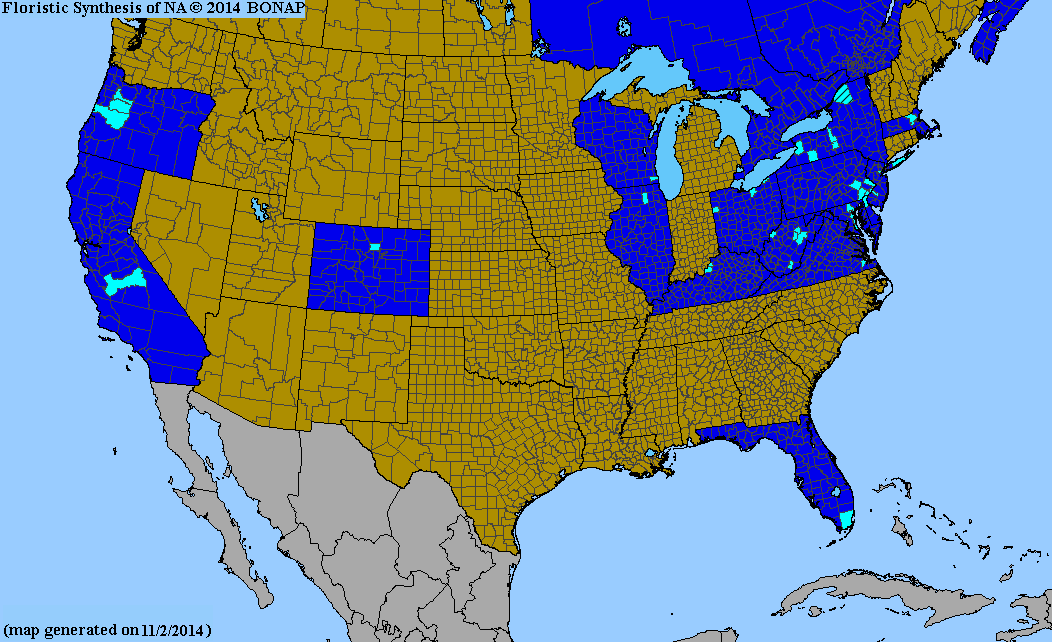
A creeping perennial introduced at scattered sites across North America, invasive in places, preferring near-neutral pH.
↑Range - Expand
| Legend | Color |
| Introduced | |
| Introduced or Not Present |
This tentative map is based on our own research. It may have limited data on Canada and/or Mexico, and there is some subjectivity in our assignment of plants as introduced vs. expanded. Read more in this blog post.
Although this plant occurs somewhere in each of these regions, it may only occur in a small part of some or all of them.
↑Similar Plants
↑Habitat
This species is not widely-established in North America, so its habitat preferences are not fully known. It is most common in the Delaware Piedmont and to a lesser degree, adjacent areas of the Pennsylvania Piedmont.
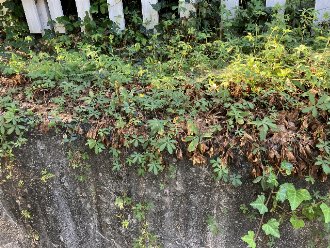
It is mostly found in anthropogenic habitats, including lawns and gardens. It prefers near-neutral soils and full to partial sun. Although it often takes advantage of dry patches in lawn to establish, it is more vigorous in moist, partly-shaded areas, and established plants often spread preferentially to such areas. In gardens, it frequently fills in edges and spaces between plants.
↑Control
This species can be difficult to control once established, typically tougher than with the related mock strawberry (Potentilla indica), although that species is more widely-established. Reproduction is primarily vegetative; seedlings are uncommon.
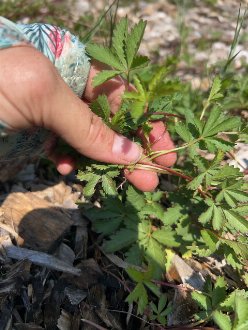
Manual control is complicated by the deep taproot and tendency of plants to break off above the root crown if pulled casually; such breakage only removes the foliage and leaves the plant to resprout with little setback. To remove established plants, it is more effective to use a trowel or other tool to loosen the taproot and lift upward slightly, then grab the plant's root directly to fully remove the taproot. Often, a vigorous plant will send out stems that root at nodes, and new nodes are initially weakly rooted, so by tracing stems back to the first vigorously-rooted node, and pulling that, one can often lift out other new nodes along the stems with less effort.
Potentilla reptans is susceptible to most of the widely-used herbicides that target broadleaf plants, including triclopyr, dicamba, and 2,4-D. However, these will also kill other broadleaf plants, including not only native Potentilla species but any native broadleaf plants as well, so their use is only suitable when this plant is growing in turfgrass with no other native broadleaf plants present.
There are also systemic factors that can favor this species over other plants, including over the native P. simplex and P. canadensis, both of which can also occur in lawns and gardens. Because the invasive P. reptans has a strong preference for near-neutral soil pH, in areas where the natural soil equilibrium would be more acidic, P. reptans can often be favored by soil enrichment or fertilization, especially by calcareous material such as lime, dolomite, or material derived from seashells. In these cases, refraining from such fertilization, and even, adding acidic material such as conifer needles, can help control this plant.
In gardens, because this plant tends to thrive mostly along edges and in spaces between plants, the use of groundcovers to fill all available space, and the management of edges to reduce exposed soil, such as allowing vegetation to slightly overhang the edge instead of cutting it back farther than the edge, can prevent this plant from colonizing and can reduce its spread if it already occurs in an area.
Because this species is not widely established in North America, but it is so difficult to remove once established, prevention is key in its spread. It is most common in the Delaware Piedmont and also to a lesser degree in adjacent areas in the Pennsylvania Piedmont. In these areas, care must be taken when moving any soil or equipment that might be contaminated with soil or seeds. These regions are also contaminated with some of the highest densities of invasive plant species of anywhere in North America, so caution is warranted here for many other reasons as well.
↑Uses
This plant was introduced as a groundcover, where it was valued for its relatively showy flowers. It is potentially invasive in North America and we recommend against ever planting it.
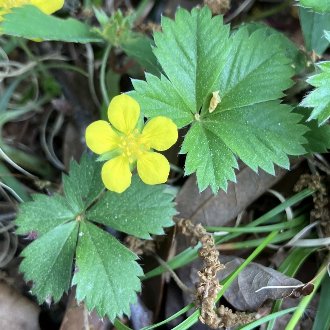
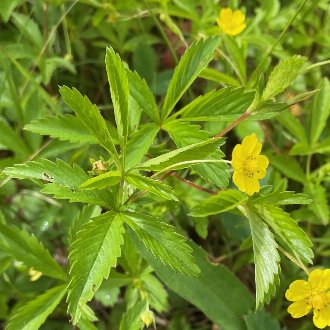
Visually-similar native alternatives include dwarf cinquefoil (Potentilla canadensis) or common cinquefoil (Potentilla simplex), and Virginia strawberry (Fragaria virginiana) or woodland strawberry (Fragaria vesca).
↑Notes
We prefer the common name "European Cinquefoil" to "creeping cinquefoil" as the two most commonly-confused native cinquefoils, dwarf cinquefoil (Potentilla canadensis) and common cinquefoil (Potentilla simplex), both also have a creeping habit, so that descriptor can be confusing or ambiguous, whereas the descriptor "European" accurately communicates that this species is native to Europe (and introduced in North America.)
↑Links & External Resources
• Potentilla reptans (creeping cinquefoil) | USDA PLANTS Database (About This Site)
• Potentilla reptans | Go Botany (About This Site)
• Potentilla reptans | Biota of North America Project (BONAP) (About This Site)
• Potentilla reptans | NatureServe Explorer (About This Site)
• Potentilla reptans | Flora of North America (About This Site)
• Creeping Cinquefoil | Maryland Biodiversity Project (About This Site)
• Potentilla reptans L. (Creeping Cinquefoil, European Cinquefoil) | Digital Atlas of the Virginia Flora (About This Site)
↑Photo gallery