
Slender Threeseed Mercury (Acalypha gracilens) vs One-Seeded Mercury (Acalypha monococca)
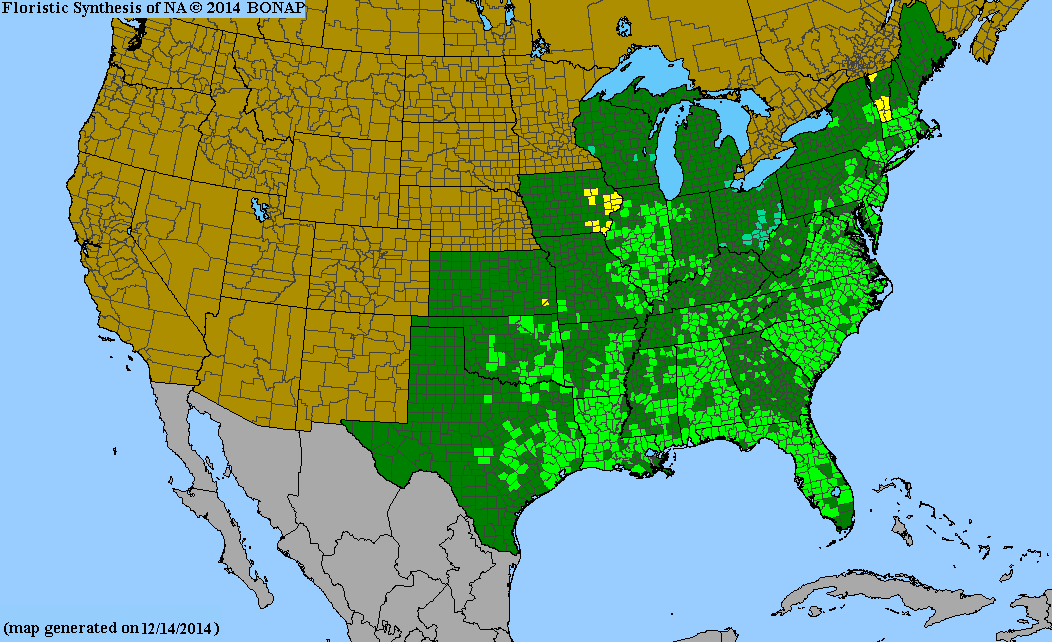
These two species are easily confused in their small range of overlap from southeast MO and southern IL southwest to east TX. They are reliably distinguished by count of seeds per bract, and they have subtle differences in leaf margin serrations and leaf tips that can ID some plants as A. gracilens. A. monococca ranges farther northwest and prefers slightly sunnier, drier conditions, higher soil pH, and tends to occur on persistently-open sites. A. gracilens ranges farther east, tolerates more acidic soil, and is found on slightly richer sites on disturbed ground.
Slender Threeseed Mercury (Acalypha gracilens) | One-Seeded Mercury (Acalypha monococca) |
An annual native mostly to the southeastern US. | An annual native to the south-central US. |
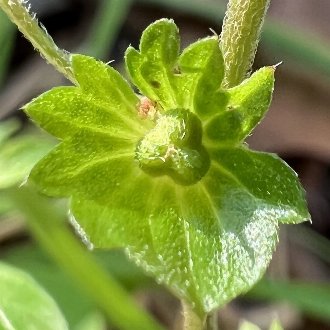 Three fruits occur per bract, corresponding to the pistils on flowering plants having 3 carpels each. Seeds average slightly smaller (1.1–1.9 mm long.) Photo © Anne Parker, CC BY 4.0. | 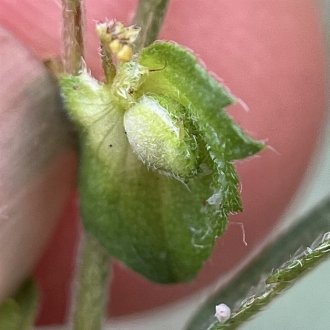 Only one fruit occurs per bract, corresponding to the pistils on flowering plants having 1 carpel each. Seeds average slightly larger (1.6–2.4mm long.) Photo © diana schwartz, CC BY 4.0. |
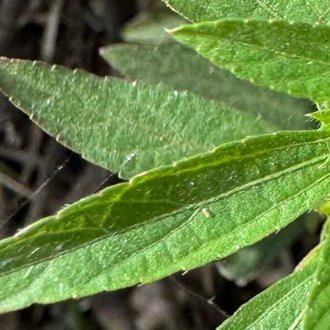 Serrate and/or crenate leaf margins may be subtle and barely-visible, but in other cases are at least slightly more pronounced. Photo © Jeff Clark, CC BY 4.0. | 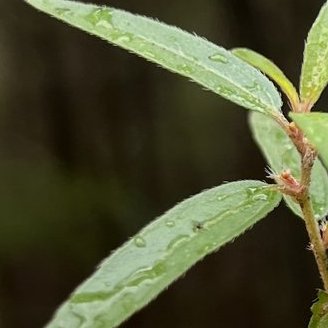 Serrations on leaf margins are consistently subtle and often barely visible at all, never quite as pronounced. Photo © Nathan Aaron, CC BY 4.0. |
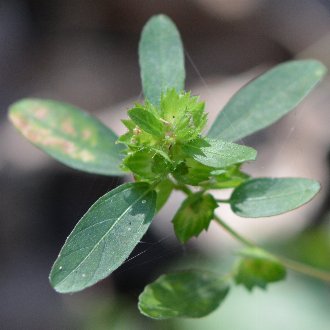 Leaf tips may sometimes come to a sharp point, but often are blunt-tipped, sometimes dramatically so. Photo © Amber M. King, CC BY 4.0. | 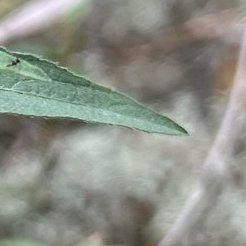 Leaf tips make an acute angle, usually quite sharp, and are rarely or never completely blunt-tipped. Photo © Nathan Aaron, CC BY 4.0. |
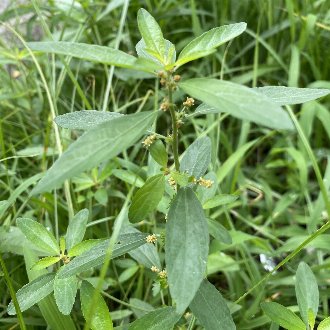 Prefers shadier, moister conditions, and is more likely on disturbed sites. Photo © Bonnie Semmling, CC BY 4.0. | 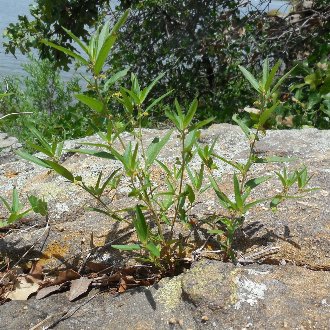 Prefers sunnier, drier conditions, and is more likely in persistent open conditions. Photo © Sam Kieschnick, CC BY 4.0. |
Additional Notes
All keys we found reference the seed count (and/or carpel count per pistil, which corresponds to the seed count) as the primary trait for separating these species, with the only other trait referenced being the seed length. The seed count is usually relatively easy to observe and photograph on mature plants, but it is not available on young plants.Although it is not possible to reliably ID all plants, a large portion of individuals can be identified by looking at leaf margins and tips. However, there is an asymmetry in that pronounced serrations on the leaf margins and/or blunt leaf tips are sometimes reliable for excluding A. monococca, but their opposite, subtle serrations and sharp leaf tips are not reliable for excluding A. gracilens. So, without observing plants flowering and/or setting seed, it remains easier to identify plants as A. gracilens and relatively harder to identify them as A. monococca in their range of overlap.
Although they are more easily distinguished, both of these species (especially A. gracilens) are frequently confused with Virginia threeseed mercury (Acalypha virginica) and sometimes even rhomboid mercury (Acalypha rhomboidea). Confusion is particularly likely on small plants such as growing in dry, nutrient-poor conditions that are more likely to overlap with these two species. Usually, the combination of shallow bract lobes and short petioles is sufficient to exclude those two species and narrow it down to the two considered in this guide.
References & External Resources
These short lists show only links helpful for ID. For a complete list of references and resources also covering other aspects of ecology, visit the links section of the full article on each plant, which is the first entry here.