
White Baneberry (Actaea pachypoda) vs Black Baneberry (Actaea racemosa)
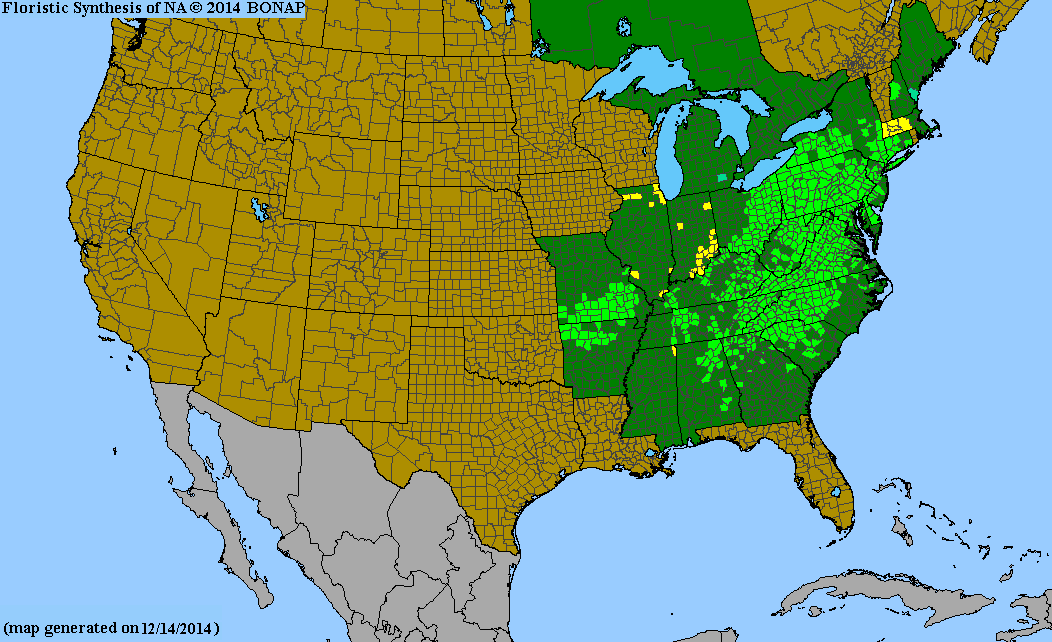
This guide is under construction and has not been published yet. It may have errors. When in doubt, double-check other sources for definitive ID.These species are easily confused when not in flower or fruiting, and overlap a lot in habitat. Unopened buds of A. racemosa can look like fruit of A. pachypoda. A. pachypoda ranges much farther west and north and prefers slightly more shade. A. racemosa ranges farther southeast, and prefers slightly sunnier and slightly moister conditions, rockier soils, and has a stronger preference for sloped terrain.
White Baneberry (Actaea pachypoda) | Black Baneberry (Actaea racemosa) |
A perennial native to rich deciduous forests of Eastern North America. | A large herbaceous woodland plant. |
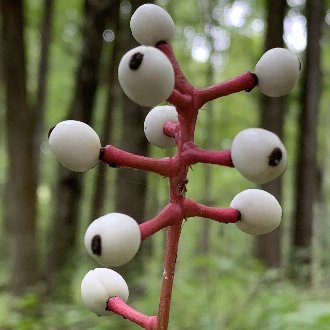 Fruit are fleshy and do not split open at maturity. Mature fruit are usually white, rarely magenta-red, and have a bold black spot. Photo © Holly Sanderson, CC BY 4.0. | 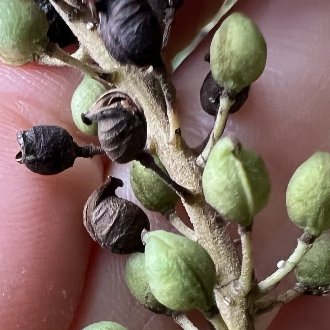 Fruit are dry and split open at maturity. Mature fruit are usually brown to blackish. Photo © Anne Parker, CC BY 4.0. |
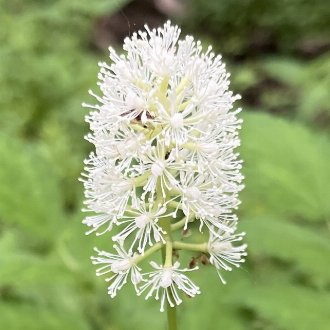 Inflorescence averages much smaller, and is usually a single, short cylinder of flowers. For at least some of the bloom period, all flowers are blooming at once. Plants bloom earlier on average (photo is from May in Ohio.) Photo © Christopher Zacharias, CC BY 4.0. | 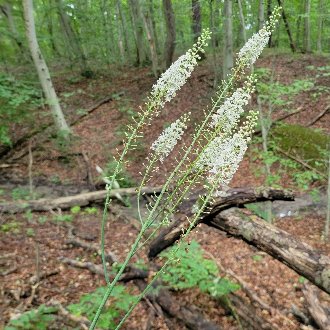 Inflorescence averages much larger, and is usually a collection of 4-9 wandlike branches, each of which has many flowers along its length. Flowers do not all bloom at once: upper buds will be unopened while lower flowers are finished blooming and beginning to form fruit. Plants bloom later on average and bloom period is longer (photo is from July in Ohio.) Photo © Elias, CC BY 4.0. |
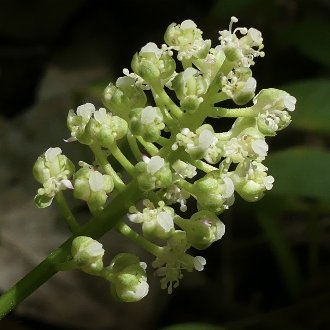 Flowerbuds remain green until opening, and when opening, green color of the sepals contrasts with white to cream-colored flower parts. Photo © Sue Carnahan, CC BY 4.0. | 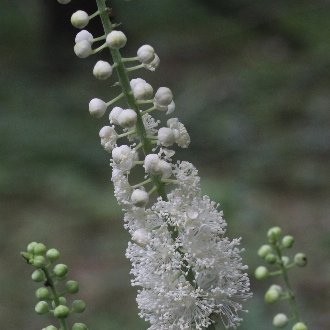 Unopened flowerbuds begin as green but often become white before opening. White buds are round and can superficially resemble A. pachypoda fruit, but they lack the bold black dot. Sepals on open flowers may be greenish but average a brighter white, closer in color to the flower parts, leading to a more uniform color when flowers open. Photo © odawgie, CC BY 4.0. |
References & External Resources
These short lists show only links helpful for ID. For a complete list of references and resources also covering other aspects of ecology, visit the links section of the full article on each plant, which is the first entry here.