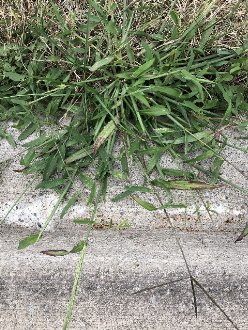

Hairy Crabgrass (Digitaria sanguinalis (L.) Scop.)
Also known as northern crab grass, common crabgrass, hairy finger-grass, large crabgrass, crab finger grass, purple crabgrass, crop grass.
↑Summary
An annual warm-season grass native to the Old World, introduced in North America as a food plant and now mostly as a lawn weed.
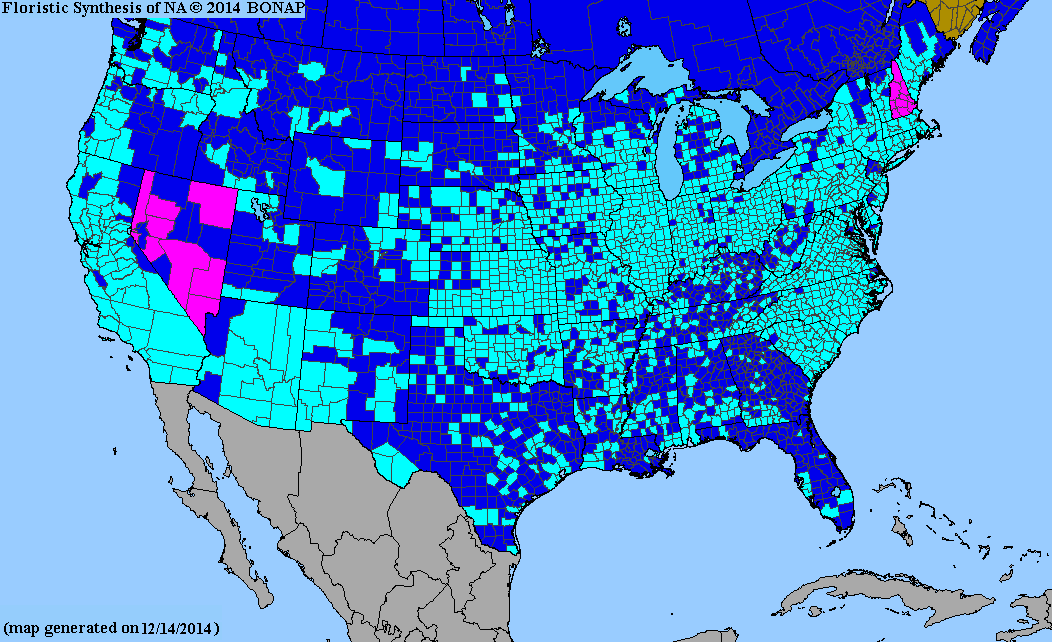
↑Range - Expand
| Legend | Color |
| Introduced | |
| Introduced or Not Present |
This tentative map is based on our own research. It may have limited data on Canada and/or Mexico, and there is some subjectivity in our assignment of plants as introduced vs. expanded. Read more in this blog post.
Although this plant occurs somewhere in each of these regions, it may only occur in a small part of some or all of them.
↑Habitat
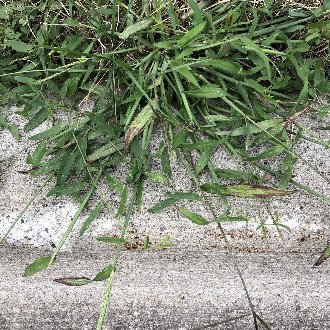
Hairy crabgrass grows in full to partial sun on sites where a disturbance has exposed soil and removed competing vegetation. It is most abundant in anthropogenic habitats, including lawns, gardens, cropland, roadsides, railroads, vacant lots, and waste areas, often growing in small cracks in cement or asphalt. It can occur in degraded natural areas including disturbed prairies and wetland margins, but in North America it is usually absent from intact wild areas.
↑Life Cycle
Hairy crabgrass is an annual warm-season grass with a short lifecycle. Upon sprouting, it establishes a fibrous root system and the stems usually sprawl horizontally. Occasionally, it will root at nodes.
The bloom period can last as long as 3 months, but plants and seeds mature rapidly, so not all plants are blooming at the same time. This can enable different cohorts of plants to colonize ephemeral habitat at different times in the same growing season.
Seeds usually exhibit dormancy and do not germinate until the subsequent growing condition, but under some circumstances, seeds can germinate immediately. Germination is typically triggered by a combination of exposure to moisture and warm temperatures, with germination most likely to be triggered when temperatures fluctuate between 68-86ºF (20-30ºC) and average about 77ºF (25ºC).
Seeds can persist long-term in the seed bank, and can still germinate after 10 years, but the seed viability is reduced to about 1%.
↑Faunal Associations
White-tailed deer consume the seedheads of this plant and can transport it to new sites in their droppings; although the viability of seeds is reduced to about 1 in 50, the large number of seeds consumed can make this still an effective distribution method. The seeds can also be carried by animal hair.
A number of insects eat the seeds, including the beetle Anisodactylus sanctaecrucis.
↑Control
Control of this species is difficult due to its short lifecycle. It has been documented resisting various herbicides, including ACCase-inhibitors, ALS inhibitors, PSII inhibitors such as triazine and atrazine, and EPSPS inhibitors such as glyphosate. Not all populations will resist all herbicides, although over time, the resistance is likely to increase as long as herbicides continue to be used.
When this species occurs as a weed in cropland, it can be managed through careful consideration of crop rotation, planting and seeding dates, and the use of cover crops to reduce exposed soil.
In lawns, hairy crabgrass can be reduced by practices that ensure a lush, full growth of vegetation in the lawn. Allowing grass to grow longer, but mowing it more regularly, using a height of 2.5-3 inches is often sufficient to keep this species out, as it cannot germinate under dense growth. Taking care to avoid mowing too low on convex curves in the lawn is important, as a flat mower can sometimes cut convex curves to a lower height. Avoiding overwatering can help, since frequent lawn irrigation can promote shallow-rooted grass which is more easily invaded by crabgrass.
It is also important to control spread of this species; it often colonizes new sites in lawns and gardens by riding on landscaping equipment. For professional landscapers who bring their equipment to multiple sites, taking care to blow and/or wash the equipment before leaving a site can greatly reduce spread.
In gardens, individual clumps of this species can be pulled by hand, but sustainable long-term prevention requires allowing plants to fill in all available space, and then minimizing soil disturbance. The use of groundcovers between taller plants can keep this species out, and the inclusion of native summer annuals occupying a similar niche can provide competition that makes it harder for crabgrass to establish.
↑Uses
Historically, this plant was cultivated as a grain, primarily by Slavic people in eastern Europe; in this use it is sometimes called Polish millet. It was brought to North America as a food plant. It is closely related to the cultivated grains raishan (Digitaria compacta), findi or white fonio (Digitaria exilis), and black fonio or iburu (Digitaria iburua), but unlike these other grains, its use has mostly been abandoned in modern times.
As a grain, it produces an unusually high yield, is easy to grow, matures quickly, and is exceptionally drought-tolerant. Because of the gradual ripening of its seed over a long period of time, it does not lend itself to mechanical harvest, and must be harvested by hand.
In parts of the world, it is used for animal feed and erosion control, and it has been studied as a biofuel.
↑Links & External Resources
• Digitaria sanguinalis (Common Crabgrass) | Illinois Wildflowers (About This Site)
• Digitaria sanguinalis (hairy crabgrass) | USDA PLANTS Database (About This Site)
• Digitaria sanguinalis | Go Botany (About This Site)
• Digitaria sanguinalis | Biota of North America Project (BONAP) (About This Site)
• Digitaria sanguinalis | NatureServe Explorer (About This Site)
• Digitaria sanguinalis | Flora of North America (About This Site)
• Hairy Crabgrass | Maryland Biodiversity Project (About This Site)
• Digitaria sanguinalis / ciliaris complex (Hairy Crabgrass, Big Crabgrass, Southern Crabgrass) | Digital Atlas of the Virginia Flora (About This Site)
• Digitaria sanguinalis (L.) Scop. (Northern Crabgrass) | Digital Atlas of the Virginia Flora (About This Site)
↑Photo gallery