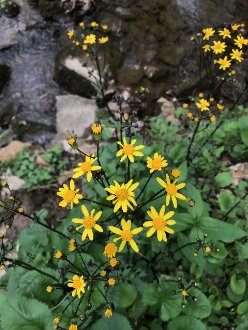

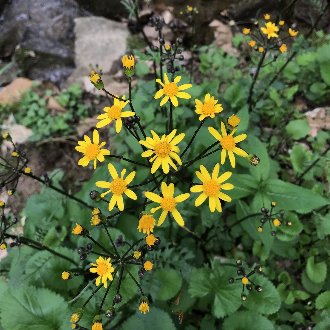
Golden Ragwort (Packera aurea (L.) Á. Löve & D. Löve)
Also classified as Senecio aureus.
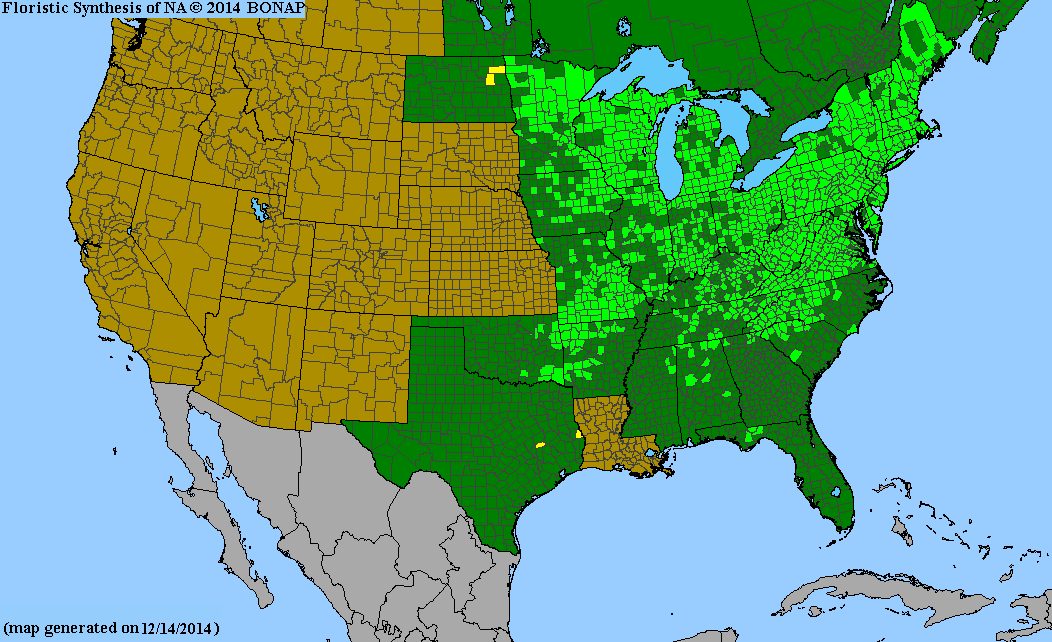
↑Range - Expand
| Legend | Color |
| Native | |
| Native or Not Present |
This tentative map is based on our own research. It may have limited data on Canada and/or Mexico, and there is some subjectivity in our assignment of plants as introduced vs. expanded. Read more in this blog post.
Although this plant occurs somewhere in each of these regions, it may only occur in a small part of some or all of them.
↑Similar Plants
↑Habitat
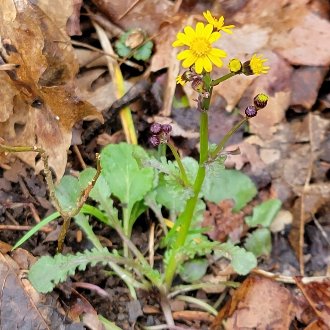
Golden ragwort is a generalist but with a preference for moist conditions and soils rich in calcium and/or magnesium. Natural habitats include floodplain forests, streambanks, wet meadows, mesic to dry-mesic upland forests, swamps, seeps, and fens. It is also frequent in anthropogenic habitats, including suburban gardens and small woodland fragments in urban and suburban areas.
It can be found in a wide range of lighting conditions, from full sun to shade under a closed canopy, but in sun it is limited to moist to wet conditions. In shade it ranges into mesic to dry-mesic conditions, especially on soils rich in organic matter that hold moisture well. In bottomlands it often occurs on rocky and sandy soils. It grows well both on slopes and in flat areas, but in sloped terrain it often prefers seeps and areas where local topography concentrates moisture. It has some tolerance to salinity, allowing it to occur in areas near the coast, as well as in areas with some runoff from road salt.
It can persist under taller perennial vegetation, especially when that vegetation is fully deciduous or otherwise lets through significant light during part of the growing season.
This species is common and abundant in much of its range, but humans have likely increased the habitat for it, as it readily adapts to habitat fragmentation, the mixture of rock and cement in with soil in urban and suburban areas, and the increased concentration of water in remaining areas of soil as water is shunted away from roads and buildings. It also has been widely planted as a native alternative to ivy and other non-native evergreen groundcovers.
↑Life Cycle
Golden ragwort is a semievergreen, often-rhizomatous, herbaceous perennial.
Plants do not usually bloom in their first year, usually growing only a single clump of basal leaves.
Plants begin blooming in their second year, blooming in mid-spring. Seeds mature quickly and are distributed usually by wind shortly thereafter. We found a number of gardening sources that mention that the seeds have an innate cold dormancy and require cold stratification to germinate, but we did not find any rigorous study establishing. Most species with seed distribution timing as early in the growing season as this one employ a flexible strategy where some seeds are able to germinate immediately, but others do not germinate until after cold dormancy.
Most established plants spread rhizomatously, with the rhizomes near the soil surface, and in this manner form vegetative colonies. However, some individual plants do not form rhizomes, which may be a function of genetics and not just conditions.
We found mention of this species' occurrence in seed banks, but could not find any information on its viability.
On most sites, reproduction is primarily vegetative and occurrence of seedlings is only occasional, serving to help this plant colonize new sites. Although some sources refer to this species as a short-lived perennial, large colonies can live for many years.
↑Uses
Golden ragwort is widely cultivated as a groundcover, and in much of its range, is one of the best-suited native plants for this purpose. Its use has soared recently as a replacement for non-native and potentially-invasive evergreen groundcovers such as english ivy (Hedera helix), common periwinkle (Vinca minor), winter creeper (Euonymus fortunei), and japanese pachysandra (Pachysandra terminalis).
In the garden, it is valued for its mostly-evergreen foliage, adaptability, showy flowers, and height which is low-growing enough to function as a groundcover, but tall enough to capture leaf litter and shade out most common lawn weeds. It also has good wildlife value, and does not climb or encroach on paths. In the heart of its range, it can be grown just about anywhere; on sunny, dry sites with poor soil, it needs mulching.
↑Links & External Resources
• Packera aurea (Golden Ragwort) | Illinois Wildflowers (About This Site)
• Packera aurea (Golden Ragwort) | USDA PLANTS Database (About This Site)
• Packera aurea | Go Botany (About This Site)
• Golden Ragwort | iNaturalist (About This Site)
• Packera aurea (Golden Ragwort) | Missouri Botanical Garden Plant Finder (About This Site)
• Packera aurea | Biota of North America Project (BONAP) (About This Site)
• Packera aurea | NatureServe Explorer (About This Site)
• Packera aurea | Flora of North America (About This Site)
• Packera aurea | Missouri Plants (About This Site)
• Golden Ragwort | Maryland Biodiversity Project (About This Site)
• Packera aurea (Golden Ragwort) | Minnesota Wildflowers (About This Site)
• Packera aurea (L.) A. & D. Love (Golden Ragwort, Heartleaf Ragwort) | Digital Atlas of the Virginia Flora (About This Site)
↑Photo gallery