
Yellow Buckeye (Aesculus flava Aiton)
Also known as common buckeye, sweet buckeye, big buckeye; also classified as Aesculus octandra Marshall.
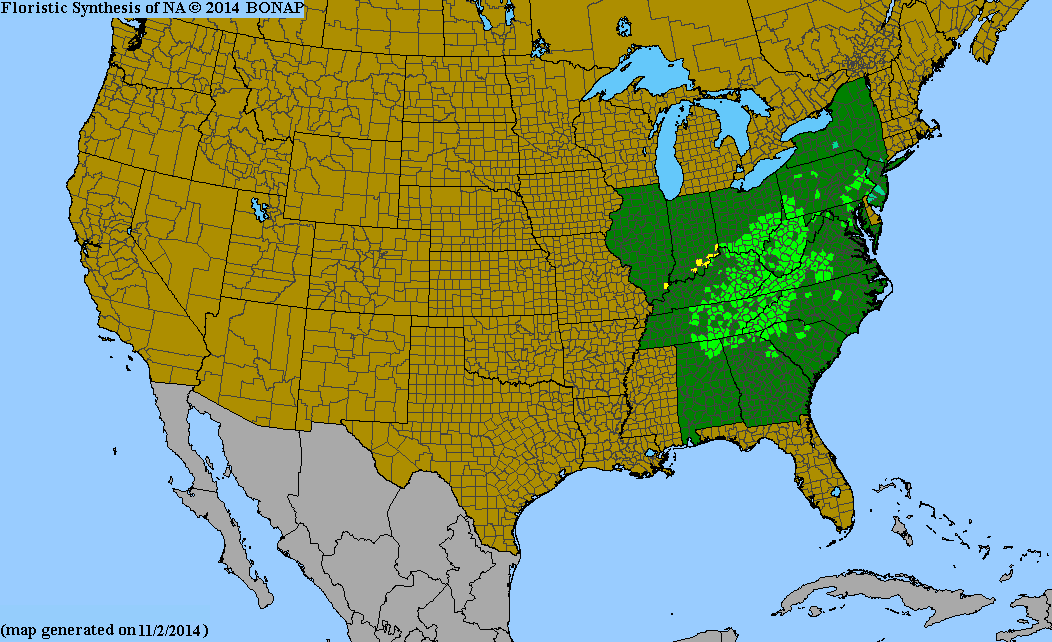
↑Range - Expand
| Legend | Color |
| Native or Expanded or Not Present | |
| Native or Expanded | |
| Expanded or Not Present | |
| Native | |
| Native or Not Present | |
| Expanded |
This map is based on our research. We have checked its accuracy to Level 3 ecoregions. Although this plant occurs somewhere in each of these regions, it may only occur in a small part of some or all of them.
This species is widely cultivated as an ornamental; it has escaped cultivation and established in the wild on a few sites in New York State and New Jersey, either contiguously with or not far from its native range.
↑Habitat
Yellow Buckeye is primarily found in late-successional growth of mixed mesophytic forests on sites with moist, deep, rich, well-drained soil. In the north of its range, Yellow Buckeye grows primarily in well-drained portions of bottomlands, whereas in the south of its range it grows primarily on mesic slopes in mountains, mostly in coves, canyons, and ravines. It can also occur in dry forests on calcareous soils.
Its soil pH preferences vary by elevation; at low to mid elevations, it is mostly limited to base-rich soils, but at high elevations it also occurs in acidic soils.
It is considered a climax species, is highly shade-tolerant, and often shares the canopy with other shade-tolerant trees such as sugar maple (Acer saccharum) and American basswood (Tilia americana). It also associates with American tuliptree (Liriodendron tulipifera), white ash (Fraxinus americana), and various oaks (Quercus sp.), although those species tend to occupy earlier-successional stages in its habitat.
This species is thought to have previously had a more extensive range extending farther north; its range was severely reduced by the Pleistocene glaciation, and it has not expanded back into its historic range due to glaciation permanently reducing its possible habitats. It is not fully known what limits this species' expansion beyond its relatively restricted range. Its large, heavy seeds limit the distances over which it can spread, so it cannot colonize new habitats separated from much distance from areas where it is already abundant. The limited distribution likely combines with it being particular about soil conditions to limit its expansion. It sometimes escapes from landscaping and has established sustaining wild populations in some regions.
↑Uses
The yellow buckeye is uncommonly used in landscaping, primarily as a shade tree, and it is probably underutilized for this purpose. It is valued for its showy flowers, and attractive fall color, and is generally easy to grow although not suitable for dry sites, especially those also exposed to wind.
It is usually avoided as a street tree because of its tendency to drop a lot of litter, including twigs and rather heavy fruit. It sometimes becomes unsightly, due to leaf blotch, spots, or scorch, powdery mildew, and anthracnose, and it also can develop major lacebug, bagworm, borer, or Japanese beetle infestations. These problems usually do not hurt the tree, although they can become more severe when it is planted on an unsuitably dry site.
The wood of this species is among of the softest and weakest of all North American deciduous trees, and is thus considered low quality and not usually used for lumber. It also decays easily. It is primarily used for pulpwood, but has minor uses in furniture boxes and crates. Burls are much more valuable and are used for specialty turned objects, electric guitar tops, and pen blanks.
↑Links & External Resources
• Aesculus flava (Yellow Buckeye) | USDA PLANTS Database (About This Site)
• Aesculus flava (Yellow Buckeye) | Missouri Botanical Garden Plant Finder (About This Site)
• Yellow Buckeye | Virginia Tech Dendrology Factsheets (About This Site)
• Aesculus flava | Biota of North America Project (BONAP) (About This Site)
• Aesculus flava | NatureServe Explorer (About This Site)
• yellow buckeye | Silvics of North America (About This Site)
• Aesculus flava Sol. | Plants of the World Online (POWO) (About This Site)
• Yellow Buckeye | Maryland Biodiversity Project (About This Site)
• Aesculus flava Ait. (Yellow Buckeye) | Digital Atlas of the Virginia Flora (About This Site)