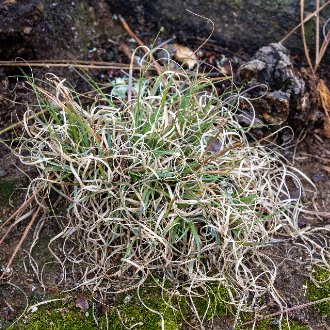

Poverty Oatgrass (Danthonia spicata (L.) P. Beauv. ex Roem. & Schult.)
Also known as poverty grass, poverty oats, poverty oat grass, curly grass, moonshine grass, curly dan.
↑Summary
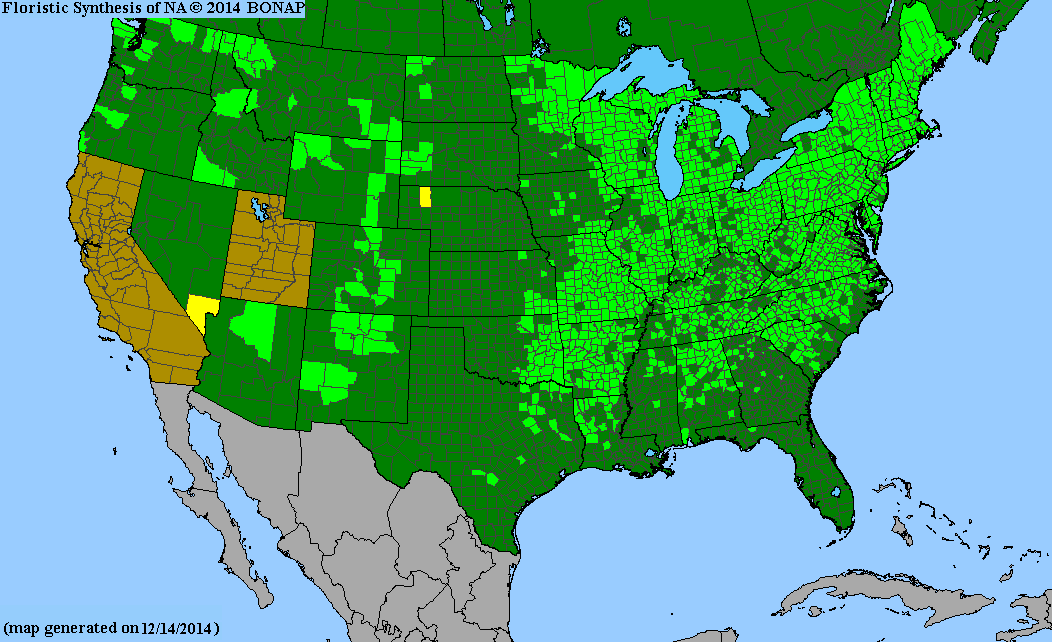
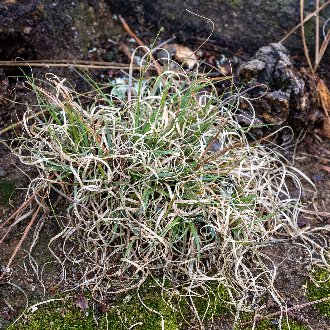
A low-growing cool-season perennial grass native throughout North America, favoring areas with dry, nutrient-poor soil.
↑Range - Expand
| Legend | Color |
| Native | |
| Native or Not Present |
This tentative map is based on our own research. It may have limited data on Canada and/or Mexico, and there is some subjectivity in our assignment of plants as introduced vs. expanded. Read more in this blog post.
Although this plant occurs somewhere in each of these regions, it may only occur in a small part of some or all of them.
↑Habitat
Danthonia spicata occurs in a wide variety of sunny to lightly wooded habitats where there are dry, low-fertility conditions in the surface soil. It is most common throughout eastern North America but it has scattered populations through the West as well, although it is absent from the drier portions of the continent; it requires drier sites but in a climate with a higher average rainfall. Natural habitats include sand and gravel prairies, clearings and margins in upland woods, rock outcroppings, and barrens, including both limestone, shale, and sandstone barrens. Anthropogenic habitats include dry portions of abandoned fields, overgrazed pastures, roadsides, parks, and anthropogenic woodland edges, and lawns and gardens, especially in areas where soil has been stripped and/or compacted.
It typically occurs where mineral soil is close to the surface, especially where it has been exposed by erosion, and the A horizon (organic-matter-enriched soil) over the minerals is thin. Favored mineral substrates include limestone, marble, sandstone, granite, shale, siltstone, clay, chert, and coarse sands. It is particularly common on sandy soil; on clay soils it is restricted to areas with good topographic drainage, as it requires good drainage.
It tolerates a wide range of soil pH, but is absent from both pH extremes; in the southeastern coastal plain where temperatures and rainfall are high and soils more acidic, it becomes less common and restricted to local pockets of more mineral-rich soils. Conversely, near its western range limits in the Great Plains where rainfall is lower and soil pH is higher, it becomes more limited to locally-acidic soils.
It occupies different successional states in different habitats: it is an early colonizer of coastal sandplains and abandoned pastures, whereas it is a secondary colonizer of forested sites disturbed by clearcutting or wildfire. It is eliminated from habitats when the tree canopy closes and only persists long-term where conditions, such as regular fire, erosion, or other disturbance, or rock outcroppings or other conditions maintain the high light levels.
Danthonia spicata can survive mowing and can grow in lawns, especially when the lawns are neither fertilized nor irrigated. It is competitive under conditions of low soil moisture and nutrient levels, and can become dominant on hilltops or sloped terrain where the soil has been mismanaged by years of removing leaf litter and any practices that strip topsoil. However it is outcompeted by other turfgrasses and broadleaf plants under richer conditions. In open parkland or gardens where the lower branches of trees have been removed by pruning, it often grows near the base of trees, although natural woodlands usually have too much shade at the base of trees to support its growth.
Humans have both destroyed habitat for this grass, and created new habitat for it. On many sites it is reliant on fire and it has been eliminated from many sites by fire suppression. However, it tends to benefit from soil mismanagement as it is favored by both erosion and soil compaction. In recent years, aggressive leaf-blowing has increased its prevalence in suburban areas. It also can benefit from roads, especially when the roadbed contains well-drained substrates such as gravel and sand that creates the dry, sunny, disturbed conditions it favors.
↑Life Cycle
Danthonia spicata is a short-lived, cool-season perennial grass that reproduces vegetatively by tillering, as well as by seed.
Seeds germinate when they are exposed to sun and mineral soil; an important factor in triggering germination is the large oscillation of day and nighttime temperatures, which is common when sun shines on bare mineral soil. Reliance on this mechanism prevents the seeds from germinating in richer, moister soil where the plants would likely be outcompeted by other vegetation.
Plants grow through the spring cool season. Established plants flower in late spring to summer; although most populations cross-pollinate, some populations in mountains are cleistogamous, producing flowers that do not open and only self-pollinate. Most first-year plants do not flower. Plants usually go dormant in summer, with longer dormancies in hot, dry summers and in the south of its range. In early fall, when temperatures cool, a second phase of growth begins.
This species alters its reproductive strategy situationally, allocating more energy to vegetative reproduction when growing in open conditions with sparse vegetation, and allocating greater energy to seed production when the forest canopy begins to close. This strategy is an adaptation to survive long-term after the population gets shaded out.
Seeds can persist for decades in the seed bank. On many sites, the original source population has long since vanished by the time the seeds germinate.
Fire top-kills plants, and entirely kills a portion of plants. However, fire can also create more open conditions favoring germination of seeds, and/or increased vegetative reproduction of surviving plants.
In most established populations, mortality occurs by shading as the canopy of trees and shrubs closes above it. Young plants germinating on unsuitable sites are frequently killed by competition, and can also be killed by flooding or waterlogging of soil when they germinate on too poorly-drained a site, as can happen during unusual dry spells.
The lifespan of this species has been studied and results are inconsistent, pointing to its lifespan likely varying considerably in different habitats. A study in a pine-hardwood forest in Michigan found a half-life of 2.2 years, meaning half the individuals die within 2.2 years, but its lifespan may be lower in more open habitats. On sites where its presence is dependent on fire, populations may persist for 20-30 years in the absence of fire before they are eliminated by a closed canopy.
↑Faunal Associations
The low growth habit of this grass, combined with the persistence of the dead leaves from the previous season, limits its attractiveness to large herbivores; these herbivores usually avoid it and will only browse it sparingly, early in the season, if little else is available.
The larvae of a few lepidoptera eat the foliage, including Leonard's skipper (Hesperia leonardus), the Indian skipper (Hesperia sassacus), and the brown Arctic (Oeneis chryxus). Grasshoppers also eat the foliage, including the sprinkled grasshopper (Chloealtis conspersa), green-striped grasshopper (Chortophaga viridifasciata), and the slant-faced pasture grasshopper (Orphulella speciosa). There is a specialist gall midge, the oat grass midge (Calamomyia danthoniae), that forms galls on this plant, and the leafhopper Laevicephalus melsheimerii has also been recorded eating this species.
↑Uses
Danthonia spicata has been explored in recent years as a turfgrass. It has the advantages of being exceptionally drought-tolerant, thriving without irrigation or fertilizer, and staying healthy even in drought. Its curly foliage is also attractive and distinctive. It also has the massive benefit of requiring only minimal mowing to maintain at typical lawn height, in some conditions as little as twice a season.
Its use as a turfgrass is limited by its intolerance of moist and/or poorly-drained conditions, and its lack of competitiveness in mesic and/or rich conditions. If planted in moist, poorly-drained conditions it will die, and if planted in mesic and/or rich conditions, it will be outcompeted by other turfgrasses. Most lawns, especially those on soils with a significant clay content, have a variety of moisture conditions and will have some spots unsuitable for this species, even if much of the yard is ideal for it.
Danthonia spicata can also be grown as an ornamental bunchgrass, where it is valued for its delicate seedhead, its tolerance of harsh sites where moisture and/or nutrients are too sparse for most plants, and its ability to coexist with other plants without choking them out.
↑Related Plants
There are numerous Danthonia species native to North America, and one introduced species. The genus is native to both North and South America and Europe. The relationships between the species are not clear.
This species overlaps with different native members of its genus in different regions: in the southeast the main overlap is with downy danthonia (Danthonia sericea); in the northeast and higher elevations of the southern appalachians, the overlap is with flattened oatgrass (Danthonia compressa). In the west there is overlap with onespike danthonia (Danthonia unispicata), timber oatgrass (Danthonia intermedia), and california oatgrass (Danthonia californica), and, only in the mountain west, there is overlap with parry's oatgrass (Danthonia parryi). There are also small areas of overlap in isolated parts of the West Coast, with common heathgrass (Danthonia decumbens).
↑Links & External Resources
• Poverty Oatgrass | Fire Effects Information System (FEIS) (About This Site)
• Danthonia spicata (Poverty Oat Grass) | Illinois Wildflowers (About This Site)
• Danthonia spicata (Poverty Oatgrass) | USDA PLANTS Database (About This Site)
• Danthonia spicata | Go Botany (About This Site)
• Poverty Oatgrass | iNaturalist (About This Site)
• Danthonia spicata | Biota of North America Project (BONAP) (About This Site)
• Danthonia spicata | NatureServe Explorer (About This Site)
• Danthonia spicata | Flora of North America (About This Site)
• Danthonia spicata | Missouri Plants (About This Site)
• Poverty Oatgrass | Maryland Biodiversity Project (About This Site)
• Danthonia spicata (L.) Beauv. ex Roemer & J.A. Schultes (Poverty Oatgrass) | Digital Atlas of the Virginia Flora (About This Site)
↑Photo gallery