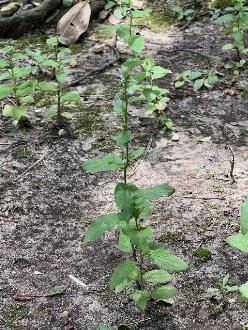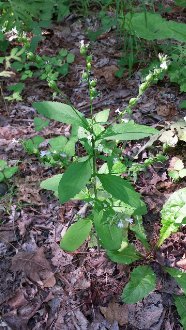

Inflated Lobelia (Lobelia inflata L.)
Also known as bladder-pod lobelia, Indian Tobacco, Indian-tobacco.
↑Summary
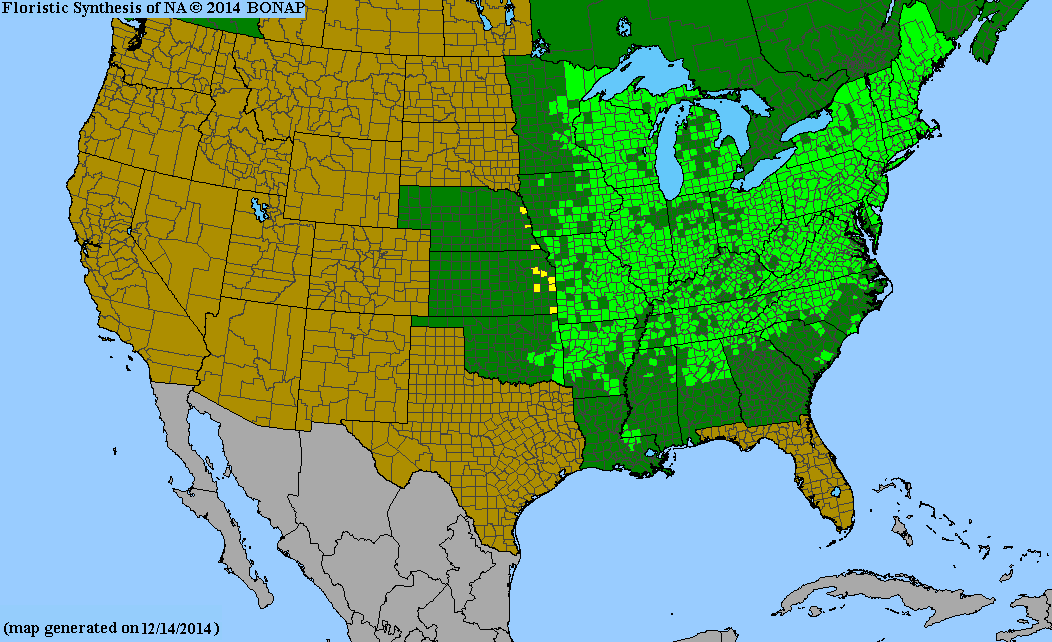
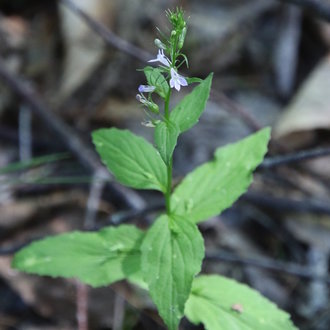
A usually-annual plant native to Eastern North America, an opportunistic generalist of disturbed, partly-shaded habitats.
↑Range - Expand
| Legend | Color |
| Native | |
| Native or Not Present |
This tentative map is based on our own research. It may have limited data on Canada and/or Mexico, and there is some subjectivity in our assignment of plants as introduced vs. expanded. Read more in this blog post.
Although this plant occurs somewhere in each of these regions, it may only occur in a small part of some or all of them.
↑Description & Identification
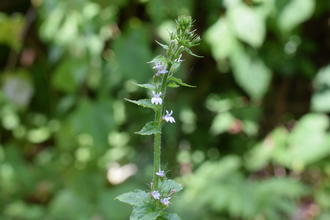
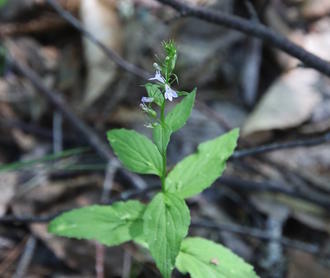
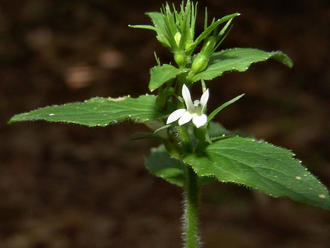
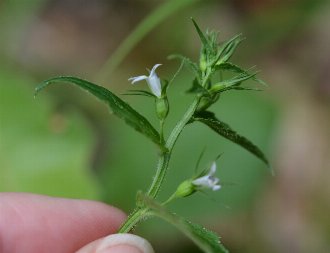
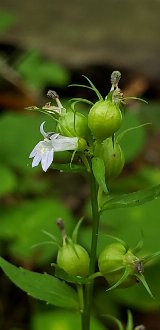
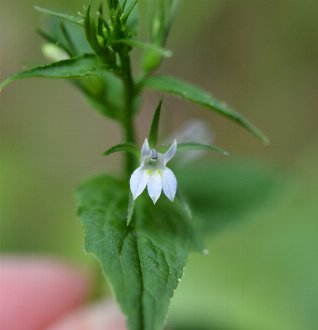
In bloom, Lobelia inflata is usually easily identified due to the distinctive shape of its flowers identifying it as a Lobelia, but the flowers being smaller than all other members of this genus that overlap with it in range.
↑Similar Plants
↑Habitat
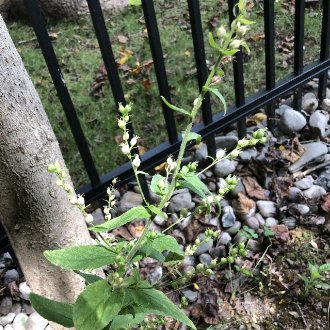
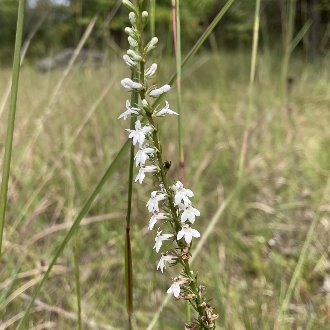
Lobelia inflata is a generalist that occurs in a wide range of disturbed habitats. Natural habitats include shorelines of rivers or lakes, open deciduous woodlands, savannas, cliffs, ledges, or balds, and partly-shaded seeps. It is often more common in anthropogenic habitats, including woodlands paths, powerline clearances through forests, pastures, cropland, lawns, and gardens. Its habitats are often ephemeral and its abundance on a particular site may vary greatly from year to year.
In most of its range, it prefers partial sun, but in the north it ranges into full sun as well. It is found in a wide range of moisture conditions, usually from moist to dry-mesic, but in the south of its range it becomes more restricted to mesic conditions.
It tolerates nutrient-poor soil and a range of soil textures including loam, clay-loam, and rocky soils, but is less tolerant of sandy soils.
On most sites it relies on small-scale disturbance that exposes soil and removes competing vegetation, in order to establish. In forests, it usually only occurs where larger-scale disturbance has opened up some of the canopy. Along shores, it often occurs where flood-scouring or declining water levels have exposed bare soil.
Humans have likely increased the habitat for this species through a combination of creating more partly-sunny sites, and an increase in soil disturbance including mowing, weedwhacking, and weeding of gardens. Human-induced deer overpopulation may also favor this plant, as it resists deer browsing and benefits from the increased light and disturbance in deer-overbrowsed habitats.
This plant can sometimes survive in lawns, although it is not ideally suited to doing so. Rosettes can survive indefinitely even with regular mowing, but mowing will remove flowering stems, so this plant reproduces best in lawns where the mowing is sporadic during the late part of the growing season when it is flowering and setting seed.
↑Life Cycle
Lobelia inflata is an annual, biennial, or rarely, monocarpic perennial. Although many sources describe it only as a summer annual, its lifecycle is flexible. Most individuals live as a summer annual, especially in the north of its range, but some individuals exhibit other timing, especially in the south of its range and during mild winters.
Seed germination is flexible and probabilistic. A study by Baskin & Baskin (1992) found germination only occurs when exposed to light, and is more likely in warm temperatures. Some germination occurs when daily temperatures oscillate between about 43ºF (6ºC) at night and 59ºF (15ºC) during the day, but germination rates are much higher at warmer temperatures. These temperatures can occur during warm spells in winter in the southern portion of this plant's range, whereas in the north. Even in warm weather and when exposed to suitable conditions, some seeds will not germinate. This flexibility leads some seeds to persist long-term in the seed bank.
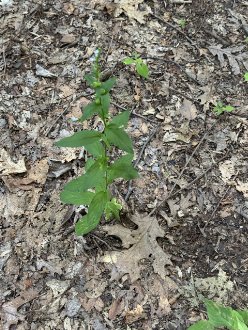
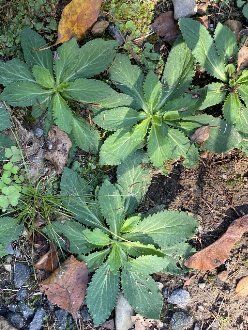
Plants initially grow as a rosette, with leaves pressed flat against the ground. In this stage, plants are highly resistant to frost and cold.
During the warm part of the growing season, plants bolt, growing upright and begin flowering and producing seed. Different individuals thus can spend different portions of their life as a rosette; plants germinating in late spring or early summer may grow upright almost immediately, whereas ones germinating in late summer or fall may spend over half their lives as a rosette. Rarely, plants will grow through the entire growing season as a rosette, delaying bolting until a later year.
Plants usually flower some time from mid-summer into fall. The timing of bolting, flowering, and seed production varies considerably even on plants from the same population growing on the same site. This variability of timing was proposed by Simons and Johnston (2003) as a "conservative bet‐hedging strategy" to allow the plant to adapt to the unpredictable growing season lengths in its range.
Hughes & Simons, (2014) conducted experimental manipulations of this species and recorded that plants also grow differently in response to the time bolting is initiated. Plants that bolt earlier tend to branch less and produce flowers and seeds more sequentially, spread over a longer period of time, whereas plants that bolt later produce more-branched inflorescences with more simultaneous flowering and seed production.
Plants in the flowering and seed production phase are typically killed entirely by frost.
↑Faunal Associations
The foliage is toxic to mammals and avoided by them.
The flowers attract primarily halictid bees, and among them are typically only accessible to the smaller halictid bees.
We could not find information on any other animals supported by this plant.
↑Notes
We prefer the rarely-used common name "Inflated Lobelia" because it is more descriptive, with "inflated" being a literal translation of the scientific epithet inflata.
The widely-used common name "Indian Tobacco" is misleading as this species is not closely related to the true tobaccos (Nicotiana sp.) and furthermore the common name "Indian tobacco" is also used to refer to Indian tobacco (Nicotiana quadrivalvis). In addition the term "Indian" refers to the older term to reference Native Americans, which is ambiguous in the world of plants as there are also plants on this continent that originated in India.
↑Links & External Resources
• Lobelia inflata (Indian Tobacco) | Illinois Wildflowers (About This Site)
• Lobelia inflata (Indian Tobacco) | USDA PLANTS Database (About This Site)
• Lobelia inflata | Go Botany (About This Site)
• Lobelia inflata | Biota of North America Project (BONAP) (About This Site)
• Lobelia inflata | NatureServe Explorer (About This Site)
• Lobelia inflata | Missouri Plants (About This Site)
• Indian-tobacco | Maryland Biodiversity Project (About This Site)
• Lobelia inflata (Indian Tobacco) | Minnesota Wildflowers (About This Site)
• Lobelia inflata L. (Indian Tobacco) | Digital Atlas of the Virginia Flora (About This Site)
↑Photo gallery