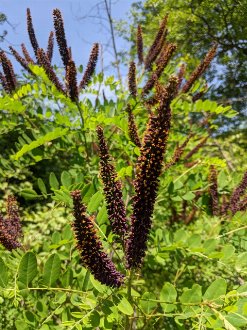

False Indigo Bush (Amorpha fruticosa L.)
Also known as desert false indigo, indigobush.
↑Summary
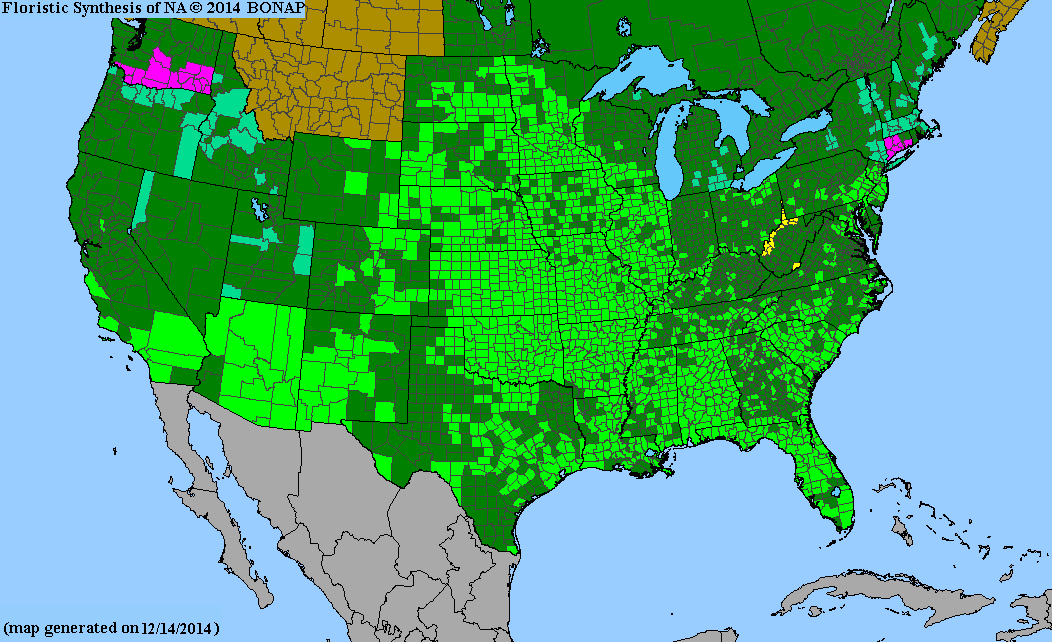
A shrub native across the southern and central U.S, expanding its range northward.
↑Range - Expand
| Legend | Color |
| Native | |
| Expanded | |
| Native or Not Present | |
| Native or Expanded | |
| Expanded or Not Present | |
| Native or Expanded or Not Present |
This tentative map is based on our own research. It may have limited data on Canada and/or Mexico, and there is some subjectivity in our assignment of plants as introduced vs. expanded. Read more in this blog post.
Although this plant occurs somewhere in each of these regions, it may only occur in a small part of some or all of them.
This species is occasionally planted in landscaping and less commonly in ecological restoration projects. Although it does escape from such use, it is also spreading on its own, taking advantage of humans creating more open and disturbed habitats in bottomlands. It has widely expanded north of its native range, either contiguously with its native range or separated by only short distances.
↑Habitat
False indigo bush is mostly found in moist bottomlands and wetland margins, especially on sites exposed to more sun. Natural habitats include open floodplain forests, wet prairies, and shores of lakes, rivers, streams, and marshes. Anthropogenic habitats include low, wet areas along roadsides, railroads, and in industrial areas, and piers and walls along rivers and lake shores.
It occurs in wet to moist conditions and tolerates temporary flooding, but is absent from areas with persistent standing water. It tolerates drought stress better than most plants that prefer wet to moist conditions. It tolerates a variety of soil types and textures, but is more common on sites with low nitrogen availability. It tolerates a wide range of soil acidity including alkaline to moderately acidic (5.0-8.5.) It tolerates some salinity and can grow along the more inland portions of tidal estuaries, but is absent from areas closer to the ocean. Its salt tolerance enables it to grow in ditches along roads where salt is used.
On sites with richer and deeper soils, it relies on vegetation-removing disturbance to establish, and will be eliminated as a tree canopy closes over it. Established plants tolerate some shade but it prefers full to mostly-sunny exposures. In the humid East, where it is usually uncommon and scattered, it only persists long-term on sites with some sort of adverse soil conditions that it tolerates more than other plants, such as rocks or cement along a shoreline where the conditions alternate between flooded and very dry. In the Central US and parts of the south where it is more abundant, it can persist longer on a wider variety of sites.
Humans have decreased the habitat for this species in much of its range through the destruction of wetlands and conversion of wet prairies to agriculture, but have also created new habitats for it and contributed to it expanding greatly beyond its native range through planting it in landscaping, and modification of shorelines by removing dense vegetation that would shade it out and creating more open structures that favor it.
↑Life Cycle
False indigo bush is a long-lived, thicket-forming shrub that can reproduce both by seed and vegetatively. Its growth habit and method of spread varies considerably by site.
Established plants will often send up new stems from lateral roots, where those roots are exposed to sufficient sunlight, forming dense thickets on favorable sites. These roots and new stems can also help this plant adapt to long-term changes in water levels, moving either to drier or wetter ground as water levels rise or fall, respectively. Young plants typically lack the ability to do this and can be killed by smaller changes in water levels.
We found conflicting information on its lifespan. Some sites claimed a lifespan as long as 200 years which could be possible, but the source of these claims was not clear. This species can survive at least 25 years on anthropogenic sites. It likely is longer-lived on sites where harsher soil conditions favor it over other plants, and shorter-lived on disturbed sites that it colonizes only temporarily and where richer soils accumulate. The lifespan of individual stems can be much shorter than the lifespan of the plant as a whole.
Mortality can occur through long-term inundation or shading from a closed canopy of taller trees. Due to its drought-tolerance, this species is usually not killed by drought, but rather, out-competed by taller and more shade-tolerant vegetation that establishes if long-term drought removes the temporary waterlogging that favors this plant over other vegetation.
↑Control
In most of its range in North America, this species is native and can even be threatened and declining in places, and thus does not need to be controlled and may benefit from being encouraged.
However, it has become invasive in several places outside its native range. It is widely agreed to be invasive in Europe. It is also considered invasive in Washington and Oregon, which are disconnected from its native range. There are also introduced populations in Nevada and Utah, although it is not considered invasive there. It is sometimes considered invasive in Maine, Michigan, New Hampshire, Connecticut, Rhode Island, and New Jersey, but these classifications are controversial. FSUS classifies it as "maybe exotic" in New Jersey, but the designation of exotic does not imply invasiveness.
Removal of this species can be difficult where it is invasive because it tends to occur along hard-to-access areas of coastline, and when it grows in urban areas out of cracks in walls, it can be hard to remove without causing damage. The most important aspect of control is prevention: not planting it outside its native range and removing it from landscaping where it occurs, especially in areas where it is known to become invasive. It can remain in the seed bank for a long time, so taking care to avoid removing vegetation and disturbing soil along shorelines and in bottomlands where it is present because it relies on such disturbance to establish. Intact riparian vegetation can prevent its germination.
↑Uses
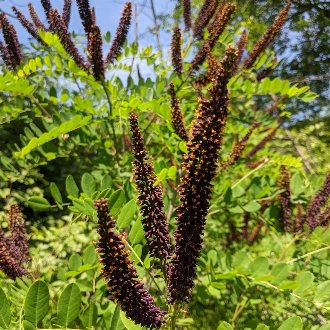
Occasionally used in landscaping, where it is valued for relatively small size, tolerance of a wide range of soil and moisture conditions, and its unique deep-purple flowers which often attract butterflies. Its use is sometimes limited by its tendency to form thickets, reproducing aggressively both vegetatively and by seed.
Within and adjacent to its native range, it can also be used for ecological restoration, including erosion control along shorelines, and reclamation of acid mine spoils, especially where these spoils reach into riparian areas and bottomlands that this species favors.
↑Notes
This species is considered invasive in many parts of the world, including primarily Europe and Asia, and also parts of South America. It has the potential to alter succession trajectories, particularly in bottomlands.
In North America, although it has expanded far beyond its native range, the insects that eat it have also expanded with it, and it does not dominate or form large monocultures, and it does not seem to pose any ecological threats in the new areas it has colonized.
↑Links & External Resources
• Amorpha fruticosa (False Indigo) | Illinois Wildflowers (About This Site)
• Amorpha fruticosa (False Indigo Bush) | USDA PLANTS Database (About This Site)
• Amorpha fruticosa | Go Botany (About This Site)
• Amorpha fruticosa (False Indigo) | Missouri Botanical Garden Plant Finder (About This Site)
• Desert False Indigo | Virginia Tech Dendrology Factsheets (About This Site)
• Amorpha fruticosa | Biota of North America Project (BONAP) (About This Site)
• Amorpha fruticosa | NatureServe Explorer (About This Site)
• Amorpha fruticosa | Missouri Plants (About This Site)
• False Indigo Bush | Maryland Biodiversity Project (About This Site)
• Amorpha fruticosa (False Indigo) | Minnesota Wildflowers (About This Site)
• Amorpha fruticosa L. (False Indigo-bush, Tall Indigo-bush) | Digital Atlas of the Virginia Flora (About This Site)
↑Photo gallery