
Southeastern Poison Oak (Toxicodendron pubescens) vs Eastern Poison Ivy (Toxicodendron radicans)
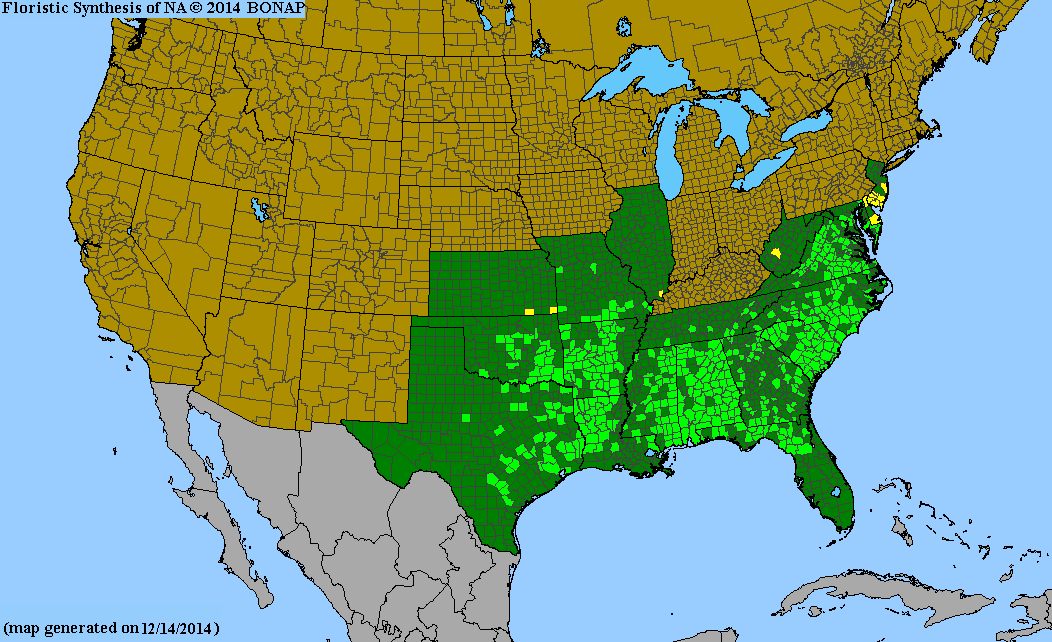
These species are visually similar and both have highly variable leaf shapes. The range of T. radicans contains nearly the entire range of T. pubescens. They can usually be easily distinguished by differences in growth habit and leaf shape. T. radicans ranges farther north and west, tolerates greater shade, and ranges into moister habitats with richer soil, and is common and abundant in much of its range. T. pubescens is more tolerant of dry, rocky or sandy soils and is more restricted these habitats, and is less abundant in much of its range.
Southeastern Poison Oak (Toxicodendron pubescens) | Eastern Poison Ivy (Toxicodendron radicans) |
A low-growing, rhizomatous shrub favoring dry, infertile soils, native to the southeastern to south-central US. | A perennial woody vine that can cause a dangerous allergic reaction following contact with its sap. Widespread and abundant in much of its range, and highly variable in appearance. |
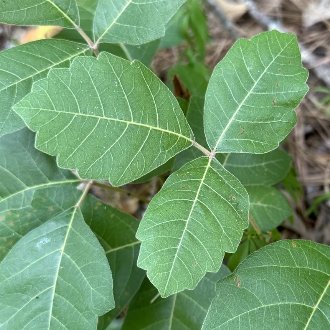 Leaflets are more blunt-tipped, making either an obtuse, or broader acute angle. Leaflets are never long-acuminate. Lobes, if present, also tend to be more blunt-tipped. Photo © Ashwin Srinivasan, CC BY 4.0. | 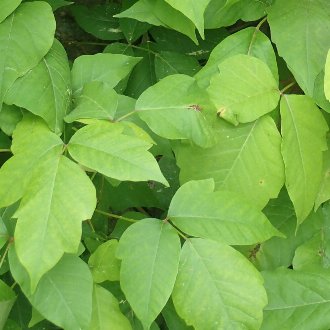 Leaflets are sharper-tipped, often making a narrower acute angle, and are sometimes long-acuminate, tapering to a long, narrow point. Lobes, if present, make narrower angles and may also taper to a point. Photo © John Baur, CC BY 4.0. |
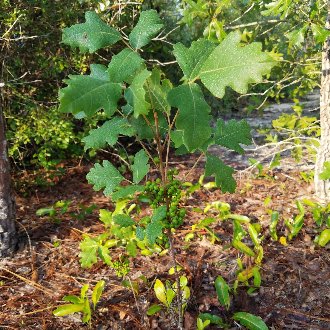 Plants grow as a small shrub, supporting their own weight and not climbing. Photo © Leila Dasher, CC BY 4.0. | 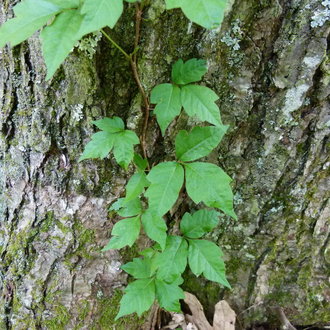 Plants may grow as a small shrub, but often climb using aerial rootlets. Photo © botanygirl (iNaturalist), CC BY 4.0. |
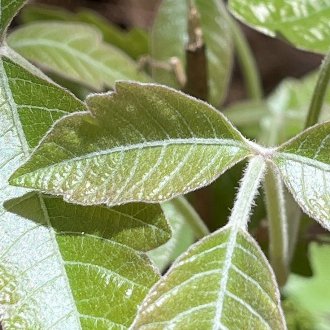 Young leaves are densely covered in fine hairs throughout, initially looking velvety. Hairs wear off or become less visible on mature leaves. Photo © ian bullock, CC BY 4.0. | 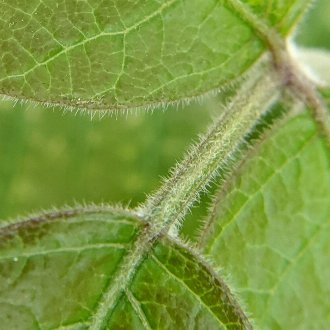 Hairs on young leaves are sparser, but tend to be longer, and are more concentrated along veins and leaf margins. Hairs similarly become less visible on mature leaves. Photo © Adam Kranz, Public Domain. |
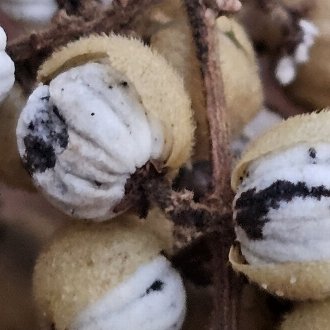 Surface of fruit is consistently pubescent (covered in hairs) and hairs are longer. Photo © Daniel Washburn, CC BY 4.0. | 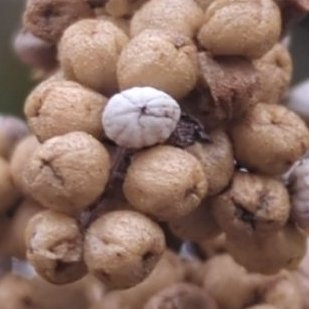 Surface of fruit may be pappilose (covered in short, rounded bumps), scabrous (rough from short, stiff hairs) or puberulent (covered in fine, short hairs) so hairs, if present, are shorter. Photo © Tom Field, CC BY 4.0. |
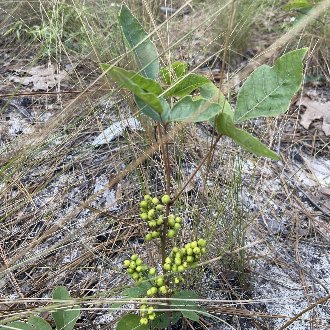 Restricted to dry habitats, usually with soils of low-fertility such as sandy and/or rocky soils, where vegetation is sparse and sunlight is greater. Photo © Scott Ward, CC BY 4.0. | 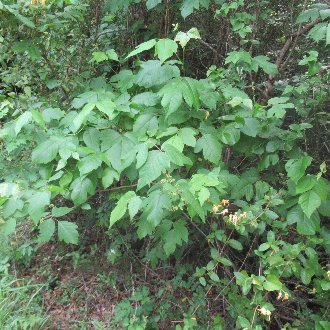 Found in a wider range of habitats, and ranges into richer, moister habitats with more shade. Photo © Linda Jo Conn, CC BY 4.0. |
Additional Notes
WARNING: Both of these species contain urushiol, which can cause a delayed, often severe, contact dermatitis. Avoid touching them, and if you come into contact with the sap, make sure to wash quickly and thoroughly.Although these species can sometimes be told apart by looking at a single leaf, the range of variability among leaf shape in both species is high. It may be necessary to look at many leaves from each species before seeing which aspects of leaf shape are reliable for ID. The number or location of lobes or teeth on the leaf margin is not reliable.
Both species are relatively indifferent to soil chemistry and their habitat differences are driven mainly by moisture availability and light. T. radicans is the more generalist of the two species and is also more abundant in its range, and is more likely to occur in typical habitat of T. pubescens than vice-versa. The two species are more likely to grow side-by-side in habitats where dry, open areas supporting T. pubescens border lower, richer, moister areas where T. radicans occurs.
North and west of its range, T. pubescens becomes replaced by western poison ivy (Toxicodendron rydbergii), which is ecologically similar as a shrub that prefers drier conditions than T. radicans.
References & External Resources
These short lists show only links helpful for ID. For a complete list of references and resources also covering other aspects of ecology, visit the links section of the full article on each plant, which is the first entry here.