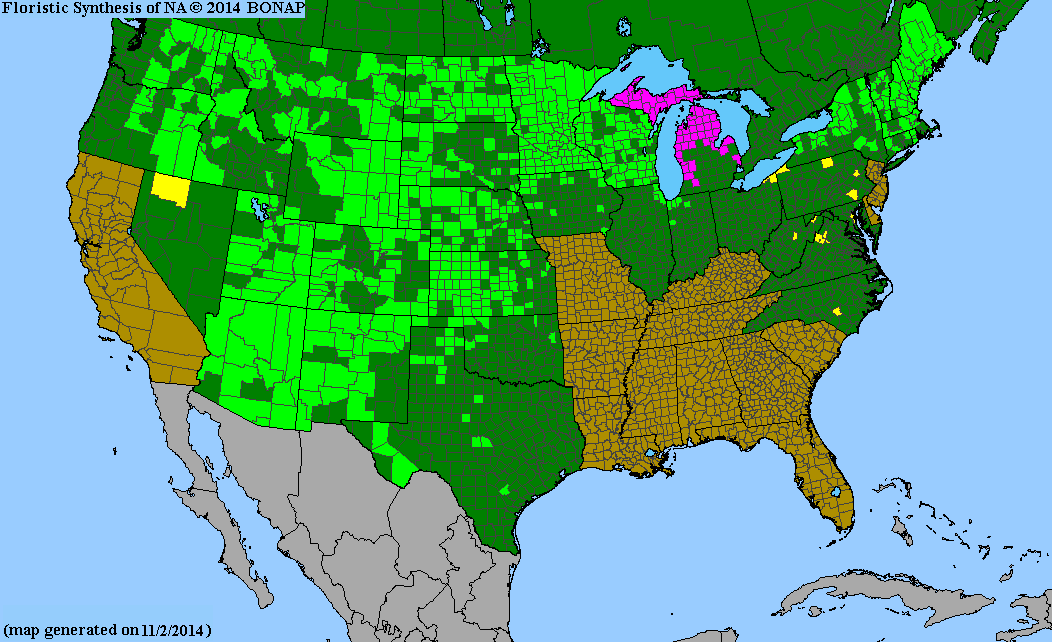

Eastern Poison Ivy (Toxicodendron radicans) vs Western Poison Ivy (Toxicodendron rydbergii)
These two species are visually similar and have significant range overlap in eastern Canada and the north and central US. Vining plants or ones with aerial rootlets are easily identified as T. radicans, which averages hairier and with slightly larger fruit. T. radicans ranges farther southeast, to lower elevations, and into shadier habitats, and is found in a wide range of moisture conditions and soil pH. T. rydbergii ranges farther west and north, is more restricted to higher elevations and open habitats. In the overlap zone, T. rydbergii prefers rocky, usually acidic soils and drier conditions, although deeper in the arid west it is restricted to richer soil in ravines and canyons.
Eastern Poison Ivy (Toxicodendron radicans) | Western Poison Ivy (Toxicodendron rydbergii) |
A perennial woody vine that can cause a dangerous allergic reaction following contact with its sap. Widespread and abundant in much of its range, and highly variable in appearance. | A rhizomatous shrub native to the interior West and North of North America that can cause a dangerous allergic reaction upon contact with its sap. |
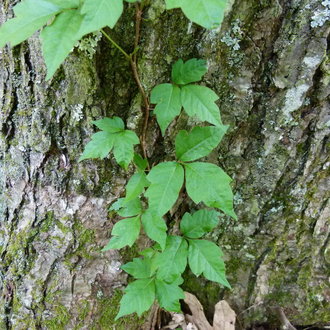 Although it can grow as a free-standing shrub, often grows as a vine that climbs by aerial rootlets that attach to surfaces, or by twining around other vegetation. Photo © botanygirl (iNaturalist), CC BY 4.0. | 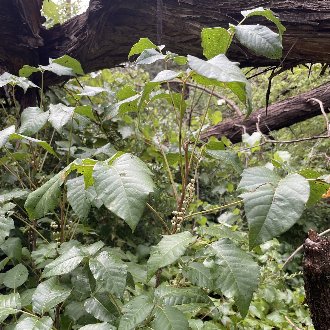 Only grows as a free-standing shrub. Does not climb other vegetation and does not form aerial rootlets, although it may lean on or prop itself up against rock faces or other flat objects. Photo © colinpena, CC BY 4.0. |
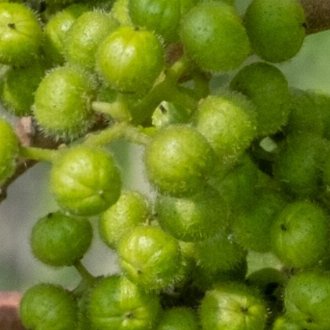 Surface of fruit is either pappilose (covered in short, rounded bumps), scabrous (rough from short, stiff hairs) or puberulent (covered in fine, short hairs). Hairs are often more visible when fruit is unripe. Fruits average smaller (2.5-5.5mm) although with much overlap. Some populations tend to have larger fruit. Photo © Alex Abair, CC BY 4.0. | 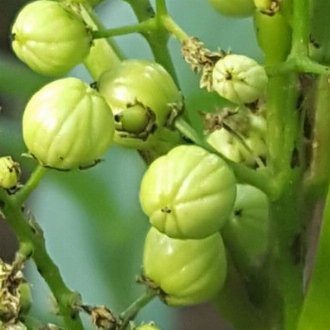 Fruit is hairless and smooth, even when unripe. Fruits average larger (4-7mm, rarely as small as 3mm) although with much overlap. Some populations tend to have smaller fruit. Photo © Alex Abair, CC BY 4.0. |
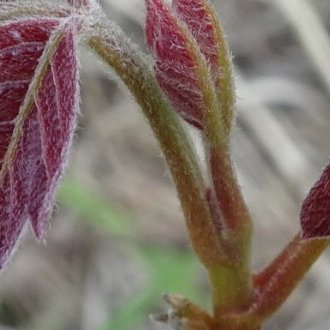 Especially on T. radicans var. negundo, the variety most likely to overlap with T. rydbergii, the petiole (stem connecting the leaf to the twig) is pubescent, although hairs may be very fine and require a close view to see. Foliage also averages hairier. Photo © Thomas Koffel, CC BY 4.0. | 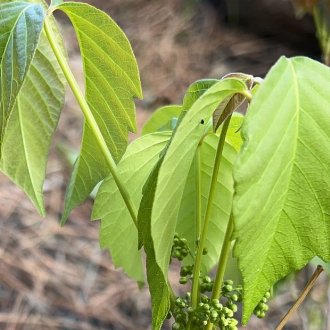 Petioles are either completely hairless or nearly so. Foliage also averages less hairy and often looks hairless or nearly so. Photo © Jesse, CC BY 4.0. |
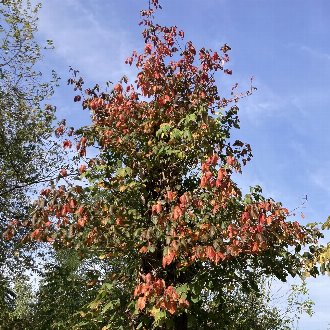 Climbing plants can reach canopy height (to 45m or 150ft). Free-standing plants reach similar heights of 1m (3ft), rarely taller. Photo © Jenn E., CC BY 4.0. | 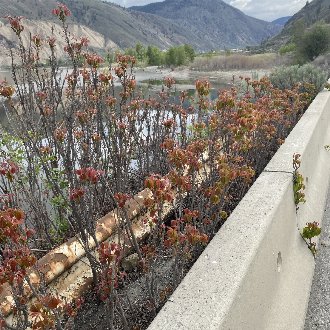 Plants usually grow only up 1m (~3ft) tall, rarely to 3m (~10 ft). Photo © Z, CC BY 4.0. |
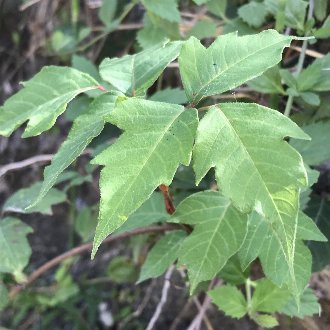 Although many leaflets have only shallow lobing or even none, leaflets are more likely to have deep lobing. Photo © Ryan Donnelly, CC BY 4.0. | 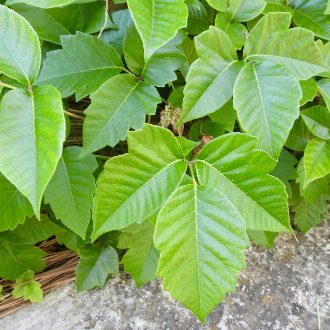 Although lobing is still variable, lobing averages shallower and the deepest-lobed leaflets are still more shallowly-lobed. Photo © Bob Nieman, CC BY 4.0. |
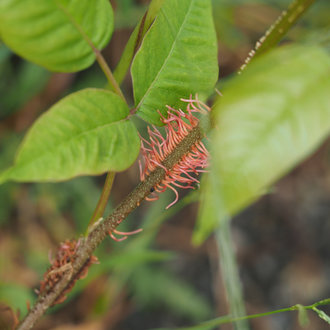 Even non-climbing plants or non-climbing portions of plants may produce aerial rootlets. Not all plants produce aerial rootlets. Photo © mefisher, Public Domain. | 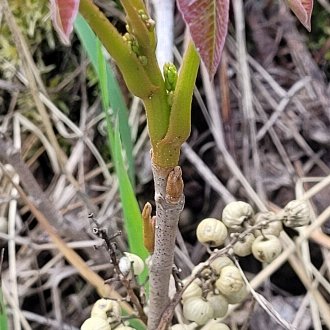 Plants never produce aerial rootlets. Photo © Leanne Stacy Reitan, Public Domain. |
Additional Notes
The common name descriptors "eastern" and "western" on these species can be misleading: T. radicans ranges farther west than most "eastern" species, well into the drier portions of the Great Plains, West Texas, and even southern Arizona. Similarly, T. rydbergii, at least in the north, ranges the entire way east to the Atlantic coast. In much of the range overlap, it is useful to think of T. radicans as the more southerly species and T. rydbergii as the more northerly one. As one would expect with this labeling, T. radicans favors lower elevations than T. rydbergii.There is an asymmetry in these species in that it is easier to identify a plant definitively as T. radicans than as T. rydbergii. However, in most of the range overlap, the variety T. radicans var. negundo is most likely to overlap with T. rydbergii, and this species both is more likely to have deep lobing and pubescent petioles.
Although T. rydbergii is rare near the southeastern limits of its range, it has been reported in the mountains of WV and VA, and the PA Piedmont, and it is possible that it is under-reported due to the difficulty of identifying it.
Southeast of where T. rydbergii occurs, it is replaced by southeastern poison oak (Toxicodendron pubescens) which occupies a similar niche of a non-vining rhizomatous shrub that inhabits dry uplands. There is almost no overlap between these two species and a large gap between their ranges in which only T. radicans occurs.
References & External Resources
These short lists show only links helpful for ID. For a complete list of references and resources also covering other aspects of ecology, visit the links section of the full article on each plant, which is the first entry here.