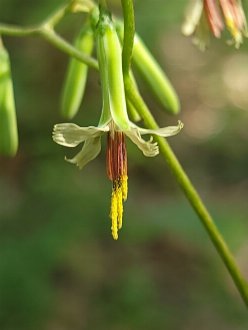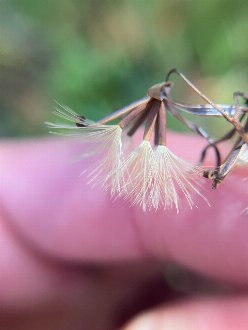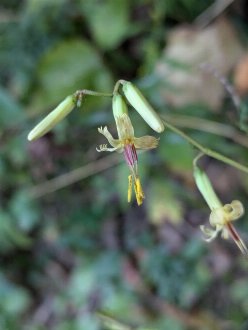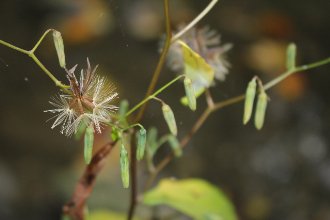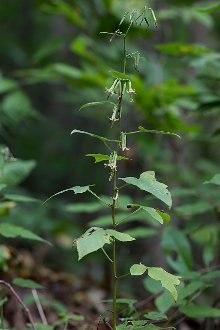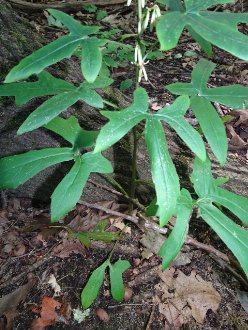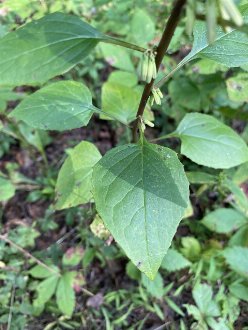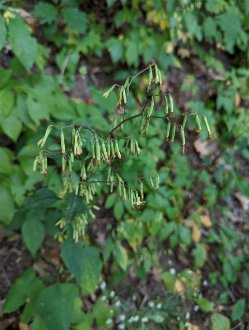

Tall Rattlesnakeroot (Nabalus altissimus (L.) Hook.)
Also known as tall white lettuce, tall rattlesnake root; also classified as Prenanthes altissima L.
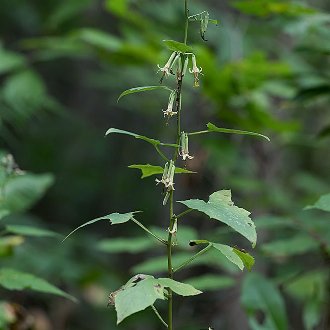
↑Summary
Thought to be a monocarpic perennial, found in well-drained sites in forests, native to Eastern North America.
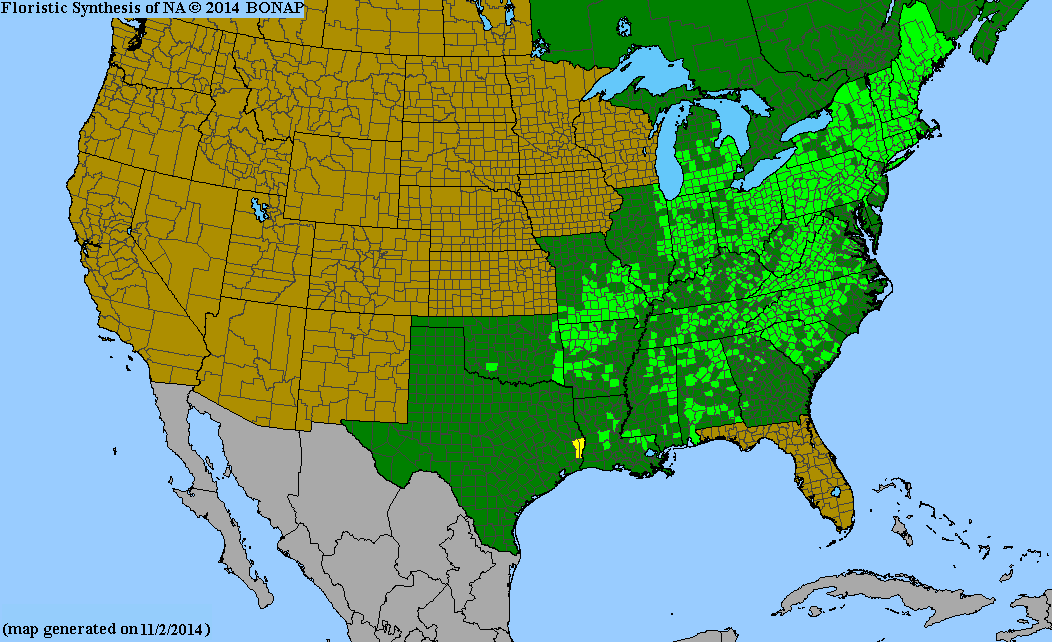
↑Range - Expand
| Legend | Color |
| Native | |
| Native or Not Present |
This tentative map is based on our own research. It may have limited data on Canada and/or Mexico, and there is some subjectivity in our assignment of plants as introduced vs. expanded. Read more in this blog post.
Although this plant occurs somewhere in each of these regions, it may only occur in a small part of some or all of them.
↑Similar Plants
↑Habitat
Nabalus altissimus is found in small gaps in deciduous forests or in deciduous woods with a slightly open canopy. Natural habitats include edges and gaps in rich mesic forests, rocky upland forests, sandy woodlands, sloped margins of floodplain forests, shady ravines and bluffs, swamps, and seeps. It also occurs in anthropogenic edges, especially along paths or where small roads cut through dense woods, but it is usually absent from fully anthropogenic habitats.
It usually occurs on sites with rich, loamy soils, but can tolerate some sandy or rocky material in the soil. It most often occurs on mesic sites but can range from moist to slightly dry sites. In the westernmost portions of its range it is more restricted to moist sites.
It often associates with highly shade-tolerant species such as sugar maple (Acer saccharum), American beech (Fagus grandifolia), and American basswood (Tilia americana), but in these woods it is limited to areas where either a disturbance or persistent gap has partly opened the canopy.
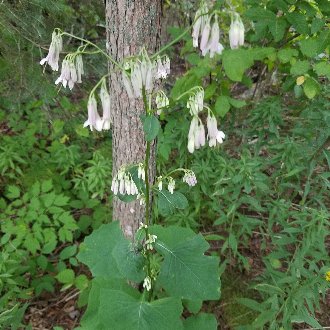
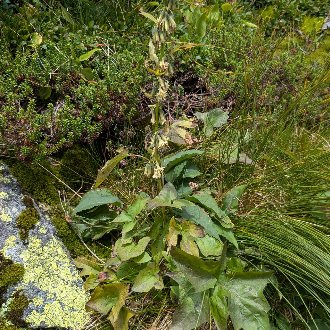
It usually is limited to soils that are slightly acidic. On sites with more strongly acidic soils, it is replaced by three-leaved rattlesnake root (Nabalus trifoliolatus), whereas on sites with higher soil pH it is replaced by white rattlesnakeroot (Nabalus albus). As the pH conditions that this species prefers are more ideal for plant growth, it tends to be the most shade-tolerant of the Nabalus species and tends to occur in the richest forests.
The relationship of this species to humans is complex. It does not occur in fully anthropogenic habitats but it thrives in anthropogenic edges, so it may benefit from small roads and paths through forests that would otherwise be too dense for it to occur, but it also is harmed by the clearing of forests. It relies on the small gaps that form from natural disturbances like windthrow or the deaths of isolated trees, and cannot thrive in a clear-cut area. It may have benefited from the "mesophication" of Eastern Forests, influenced by fire suppression following European Colonization, as it is more common in forest types that do not burn, relative to the other Nabalus species. It has also likely been harmed by human-induced deer overpopulation, as it is a preferred deer browse.
↑Life Cycle
we could not find any sources verifying this plant's life cycle, but some closely-related Nabalus species are monocarpic perennials. Missouri Plants reports that it can sometimes reproduce vegetatively, forming colonies.
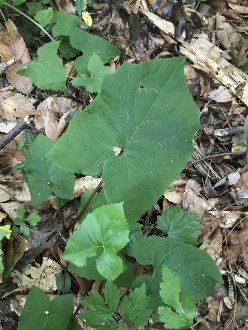
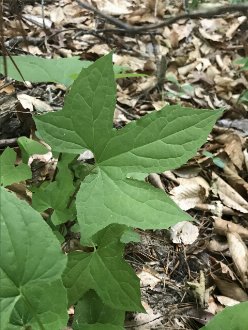
Plants initially form basal rosettes, which may persist for many years without flowering.
↑Links & External Resources
• Prenanthes altissima (Tall White Lettuce) | Illinois Wildflowers (About This Site)
• Prenanthes altissima (tall rattlesnakeroot) | USDA PLANTS Database (About This Site)
• Nabalus altissimus | Biota of North America Project (BONAP) (About This Site)
• Nabalus altissimus | Go Botany (About This Site)
• Prenanthes altissima | NatureServe Explorer (About This Site)
• Prenanthes altissima | Flora of North America (About This Site)
• Nabalus altissimus | Missouri Plants (About This Site)
• Tall Rattlesnake Root | Maryland Biodiversity Project (About This Site)
• Prenanthes altissima L. (Tall Rattlesnake-root) | Digital Atlas of the Virginia Flora (About This Site)
• Nabalus altissimus (L.) Hook. | Plants of the World Online (POWO) (About This Site)
↑Photo gallery