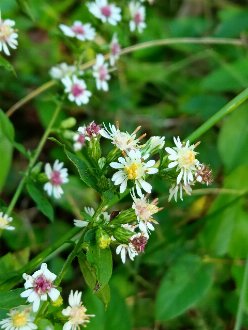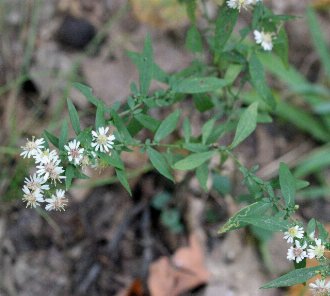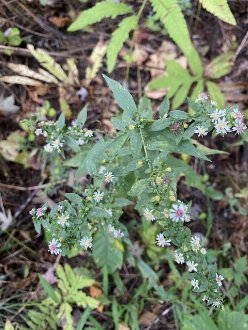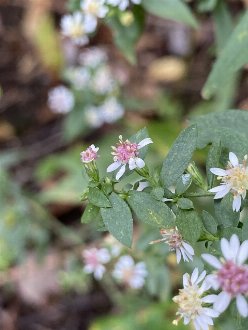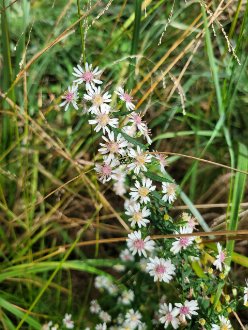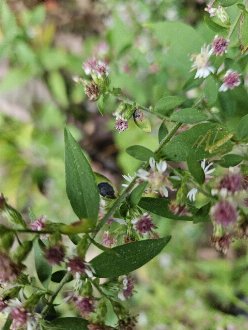

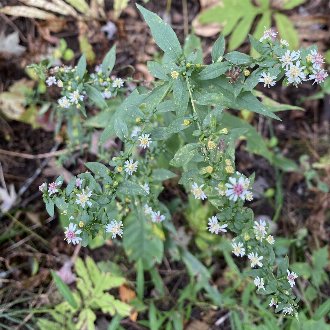
Calico Aster (Symphyotrichum lateriflorum (L.) Á. Löve & D. Löve)
Also known as starved aster, goblet aster.
↑Summary
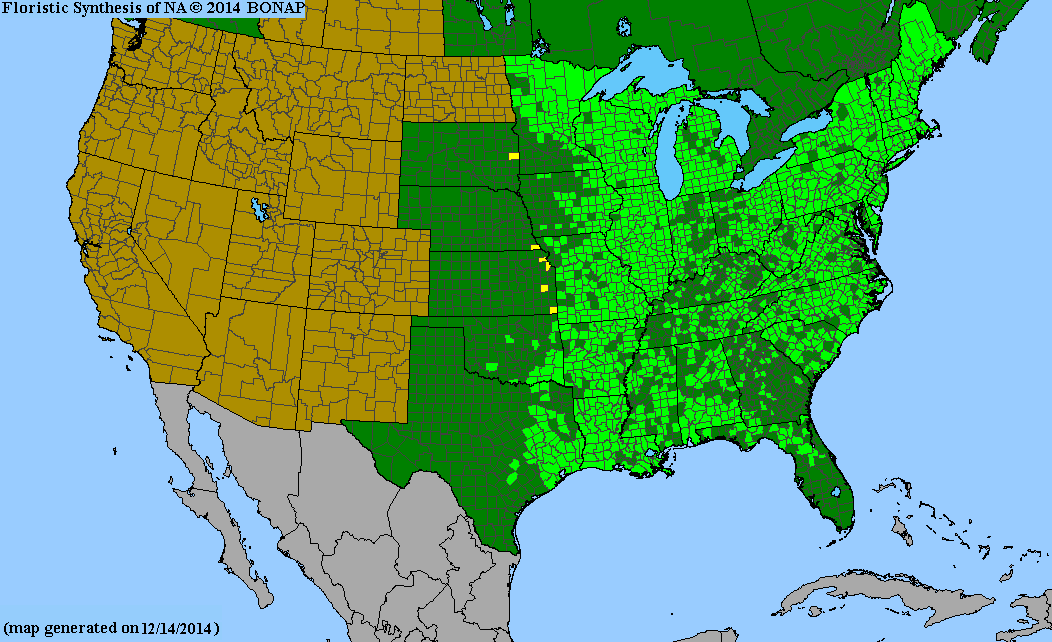
A perennial of moist, partly-wooded areas in eastern to central North America.
↑Range - Expand
| Legend | Color |
| Native | |
| Native or Not Present |
This tentative map is based on our own research. It may have limited data on Canada and/or Mexico, and there is some subjectivity in our assignment of plants as introduced vs. expanded. Read more in this blog post.
Although this plant occurs somewhere in each of these regions, it may only occur in a small part of some or all of them.
↑Similar Plants
↑Habitat
Calico aster is a generalist occurring in a wide range of conditions loosely centering around partly-sunny habitats with average moisture conditions. Natural habitats include moist meadows, floodplain forests, moist flatwoods (both pine and deciduous), woodland borders and openings, open upland woods, swamps, and seeps. semi-shaded sloughs near fields, and moist depressions in waste areas. Anthropogenic habitats include cleared areas in or near forests, moist depressions in fields or waste ground, and partly-shaded gardens.
It inhabits a wide range of moisture conditions from moist to dry, and a range of lighting conditions from full sun to light shade, but in full sun it is restricted to moist conditions, and in dry conditions it is restricted to the shadier end of its preferences. It tolerates temporary flooding and waterlogged soils. It is most abundant in partly-sunny sites that experience temporary waterlogging, but can be common in other conditions as well.
Calico aster prefers rich loamy to clay-loam soil with abundant organic matter, but near water it can also occur on soils with significant rock and/or sand content. It associates both with deciduous and coniferous trees, especially associating with conifers in swamps and pine flatwoods.
Calico aster has tended to benefit from human disturbance of woodlands. Its smaller height relative to some other members of its genus makes it less likely to be removed from gardens by weeding.
↑Life Cycle
Calico aster is a rhizomatous perennial.
Established plants often form a caudex, but also can spread by rhizomes to form colonies with multiple stems spaced over distances of a few inches.
↑Faunal Associations
Mammalian herbivores, including Eastern cottontail rabbit, white-tailed deer, and elk, browse this plant heavily, often preferring it to others. Birds eat the seeds and some larger birds may also eat the foliage.
↑Uses
The Calico aster is occasionally used in gardening, especially in lightly-shaded gardens. It is generally easy to grow although it can be targeted by browsing by deer or rabbits more than other plants.
↑Links & External Resources
• Symphyotrichum lateriflorum (Calico Aster) | Illinois Wildflowers (About This Site)
• Symphyotrichum lateriflorum (Calico Aster) | USDA PLANTS Database (About This Site)
• Symphyotrichum lateriflorum | Go Botany (About This Site)
• Symphyotrichum lateriflorum (White Woodland Aster) | Missouri Botanical Garden Plant Finder (About This Site)
• Symphyotrichum lateriflorum | Biota of North America Project (BONAP) (About This Site)
• Symphyotrichum lateriflorum | NatureServe Explorer (About This Site)
• Symphyotrichum lateriflorum | Flora of North America (About This Site)
• Calico Aster | Maryland Biodiversity Project (About This Site)
• Symphyotrichum lateriflorum (Calico Aster) | Minnesota Wildflowers (About This Site)
• Symphyotrichum lateriflorum (L.) A.& D. Love (Calico Aster, Starved Aster) | Digital Atlas of the Virginia Flora (About This Site)
↑Photo gallery