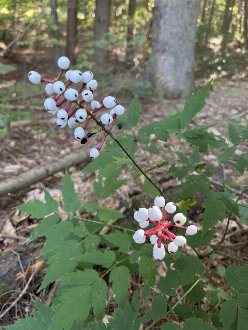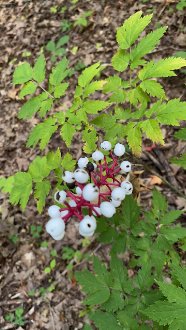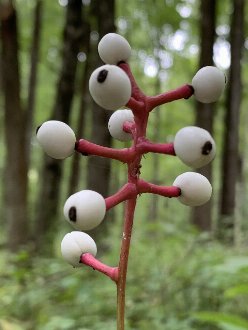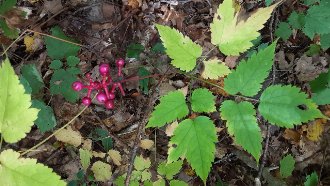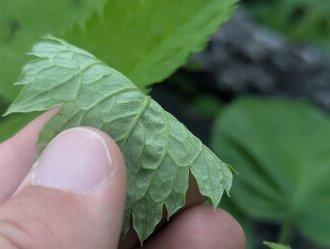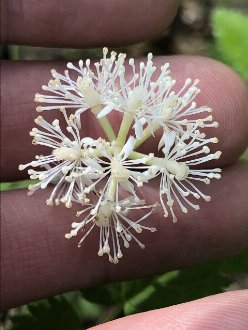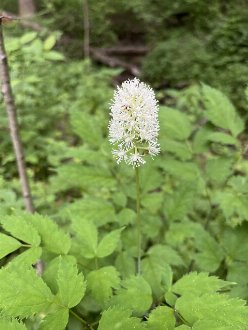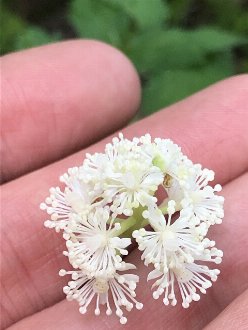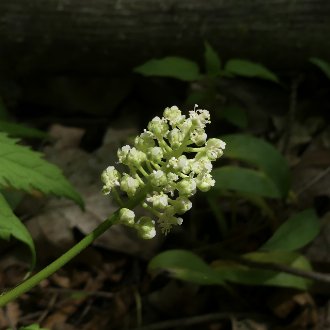

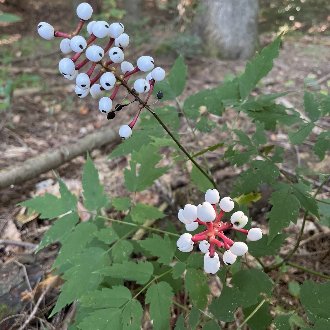
White Baneberry (Actaea pachypoda Elliott)
Also known as doll's eyes, doll's-eyes, white cohosh; also classified as Actaea alba (probable misapplication).
This species is sometimes referred to as "Actaea alba" and some sources, including USDA PLANTS, list that name as a synonym. FSUS notes this use as "probably misapplied"; POWO however lists that name as a synonym of red baneberry (Actaea rubra), which can rarely have white berries, which likely reflects the type specimen for that name (which no longer exists) being an individual of A. rubra with white berries, yet with the author's intent to describe a species with white berries, which would be this one. H.A. Gleason in 1944 explained the circumstance more fully and gave fairly long arguments in favor of retaining the name A. alba for this species, but we follow POWO's convention which is accepted by most authorities including iNaturalist, BONAP, and FSUS.
↑Summary
A perennial native to rich deciduous forests of Eastern North America.
↑Range - Expand
| Legend | Color |
| Native | |
| Native or Not Present |
This tentative map is based on our own research. It may have limited data on Canada and/or Mexico, and there is some subjectivity in our assignment of plants as introduced vs. expanded. Read more in this blog post.
Although this plant occurs somewhere in each of these regions, it may only occur in a small part of some or all of them.
↑Similar Plants
↑Habitat
White baneberry occurs in rich deciduous forests, often on sloped and/or sheltered terrain. Natural habitats include Appalachian cove forests, oak, and oak-hickory forests, and rich woods in ravines or on north-facing slopes, or near the base of cliffs. Although it is less common in anthropogenic habitats, it thrives in some disturbed forests subjected to overgrazing by deer.
It can tolerate a closed canopy to a slightly open canopy with dappled sunlight, but it is usually absent from sites with significant direct sunlight. It prefers loamy soil rich in organic matter, ample moisture, and good drainage, and it has little tolerance of either drought or waterlogged soil.
Although it usually is associated with deciduous forest, it can uncommonly occur in woods with some conifers, usually pines or junipers.
Although it usually occurs under a closed tree canopy, there is usually little to no competition in the understory where this plant occurs. When it does occur with other herbaceous vegetation, the other vegetation is usually lower-growing.
This species tolerates a wide range of soil chemistries in the heart of its range, but approaching its southeastern range limits where soils are more acidic and leached of minerals, it becomes uncommon to rare, and restricted to rich sites with higher-pH soils, usually either derived from calcareous or mafic rock, or shell marl.
↑Life Cycle
This species is a long-lived perennial with deciduous foliage that usually persists through the growing season.
Plants usually begin flowering in their third year. Plants bloom in spring, in May in most of the range, as early as mid-to-early April in the south of its range and early June in the north of its range.
Seeds ripen in late summer, and germinate after winter dormancy. Although they germinate well after passing through the digestive tract of birds, they do not require this treatment and they can also germinate readily if they are not digested.
We could not find information on this species typical lifespan in the wild, but it usually continues flowering and fruiting for at least several years once established. We also could not find information on the cause of mortality. Young plants can be killed by drought or flooding. Given its lack of occurrence on sites with competing taller vegetation, it is likely to be killed by competition and competition may be a factor in its elimination from sites with a more open canopy.
↑Faunal Associations
The foliage is highly toxic to mammals and thus avoided by mammalian herbivores.
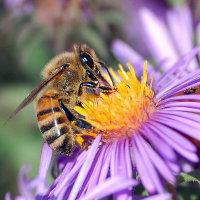
The flowers lack nectar, but halictid bees visit them to collect pollen. Various birds eat the berries, including Ruffed Grouse, Yellow-Bellied Sapsucker, and American Robin; the berries are likely not an important or preferred food source for these birds.
Although the moth Eupithecia cimicifugata has been recorded eating the fruit of the related black baneberry (Actaea racemosa), we could not find any records of any lepidoptera feeding on this plant.
↑Uses
White baneberry is occasionally grown in shade gardens and landscaping, where it is valued for its shade tolerance, deer resistance, attractive foliage, showy flowers, and distinctive fruit. It is low-maintenance and easy to grow in its preferred conditions, but its use is limited by it being demanding of shade and moist, well-drained, rich soil.
↑Related Plants
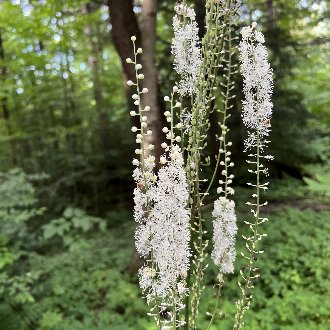
The black baneberry or black cohosh (Actaea spicata) overlaps with much of this species range but is somewhat more restricted in range. Where the species overlap, they overlap somewhat in habitat. These two species can hybridize, producing Louis's baneberry (Actaea ×ludovicii) which is widely distributed in upstate New York, with scattered reports elsewhere, but not reported from the south of the range overlap.
Numerous other Actaea species occur in North America; all are native except one, Actaea spicata, which has become established in northern New Jersey. Mountain bugbane (Actaea podocarpa) has a smaller range almost entirely contained in this species' range, and the uncommon to rare Appalachian bugbane (Actaea rubifolia) has an even more restricted range, also almost entirely contained in this species' range.
↑Notes
We prefer the common name "white baneberry" because the name "baneberry" is also shared in common with other Actaea species so it communicates this plant's close relationship to those other species; it also connotes the toxicity of this plant as "bane" means a source of harm or ruin and the descriptor is common among poisonous plants. Additionally, the descriptor "white" is useful here as this is the only Actaea or baneberry species with white berries.
The rarely-used common name "white cohosh" is perhaps acceptable although in general "cohosh" is misleading because besides referring to the Actaea species, it also refers to the not-closely-related blue cohosh (Caulophyllum thalictroides), which bears only superficial resemblance.
↑Links & External Resources
• Actaea pachypoda (Doll's Eyes) | Illinois Wildflowers (About This Site)
• Actaea pachypoda (White Baneberry) | USDA PLANTS Database (About This Site)
• Actaea pachypoda | Go Botany (About This Site)
• Actaea pachypoda (White Baneberry) | Missouri Botanical Garden Plant Finder (About This Site)
• Actaea pachypoda | Biota of North America Project (BONAP) (About This Site)
• Actaea pachypoda | NatureServe Explorer (About This Site)
• Actaea pachypoda | Flora of North America (About This Site)
• Actaea pachypoda | Missouri Plants (About This Site)
• White Baneberry | Maryland Biodiversity Project (About This Site)
• Actaea pachypoda (White Baneberry) | Minnesota Wildflowers (About This Site)
• Actaea pachypoda Ell. (White Baneberry, Dolls'-eyes) | Digital Atlas of the Virginia Flora (About This Site)
• Actaea pachypoda Elliott | Plants of the World Online (POWO) (About This Site)
↑Photo gallery