
How To Identify Plants
May 7th, 2026 by Alex Zorach
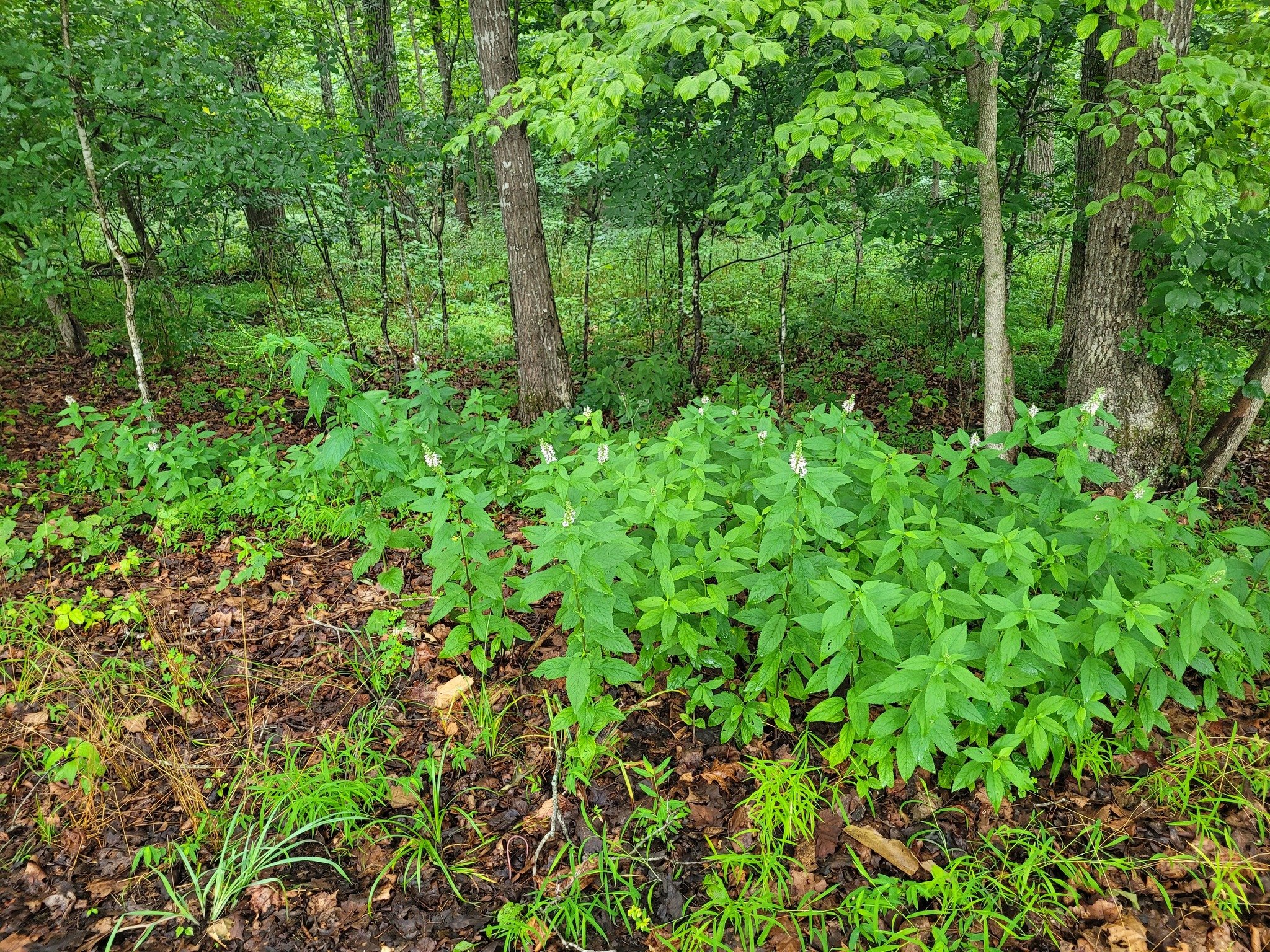
One of the questions I get asked most frequently is: how do you identify plants? There is no short answer to this question, other than with great effort. But I hope this post can describe the process I use so that it might help others. The most important thing about plant ID is to understand that it is a lifelong process and you will have the best results if you approach it both with a zeal for observing and learning, and with humility, realizing that you will always know little relative to the totality of what there is to know.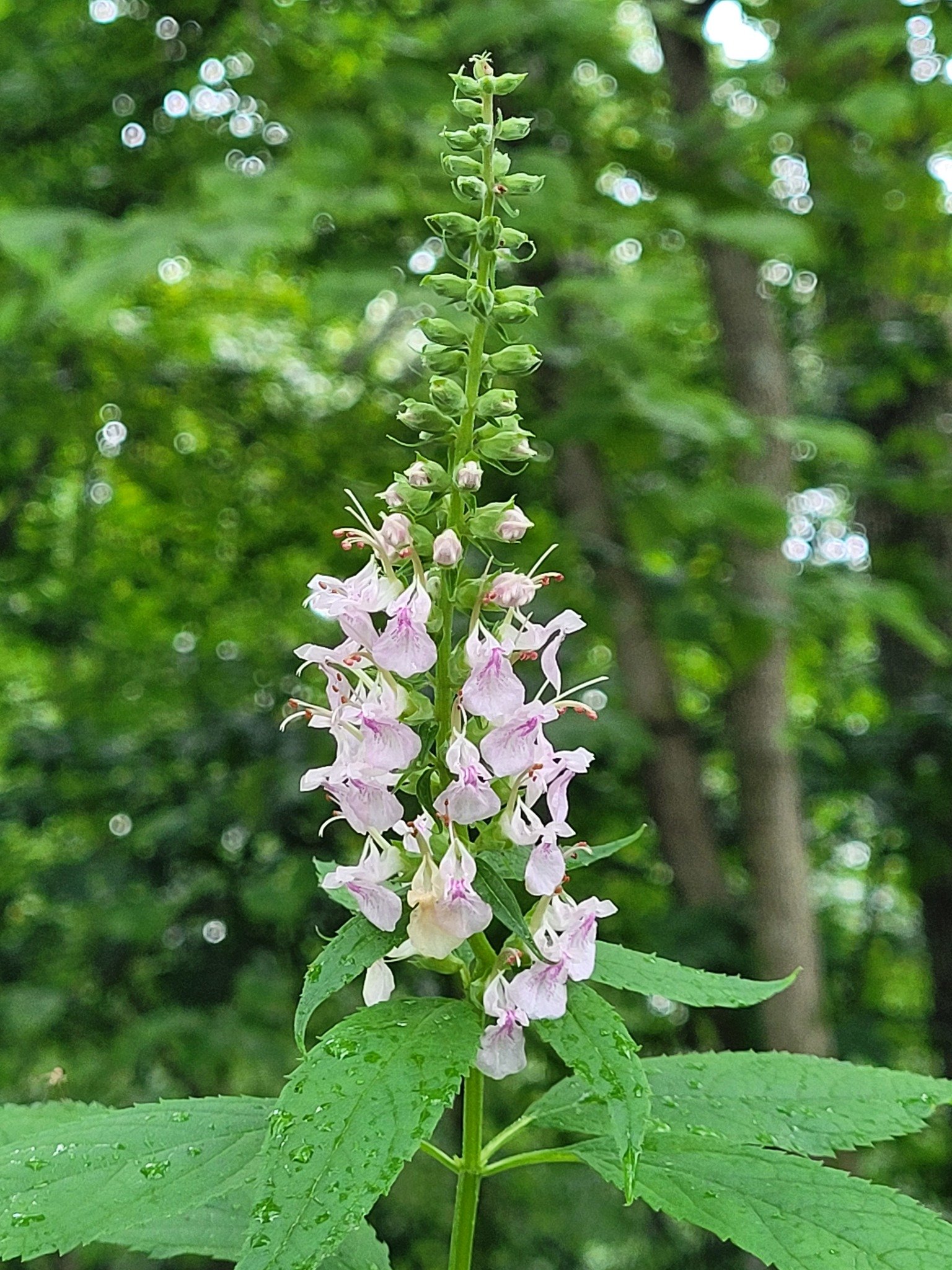 What is this plant, which was observed growing in a moist woodland opening in Mammoth Cave National Park, in Edmonson County, KY? How would you figure out what it is? Click here for a picture of its habitat and growth habit. Try reading this blog post and testing your newfound skills, then Click here for the answer. Public Domain photo by Clare Bledsoe, Source.
But there are also numerous tips and tricks, each of which can lead to small breakthroughs. My goal with this post is to collect all of my insights into one place so that someone reading it can dramatically ramp up their ability to ID plants, or at least, become much faster and more efficient at learning how to ID plants.
Learning from Birdwatchers
One of the best insights I ever had about how to identify plants came from a book about identifying not plants, but birds: The Field Guide to Advanced Birding by Kenn Kaufman. Unlike most field guides, which are picture-rich depictions of what each species looks like, this prose-rich meta guide explains how to look at birds and how to get better at looking at birds.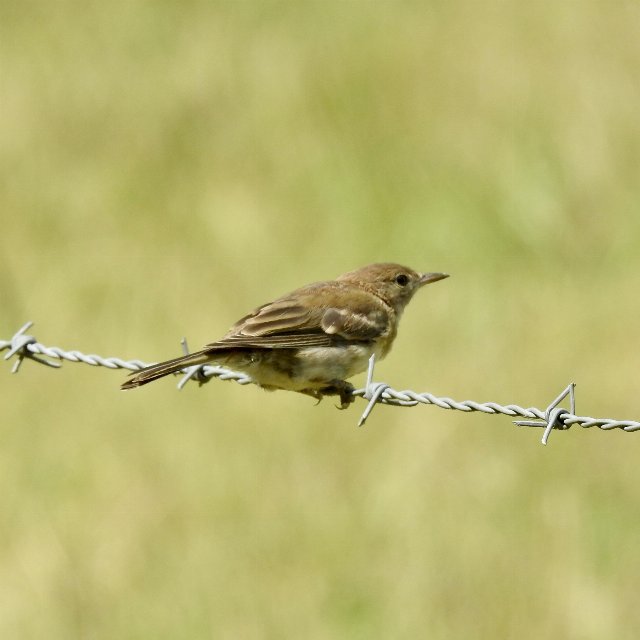 Pine warbler (Setophaga pinus) in fall plumage is often considered one of the "confusing fall warblers" which are notoriously hard to ID. A lot of plants can be harder to ID than even these warblers, due to the massive number of species. But, unlike birds, plants sit still. Photo © Laura Clark, CC BY 4.0, Source.
Kaufman notes that a lot of beginner birdwatchers look at a bird only until they are sure what it is, and then they immediately turn their attention to some other bird that they have not yet identified. His core advice is to spend more time observing birds that you have already identified, starting with the most common species where you already know exactly what they are. This advice humbled me as I had been doing exactly what he was telling me not to do.
By looking at a bird whose identity you already know, you will learn that species better. But you also hone your general skills for looking closely at birds. This ensures that when do do see something new and different, you will immediately know that it is something unfamiliar, and you will also be better able to articulate how it is different and how you recognized it as different.
This same process can apply to plants. So I recast his advice to the world of plants: if you want to get better at identifying plants, start by looking at the plants whose identity you already know. And don't forget how lucky you are, compared to birdwatchers: the plants sit still and you can take your time and get as close as you want to.
Why I Treat Keys With Caution
When I first started studying plant identification I focused on dichotomous keys, those long decision trees asking question after question. After years of wrestling with these keys, I concluded that in a majority of the cases and for most people, keys are not the best way to identify plants. Even when they work, they need to be balanced with and checked against other methods.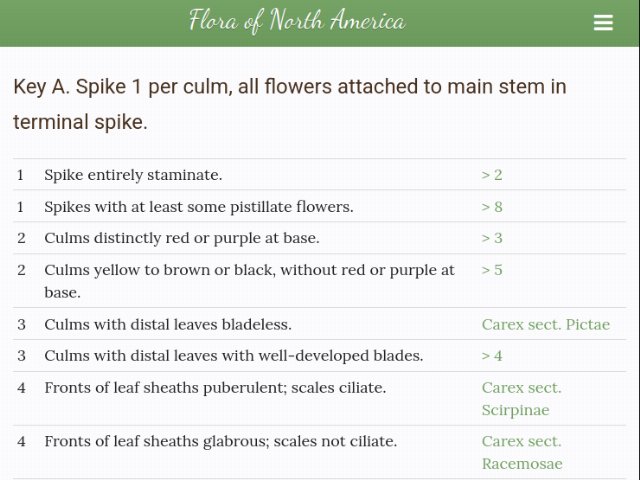 This screenshot shows part of the Carex Key from Flora of North America. This key is divided into 6 sections and this section has 33 entries. The key is so large both because the Carex genus is diverse, and because FNA covers all of North America. It requires access to the plant at the time of blooming and/or seed production, and knowledge of specialized botanical terminology. The decisions in the key do not correspond to taxonomic relationships, and some taxa appear in the key on multiple lines.
What can go wrong with keys?
- Keys waste time by having you check through plants that, for whatever reason, are not an option in your particular scenario. The effort necessary to accurately navigate each choice in a key is usually greater than the effort necessary to exclude most of the other options. For example, you might be using a key for Pennsylvania which checks against all plants possible anywhere in the state, and many of them may not occur in your region.
- Keys are not robust with respect to errors. In order to get a correct identification from a key, every choice must be correct. Sometimes when you make an error, it is not apparent until you get to the end of the process, and then you need to find the error, which can be time-consuming.
- The choices in keys do not always correspond to taxonomic relationships (which taxa are closest-related to each other), so time invested in using keys may not help learn these relationships.
- Keys can be wrong, especially in the case of aberrant individual plants, which are more common than you might realize. Dimensions, counts, color, texture, and other aspects of plant morphology, as well as bloom timing, can all be outside the parameters of the descriptions used in keys on some individuals, both due to natural variation and stressors on the plant.
- Keys often reference aspects of a plant that are not visible at all times of year, such as flowers or seeds, even in cases where the plants can be clearly identified through other features such as leaves, habitat, or range.
- Keys often require more knowledge of botanical terminology than is necessary to confidently identify a species. The terminology is necessary not for the keys to function, but for them to be concise enough that the volumes containing the keys do not end up reaching an unmanageable length, and so that they can be practically written and maintained by their authors or maintainers.
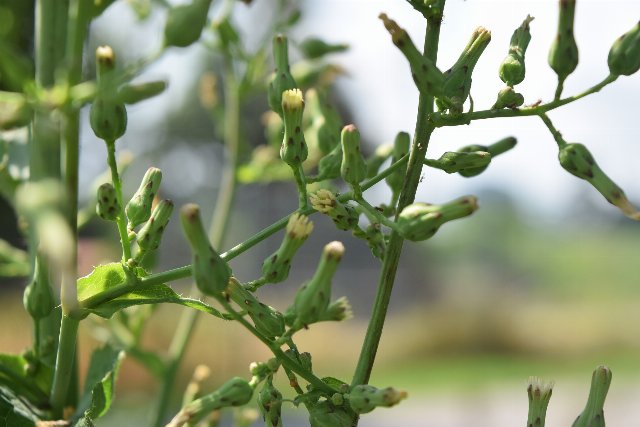 The populations of tall blue lettuce (Lactuca biennis) in and around northern Delaware, including into southeastern PA, have a rare pale yellow color morph. Many keys for Lactuca assume L. biennis flowers are pale blue to white, which can lead to confusion. Note that FSUS's key for Lactuca acknowledges the flowers of this species can be "rarely yellow". In my experience FSUS has more reliable keys than most, but even there it is possible to find individual plants for which a key will not yield the correct ID. Photo © Alex Zorach, CC BY 4.0, Source.
I am not saying never to use keys. They have their purpose, and as you learn more you will likely get more out of them. But if you are starting out, you can save a lot of time and learn a lot faster through other approaches. Then return to the keys when you know how to interpret them, and use them to rigorously confirm an ID you are already relatively certain of, or perhaps to discover a rare but possible plant that isn't showing up through your other methods.
So if not keys, what to do?
My approach to plant identification is as follows:- Learn common, easy-to-identify plants first.
- Closely observe plants you have already identified.
- Identify to a higher taxon if possible, such as genus, family, or other grouping.
- Check which plants are possible based on range.
- Look at habitat in depth.
- Once you've narrowed it to a reasonable number of species, read descriptions and look up pictures of those species.
- Use tools to check for common lookalikes that might be outside the subset of plants you are examining (I outline a process for this below.)
- If you cannot even get started, use AI-based tools (I will highlight which ones I prefer below) to make an initial guess. Then check the family, genus, species, or other taxon rigorously.
By the time you've done all these things, you will usually know inside and out, which plant you are looking at, and you'll be able to identify how and why you know. But, more importantly, all of the extra work you are doing will help prepare you to later identify other plants. Plant ID is less about identifying individual plants in isolation, and more about building a web of knowledge. It may seem time-consuming to identify a single plant, but you can take solace in the fact that in the course of doing so, you lay the foundations to identify many other plants more easily in the future.
I will now go through each of these points in detail to show you how I do them.
Learn Common, Easy-to-Identify Plants First
Some plants are easier to identify than others. For example, in most of Eastern North America, American pokeweed (Phytolacca americana) is not only abundant, but nothing else looks remotely like it (three other Phytolacca species do occur in North America but all are exceedingly rare.)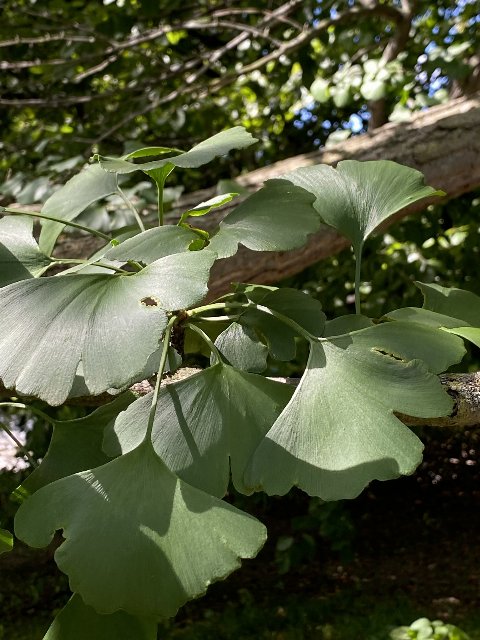 Ginkgo (Ginkgo biloba) has a visually-distinctive leaf. Because it is easy to definitively ID, it can be a good starting point for the process of looking more closely at plants. Once you have identified a tree as a gingko, you can begin looking at more subtle aspects of its morphology, such as its bark or form. Photo © Sandy Wolkenberg, CC BY 4.0, Source.
From there, you can branch out to learning other plants that are either easy-to-identify or common, but not both. For example, Gingko is occasional in landscaping and a rare escape in the wild, but is visually-distinctive and easy to identify, so you can learn to ID it with minimal effort. Oaks (Quercus) on the other hand, are harder to ID, but common, so it might be worth learning at least the most common oaks in your region. Even if more effort is required, the fact that they are common will make it easier to learn them and more worthwhile to do so.
Over time, you can advance to learning progressively rarer and more difficult-to-ID plants. These goals are often more attainable if you master a particular taxon in your region, progressing through the more common members of it and then learning the rarest ones last.
Closely observe plants you have already identified.
Once you have successfully identified a plant, now is your time to learn it. Observe the plant through its whole life-cycle. Many plants are easy to identify at a specific time of year, due to a distinctive flower or fruit, but can be hard to identify at other times of year. Watching a plant year-round will expand your ability to identify it at times of year when flowers and/or fruit are absent. For example, just about anyone can identify a fruiting pokeweed plant, but can you identify a pokeweed seedling? How about emerging pokeweed shoots from an already-established plant? How about the dead stalks of pokeweed in late winter?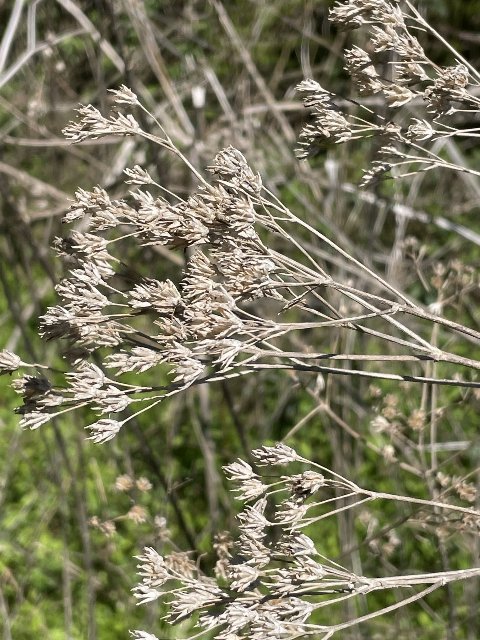 Would you recognize these stems and empty seedheads as belonging to yellow crownbeard (Verbesina occidentalis)? This growth from the previous season has persisted into March of the next year. Identifying plants in a state like pictured here is one of the key things gained by observing a plant year-round. Photo © Becky Dill, Public Domain, Source.
By following this process, you will not only expand your ability to learn how to identify a particular plant, but you will be building the knowledge and neural machinery to identify other plants in the future. For example, yellow crownbeard, pictured above, is easily confused with wingstem (Verbesina alternifolia). If you've gotten to know yellow crownbeard, and you come across an individual of wingstem, even if you have never seen it before, you may recognize it as something related but not exactly the same. This realization could prompt you to examine other species in the same genus, which in this case would lead you to a correct ID.
Deciduous woody plants are usually easiest to identify when leaves and/or flowers are present. Once you have identified one, you can then watch it through the winter (or dry season in an area where plants are drought-deciduous) and learn to identify it by aspects like its bark, form, branching habit, or buds. Sometimes these other aspects of a plant are more distinct than their leaves. For example hackberries (Celtis sp.) have leaves and a growth habit that resembles elms (Ulmus sp.), but their warty bark is entirely unlike that of elms.
Identify to a Higher Taxon if Possible
Understanding how taxonomy works and knowing some of the more common groupings into which plants are classified can make plant ID a lot easier. Like other living organisms, plants are classified in a hierarchical organization with layers or levels of names, called ranks. Scientific names take the form Genus species, and there are also lower (more specific) ranks such as subspecies, variety, and form, and higher (broader or more general) ranks such as family and order. There are also numerous intermediate layers:Kingdom (All Plants) > Division (Phylum) > Class > Order > Family > Subfamily > Tribe > Subtribe > Genus > Section > Species > Subspecies > Variety > Form
Note also that some of the key taxa of plants lie in unnamed ranks between these named ones. For example, the vascular plants (tracheophytes), the flowering plants (Angiospermae), and the gymnosperms are all clades of plants higher than division but lower than class.
The classification of plants in higher taxa than species is subjective. Some genera are large and contain dozens or even hundreds of species (i.e. Astragalus) whereas other genera might contain only one species (i.e. snowplant (Sarcodes sanguinea)) and the same can be true of higher taxa such as families. Similarly, some genera contain plants that look wildly different, such as the bunchberry dogwood (Cornus canadensis), a low-growing herbaceous perennial with a single whorl of leaves, in the same genus as woody plants such as the red-osier dogwood (Cornus sericea). In other cases, a large family might all look similar, such as the Amaryllidaceae family, which is almost all bulbous perennials with linear leaves.
In some cases, you might look at something and identify it to genus level easily, like you might say: "This tree looks like an oak (Quercus sp.)" whereas in other cases you might have no idea of the genus, but identify it to family level, "This plant has a compound flower, with rays around a central disc of tiny flowers, so it is probably in the composite (Asteraceae) family." or "This plant has a square stem, opposite leaves, and a distinctive aroma, so it seems like it might be in the mint (Lamiaceae) family." or you might go only to a high level, such as: "This looks like a monocot (Monocotyledon)." The more plant families, genera, and other groupings you are familiar with, the easier it will be to make these sorts of assessments.
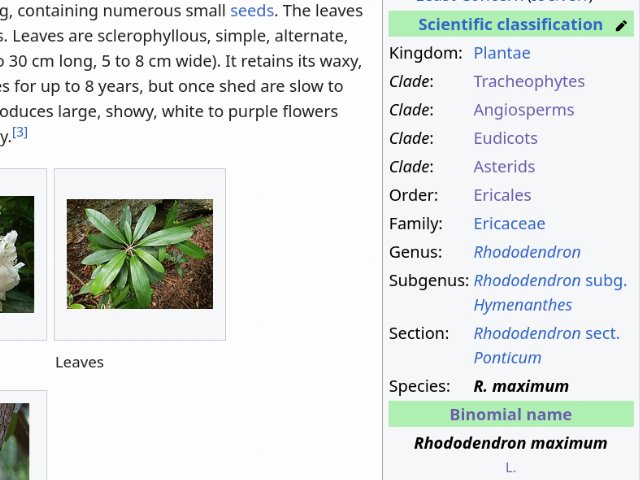 This screenshot shows the taxobox from Wikipedia's page for great laurel (Rhododendron maximum). Note how in this case, there are four clades of unnamed rank between the named rank of Kingdom and Order, and that the named ranks of Division and Class are not listed. Note also that there is a subgenus and section listed. This scenario is typical, although the specifics of how it plays out will vary a lot from one taxon to the next. Also, because Wikipedia is user-edited and worked on incrementally, just because a rank is not listed in the taxobox does not mean that the species is not classified into this rank. Some articles list more detail than others. © Wikipedia, CC BY-SA 4.0, Source.
One of the best tools for learning the taxonomy of various plant species is Wikipedia. Wikipedia has a template called a Taxobox which not only outlines the entire hierarchy of classification, but hyperlinks each higher taxon to the page on that taxon, when it exists. It can be an outstanding way to quickly learn about plant taxonomy. It is, however, a user-generated source in a constant state of flux, so in the case of taxa that have experienced major reclassifications and/or controversy, its information can be incomplete and inconsistent with other sources and sometimes even among its own articles. You can get a lot out of browsing Wikipedia and checking the Taxobox for some of your favorite plants. As you learn which higher taxa each of them is in, you will start seeing patterns, and soon, you will begin to understand how unfamiliar plants fit into these classifications.
For a more rigorous and consistently-updated source of information on plant taxonomy, check Plants of the World Online (POWO) which is run by the Kew Botanic Gardens in London. We use POWO for resolving taxonomy and follow their scheme for most, but not all species. iNaturalist is also an excellent source and has an added advantage of making it easier to browse the taxonomic hierarchy of a particular taxon. iNaturalist, like bplant, usually but not always follows POWO.
Check which plants are possible based on range.
Range is one of the best ways to narrow the possibilities for an unfamiliar plant. However, range is complicated by the fact that plant ranges are not perfectly documented, and can change over time. So, the fact that a plant is not recorded in a particular region does not mean that it could not occur there, just that it is less likely.We recommend using as local sources as possible. Our ecoregion-based range maps are best used only as a starting point. County-level range maps such as those provided by USDA PLANTS and BONAP provide finer detail, but state-level sources such as VA Plant Atlas and Maryland Biodiversity Project are often more up-to-date and sometimes offer still finer detail. FSUS is not quite as fine-tuned but offers data both on range and abundance. Some regions have print sources with verbal descriptions of plant occurences. If you are lucky enough to live in one of these areas, get your hands on these sources! And some parks and nature preserves maintain a plant list, and if you're looking at a plant at one of these sites, that list is a good place to start.
iNaturalist can also be used to narrow down plant ranges, although it is better for common plants and in regions with more data. To use its full features, you will need to access it via the website; the smartphone app supports only some of its features. Its data is user-generated so it is best approached as a suggestion, not rigorous documentation of a plant's presence or absence. The "Explore" feature on iNaturalist can be used to list the species in a particular genus or higher taxon, in a particular location. On the "Explore" page, type any taxon into the "Species" box (it accepts any taxon, not just species), then a region (which could be as fine-tuned as a county or even specific municipality) and then hit the "Species" tab and it will list the species present in observations in that region, in order of frequency of occurrence.
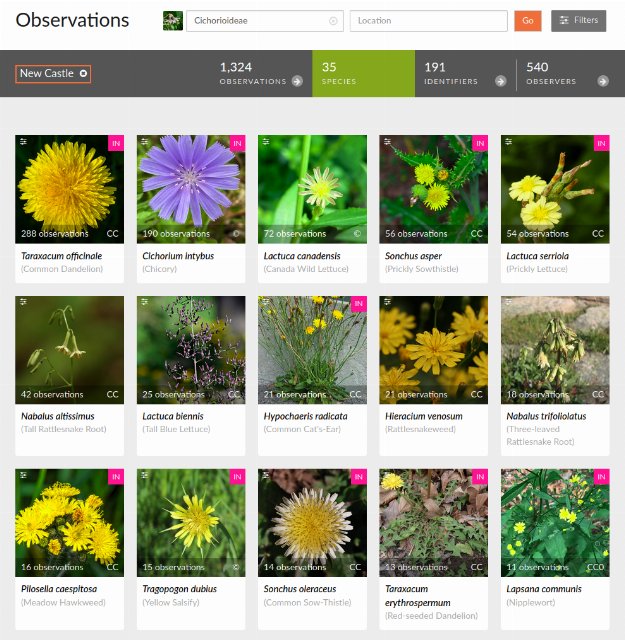 This screenshot shows the species tab on iNaturalist's observation page for the Cichorioideae tribe in New Castle County, Delaware.
For example, this link shows a list of species in the Cichorioideae tribe of the Asteraceae family, in New Castle County, DE. This list would be good to check against if you see a vaguely dandelion-like flower in this county and have no clue what it is. I live in this county and can testify that the top 5 species not only occur here and are common, but are listed in a reasonable order of how common they are. However, lower down in the list you cannot trust the data to be as useful, as the sample size is too small. I've seen species in Cichorioideae that are not even listed, but the list also contains a number of plants I've never seen here.
Note how this method of narrowing down options by range synergizes with knowledge about higher taxa covered in the previous section. You can combine a region and higher taxon to get a narrower list of likely species than with either factor alone.
Consider out-of-range plants.
Occasionally, you will struggle to ID a plant based on reported ranges, and you must consider the possibility that you have discovered a plant beyond its reported range. Several factors can be useful to assess the likelihood that you have found a plant outside its reported range:- Is the species common or abundant in adjacent areas?
- Is the species increasing or decreasing in the broader region?
- How conspicuous is it?
- How hard is it to ID?
- Is it a species or genus that gets much attention?
It is always best to be cautious and keep considering rare possibilities. When examining reports on iNaturalist of Maryland sanicle (Sanicula marilandica) in unreported counties near the southeastern border of its range, every single one that I was able to identify with confidence turned out to be a misidentification. This species is rare near its southeastern range limits, and is decreasing in these areas, possibly due to global warming. But it ticks all three of the "hard to ID", "inconspicuous", and "doesn't get much attention" boxes, so it's a species I still consider.
Look at habitat in depth.
Habitat is one of the most important ID clues. It is sometimes even easier to observe and/or less variable than the relevant aspects of a plant's shape or appearance necessary to make a definitive ID.For example, the leaf shape of swamp chestnut oak (Quercus michauxii) is similar to both chestnut oak (Quercus montana) and chinquapin oak (Quercus muehlenbergii), and can be easily confused with either species when habitat is not considered. But their habitats are almost entirely non-overlapping: swamp chestnut oak grows in moist bottomlands on acidic soils, whereas chestnut oak grows on dry uplands, also on acidic soils, and chinquapin oak prefers calcareous soils which have higher pH.
Many plants have strict preferences for less-visible aspects of habitat, such as soil pH or nutrient levels. Certain plants only (or never) occur on high pH soils such as rocky limestone or mafic soils, or vice versa on acidic, low pH soils such as occur on coarse sands, highly leached soils, and peaty or mucky soils. Our post thinking more deeply about habitat can help you to learn how to approach habitat more richly, with an eye towards ID.
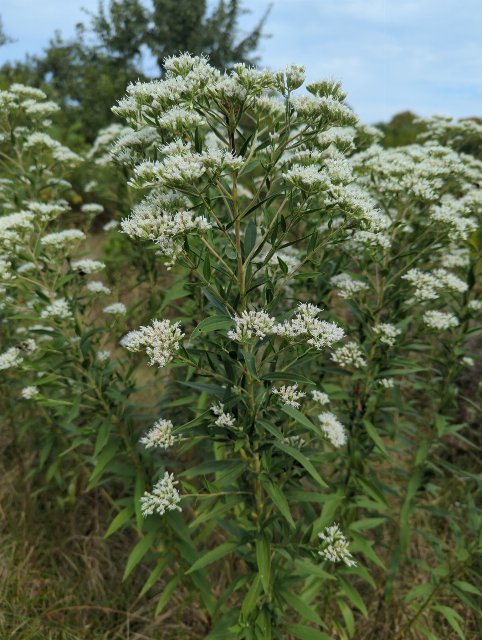 This photograph shows a plant of the Eupatorium genus in Westminster, MD. In the Northern Piedmont ecoregion where this plant was photographed, there are 14 Eupatorium species. Using Maryland Biodiversity Project's county-level range maps, this can be narrowed down to 4 possibilities: E. altissimum, perfoliatum, serotinum, and sessilifolium. This individual is Tall thoroughwort (Eupatorium altissimum), a species with a strong preference for higher pH soils and dry, sunny conditions. E. perfoliatum and E. serotinum both prefer moister conditions, and the only other to also occur on dry, higher-pH sites, E. sessifolium, prefers greater shade. The combination of dry, high pH conditions and full sun makes this species the most likely in its genus. Knowing that a site has high soil pH can be as useful as morphology. But conversely, when you have definitively ID'ed a plant as this species, it can function as a clue to the soil conditions, which may help you to identify other plants on the same site. Photo © Tom Field, CC BY 4.0, Source.
If using keys or references that do not mention habitat except in passing, I recommend supplementing them with other sources that discuss habitat more deeply, as part of the ID process. Often, considering habitat can confirm a correct ID, or can prompt you to question an incorrect ID, when you would have remained uncertain if considering morphology alone.
Beware planted or tended plants: habitat cannot be used to ID them!
A caveat to the advice to consider habitat is that habitat is only useful to identify wild plants. Plants that are cultivated, i.e. grown intentionally in gardens or landscaping, may grow in conditions that they would rarely or never survive in without help.Irrigation and/or mulching can allow moisture-demanding plants to survive on drier sites. Fertilization and/or mulching can allow plants to grow in soil lacking key nutrients. Wrapping and/or planting near a heated building can allow plants to overwinter in colder climates. Some plants can survive on a site even if they would never be able to germinate and establish there, and thus can be found if planted on sites where they would never establish on their own. And protecting plants from herbivory and/or pathogens through fencing and/or chemical treatments can allow stressed plants to survive in conditions they are not adapted to.
Perhaps most importantly of all, gardens remove competition. There are many examples of plants that prefer somehow adverse conditions and are not competitive in "ideal" conditions. Nearly all plants can survive in moist, well-drained conditions and slightly acidic pH (around 6.0.) However, plants adapted to drought, poor drainage, strongly acidic, or alkaline soil invest their energy into costly adaptations that allow them to survive these harsher conditions. In the wild, they would be overtaken by other plants that forgo these adaptations and instead grow faster in ideal conditions.
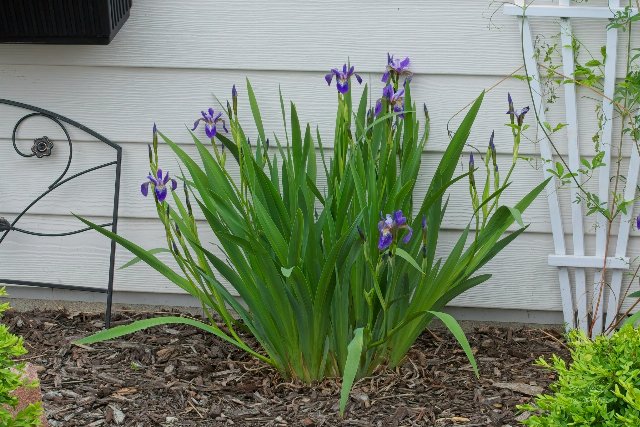 This photo illustrates the perils of using habitat to identify garden plants. Here, a northern blue flag (Iris versicolor) is growing on dry ground on the north side of a house. This species normally only occurs in wetlands with standing water. The mulch retains water which allows it to survive on drier ground, and having it planted on the north side of the house further reduces drought stress. However, in the wild it usually is found on sites with much more light. But here, competing vegetation is also kept away from it, ensuring that it gets all of the relatively little sunlight shining on this area. Both factors likely allow it to survive on a drier, less-sunny site than it would normally occur on. Photo © Daveozric, CC BY 4.0, Source.
For these reasons, habitat cannot be used to identify planted and/or cultivated plants. However, the keyfactor is whether a plant is planted and/or tended, not where it is growing. Gardens and manicured landscapes are often full of wild plants, and these anthropogenic habitats can provide accurate habitat clues for identifying wild plants, a.k.a. "weeds", that come up in them. In fact, there are large numbers of plants in North America that primarily (and sometimes only) occur in anthropogenic habitats, and indeed, lawns and gardens are some of the most common habitats in which certain plants grow. And conversely, you can find planted plants in the wild, especially where a previously tended garden has become abandoned and overtaken with wild forest, leaving a few surviving trees, shrubs, or understory plants which may not be reproducing in the wild.
So, the key to knowing how to use habitat as an ID clue is to learn the distinction between a wild plant (which may or may not occur in a garden) and a planted or cultivated plant (which may or may not occur in a wild ecosystem.)
Once you've narrowed it to a reasonable number of species, read descriptions and look up pictures of those species.
When you've used the techniques above to narrow your search down to a manageable number of species, the next step is to study the potential species and see if any fit. One of the best resources for verbal descriptions is Flora of North America (FNA). Unfortunately, FNA is not complete, although over time it is becoming more so. FNA has detailed botanical descriptions of each species as well as higher taxa. It is particularly useful in the case where you want to check specific, observable traits, like counting or measuring or checking the texture of various parts of the plant. FNA uses a lot of specialized terminology so if you have not taken a course in or otherwise learned this terminology, you may need to look up a lot of terms. There are many local and regional flora, like the book Plants of Pennsylvania that have similar descriptions. That particular book also has an outstanding glossary, parts of which are illustrated, so if you live in or near PA I would recommend buying it.Looking up pictures of various species can be valuable, but also tricky. I recommend avoiding using a generic image search, as misidentifications are common on the internet, especially for tough-to-identify species. The best sources for images are dedicated plant websites where the maintainers have rigorously checked the ID of each photo before including it in their gallery, making misidentifications rarer. Start with a local source for your region, like Illinois Wildflowers, Maryland Biodiversity Project, or Calflora, or branch out to a regional one like FSUS.
User-uploaded sources such as iNaturalist can also be a source of images, but the potential for errors is higher on these sources. I recommend only using iNaturalist for images only if you are comfortable using descriptions in sources like FNA to double-check an ID.
Most people will want to look at pictures of live plants as they occur in the wild, but for certain specialized checks, you can also look up photos of herbarium specimens. Because herbarium specimens can be quite old, make sure to check for any taxonomic changes or alternate classification schemes. For example, many herbarium specimens of tall goldenrod (Solidago altissima) are listed under the name Solidago canadensis subsp. altissima.
Let your brain process the information.
Learning takes time and you can benefit from taking breaks and revisiting the material multiple times. Once you've checked descriptions and photos and given your brain a few days to process the information, go back outdoors and look at the mystery plant again. You may have to go between the plant and the online or text sources multiple times, each time finding some new trait to examine. Over time, you will not only get better at distinguishing plants, but you will begin to connect the specialized terminology with the up-close view of the plants. Over time, these connections will make keys and botanical descriptions more accessible.Check for common lookalikes.
If you think you may have identified something, but are not 100% sure, you can check for common lookalikes. Print books on plant identification often list lookalikes in the entry for each plant. Again, one of the best sources is iNaturalist. On iNaturalist, on the page for a particular species, there is a "Similar Species" tab. Furthermore, the listings on this tab can be filtered by region; in the top-right of the page, you can change the region and you will get region-specific listings.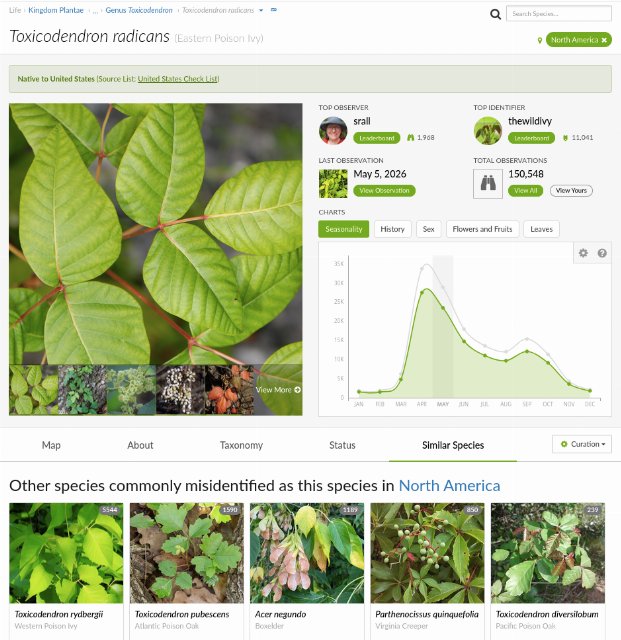 This screenshot of the iNaturalist page for Eastern Poison Ivy shows the "Similar Species" tab. In this case, the two most commonly-confused species are in the same genus (and pose a similar risk of causing a rash) but the third-most-confused is a species of maple that does not cause this rash, and the fourth is a vine that is also not closely related.
Lookalikes are often, but not always closely-related. For example, for eastern poison ivy (Toxicodendron radicans), the most common lookalikes are western poison ivy (Toxicodendron rydbergii) and Atlantic poison oak (Toxicodendron pubescens), but the third-most-confused plant is box elder (Acer negundo), which is not closely related and is actually a type of maple (Acer sp.), and the fourth is Virginia creeper (Parthenocissus quinquefolia), which is more closely related to grapes than poison ivy. Checking these listings may give you ideas of lookalikes that you did not think to check. Our plant articles also contain a "Similar Plants" section but it is nowhere near as complete as iNaturalist's listings.
Regional web sources also frequently list common lookalikes. Illinois Wildflowers, Minnesota Wildflowers, and Go Botany (for New England) are three of the best regional resources that commonly list lookalikes and explain how to distinguish them.
To be truly rigorous, you will need to check options that do not appear in these lists, but the lists can be useful early in the process. You also can learn about plants you did not know about from these lists.
If you can't get started, AI can make initial guesses, but must be checked rigorously.
Sometimes you see a plant and you are just stumped. In these cases, AI-based apps can sometimes get you a starting point. Usually, people use these as smartphone apps, but some can also be accessed as websites. We recommend iNaturalist, Pl@ntNet, plant.id by Kindwise, and Flora Incognita for this purpose, for reasons we explain below. However, even the best apps make mistakes and are only suitable for initial guesses.AI is inherently unreliable and AI suggestions need to be checked rigorously.
At least in its current manifestations of LLM's, AI is notoriously unreliable, and has been known to hallucinate (outright make-up information) as well as to reflect existing biases. Furthermore, there is evidence that many AI models have been getting worse over time in part due to being trained on AI-generated content.And yes, there is AI-generated plant ecology content on the web. While researching plant distribution, ecology, and taxonomy, I have come across whole websites with databases of plants and articles about them, including complete fabrications, like saying particular species occur in certain locations where no reliable sources say they do. And even before the flood of AI slop to wade through, the web has long been filled with horticultural and gardening websites that take a casual approach to both plant identification and taxonomy, such as the fiasco of the invasive Asian jumpseed (Persicaria filiformis) being labeled and sold as jumpseed (Persicaria virginiana).
Any AI model is only as good as the dataset it is trained on, and this fact is as true for plant ID as any other task one might give it. There aren't many plant experts out there, and most of them aren't spending the bulk of their time training and refining AI models. As such, the apps used for plant ID make frequent mistakes, and the mistakes mimic the errors that humans frequently make, including misidentifications based on visually-similar plants, and confusion based on reclassifications or taxonomic inconsistencies. Poorly-designed AI's will fare even worse, reflecting misidentifications taken from unreliable websites and often just making bizarre guesses that have you scratching your head about how they might have occurred.
Which AI tools are best?
We recommend four AI-based tools for plant identification: Pl@ntNet, iNaturalist, plant.id by Kindwise, and Flora Incognita. All four are available as smartphone apps, and all but Flora Incognita also are usable as websites. iNaturalist requires registration but the others are usable as a "guest". A caveat is that I recommend the full iNaturalist app, not their simplified "Seek" app. The Seek app not only does not produce as accurate ID's, but it also lacks many of the interactive features that make iNaturalist most useful (even for ID.)Pl@ntNet was launched in 2009 and is run by a consortium of four research organizations and a foundation. iNaturalist was launched in 2008 and is run as a non-profit and is currently administered as a joint effort of the California Academy of Sciences and the National Geographic Society. Flora Incognita was launched in 2014 and is a joint project of the Technische Universität Ilmenau and the Max Planck Institute. All of these projects are open about their team of people and general methodology, contrasting with most other plant ID apps which share little information. Of the four, iNaturalist has the advantage of being integrated with community ID's and social features which not only facilitate conversations that can help you learn how to ID plants, but also lead the ID's (and AI) to become more accurate over time. Kindwise was recognized in a 2020 study as being the best of 10 free AI plant ID apps.
One of the best-known apps for plant ID is called Picture This. Picture This has a lot of rave reviews online, and claims to include "botanical experts" on their "team", but they do not even list a single person's name, nor do they explain anything about the source of their data used to train their models, let alone their methodology. I would put Picture This and any similar apps in the "use at your own risk" category.
Curious to see whether my judgment on these apps was accurate, I decided to give a test to a bunch of apps, including our four recommended ones and three others that I would not recommend. The test involved feeding them a picture of Asian jumpseed (Persicaria filiformis), which is a good indicator of whether a model has been trained based on rigorous identification using up-to-date taxonomy. A model trained on outdated sources, or on the web at large, would be likely to misidentify this plant as Persicaria virginiana because the web is dominated by nurseries and horticultural sites that label it as such.
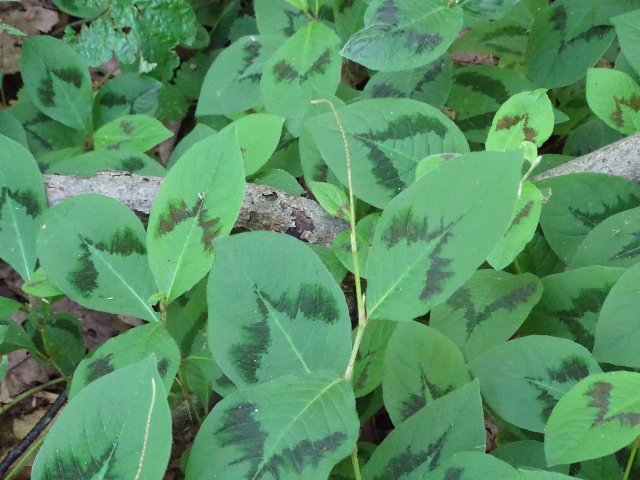 This naturalized population of Asian jumpseed (Persicaria filiformis) is growing in Mississauga, ON. Most of these populations originated as escapes of the 'Painter's Palette' cultivar which was mislabeled as jumpseed (Persicaria virginiana); many gardeners bought this cultivar and planted it thinking they were planting a native plant, only to contribute to introducing a new invasive to North America. Public Domain photo by Reuven Martin, Source.
Test Results
- iNaturalist - PASS - correctly guesses Persicaria filiformis as the first guess and presents Persicaria virginiana as the second guess.
- Pl@ntNet - PASS - correctly guesses Persicaria filiformis as the first guess, giving it an 83% probability and 16% to Persicaria virginiana. Showing the percentages is a nice touch, providing information that iNaturalist does not.
- Flora Incognita - PASS - correctly guesses Persicaria filiformis, also boldly giving a claim of 99% confidence.
- plant.id by Kindwise (formerly FlowerChecker) - PASS - Correctly guesses Persicaria filiformis.
- Picture This - FAIL - incorrectly guesses Jumpseed - Persicaria virginiana.
- Snap Plant - FAIL - guesses Persicaria maculosa, so it gets the genus correct but the species wrong.
- plantid.in - EPIC FAIL - gives the wildly-wrong guess of American burnweed (Erechtites hieraciifolius), a real head-scratcher as to how it came up with this.
This example used a crisp photo of a plant with distinctive foliage, and it is a species that not only is sold in nurseries but has gotten attention due to being an invasive that was mislabeled as a native, leading reputable sources to prioritize updating taxonomies and correcting misidentifications. Many species are both harder to ID and get a lot less attention than this one does. I frequently see iNaturalist make incorrect guesses as their first guess, and I have seen other online sources that have described all three of our other recommended apps also making incorrect guesses. So, even if you are working with the apps that seem to be the best options here, you still need to see them only as a starting point.
Keep in mind that the different apps can sometimes be better at different subsets of plants, so if you find one of them isn't getting you any closer to a correct ID, you could try another one from the subset of reputable apps. The goal is to get you a guess that is correct to at least genus or family level, when you have otherwise reached a dead-end in your ID attempts, so you might as well use one after another and see if any of them can lead you to a correct ID. But always go back to the reliable sources and check the ID thoroughly, even if it looks right at a glance.
Try it out!
Can you identify the plant at the start of this post? Or better yet, how about just go outside and try to identify anything you find? Or still better, find a plant you already recognize and observe it more closely, and then come back inside and look it up online and read more about it and research its relatives and lookalikes found in your area. Don't start with AI tools; start by building off what you know, researching more in reliable sources, and connecting that with real-world observation.Archive of All Blogs
How To Identify Plants, May 7th, 2026
The Bias Against Tall Plants, November 11th, 2025
A Focus on Goldenrods (Solidago sp.), July 23rd, 2025
Disturbance and its Role in Plant Habitat Preferences, May 29th, 2025
What "Native" or "Introduced" Mean: Myths and Misconceptions, March 11th, 2025
Smarter & More Informative Search Results, January 13th, 2025
The Effect of the 2024 US Election on Plant Biodiversity and bplant.org, October 30th, 2024
The Problems With Nursery-Bought Plants, And The Solutions, October 8th, 2024
More Databases Linked & Search Improvements for Scientific Names, July 9th, 2024
Choosing The Best Common Names For Plants: Challenges & Solutions, April 19th, 2024
Range Map & Taxonomic Update Progress, January 31st, 2024
Giving Thanks To Everyone We Rely On, November 22nd, 2023
Thinking More Deeply About Habitat, April 5th, 2023
2022 Year-End Summary: Successes & New Goals, February 15th, 2023
New Databases Linked: Flora of North America & NatureServe Explorer, November 11th, 2022
All Range Maps 2nd Generation, Taxonomic Updates, & Fundraising Goal Met!, September 29th, 2022
More Range Map Improvements, POWO Interlinking, And Notes Fields, June 7th, 2022
Ecoregion-Based Plant Lists and Search, March 30th, 2022
Progress Updates on Range Maps and More, February 10th, 2022
The Vision for bplant.org, December 9th, 2021
New Server: Software & Hardware, August 30th, 2021
More & Improved Plant Range Maps, July 19th, 2021
A Control Section for Invasive Plants, April 15th, 2021
Progress Bars & State Ecoregion Legends, March 11th, 2021
Our 2020 Achievements, February 9th, 2021
Interlinking Databases for Plant Research, November 11th, 2020
A New Homepage, Highlighting Our Articles, July 29th, 2020
A False Recovery, But North Carolina's Ecoregions are Complete!, June 9th, 2020
We're Back After COVID-19 Setbacks, April 3rd, 2020
Help Us Find Ecoregion Photos, February 27th, 2020
What We Achieved in 2019, December 30th, 2019
Plant Comparison and ID Guides, October 30th, 2019
We Are Now Accepting Donations, October 14th, 2019
US State Ecoregion Maps, New Footer, Ecoregion Article Progress, and References, September 19th, 2019
Tentative Range Maps of Native Plants, August 12th, 2019
Ecoregion Locator and Interactive Maps, July 10th, 2019
Using Ecoregions Over Political Boundaries, May 13th, 2019
How We Handle Wild vs Cultivated Plants, April 16th, 2019
A Blog To Keep People Updated On Our Progress, April 8th, 2019
Sign Up
Want to get notified of our progress? Sign up for the bplant.org interest list!